 English
  Български
  简体中文(中国)




Show map events
Thursday 08 October 2026
05 October 2026 - 11 October 2026
October 2026
 01.01.2023 - 31.12.2026
Temporary exhibition "Smart Minerals for Smartphones"
from 10:00 to 18:00 o'clock
Entrance with museum tickets.
Entrance with museum tickets.
Exhibitions
 11.04.2025 - 31.12.2026
Temporary exhibition "Minerals and Colorful Creatures. Drawings by Nature"
The Minerals of Bulgaria exposition has been expanded with a new theme: Unique mineral finds from Bulgaria, a project financed by the Ministry of culture. In 6 display cases, minerals with the most beautiful crystals, rare colors and shapes are exhibited, selected for tens of years by hundreds of geologists and collectors from all over Bulgaria.
from 10:00 to 18:00 o'clock
Entrance with museum tickets
from 10:00 to 18:00 o'clock
Entrance with museum tickets
Exhibitions
 10.12.2025 - 30.01.2027
Zahari Zograph Immersive Exhibition
The National Gallery presents one of the most iconic figures in the history of Bulgarian art – Zahari Zograph. This first immersive exhibition introduces a new way of experiencing the masterpieces of the the museum’s collection. Harnessing new technologies, the 20-minute project, created by Senzor Studio, brings his religious and secular masterpieces to life, revealing essential elements of his creative process.
The initiative promotes Bulgarian Revival аrt, a period characterized by economic, social, and cultural growth, closely tied to the pursuit of ecclesiastical and national independence. The period traces its origins to the mid-18th century, when Paisius of Hilendar wrote Istoriya Slavyanobulgarskaya (History of the Slavs and Bulgarians) in 1762—which profoundly shaped the spiritual awakening of the population and contributed significantly to the development of national consciousness…
The exhibition features a selection of icons, drawings, copies, letters, documents, and secular portraits from the artist’s early period. It also showcases a substantive collection of murals, ranging from his earliest works—created in 1838 for the Chapel of St John the Baptist at the Church of the Holy Virgin—Annunciation in Asenovgrad—to what is considered as his “final masterpiece,” the murals adorning the narthex of the Great Lavra Monastery on Mount Athos, completed between 1851 and 1852.
Zahari Zograph emerged as a defining figure of Bulgarian Revival art. His relentlessly inquisitive artistic spirit was ahead of its era, and his extensive body of work reflects the vitality of the approaching modern age, the artistry of traditional imagery, the strength of line, and the emotive power of color.
The project is realised with the financial support of the National Culture Fund of Bulgaria under the Creation programme 2024.
Media partners: BTA / Bulgarian News Agency and SOF Connect.
The initiative promotes Bulgarian Revival аrt, a period characterized by economic, social, and cultural growth, closely tied to the pursuit of ecclesiastical and national independence. The period traces its origins to the mid-18th century, when Paisius of Hilendar wrote Istoriya Slavyanobulgarskaya (History of the Slavs and Bulgarians) in 1762—which profoundly shaped the spiritual awakening of the population and contributed significantly to the development of national consciousness…
The exhibition features a selection of icons, drawings, copies, letters, documents, and secular portraits from the artist’s early period. It also showcases a substantive collection of murals, ranging from his earliest works—created in 1838 for the Chapel of St John the Baptist at the Church of the Holy Virgin—Annunciation in Asenovgrad—to what is considered as his “final masterpiece,” the murals adorning the narthex of the Great Lavra Monastery on Mount Athos, completed between 1851 and 1852.
Zahari Zograph emerged as a defining figure of Bulgarian Revival art. His relentlessly inquisitive artistic spirit was ahead of its era, and his extensive body of work reflects the vitality of the approaching modern age, the artistry of traditional imagery, the strength of line, and the emotive power of color.
The project is realised with the financial support of the National Culture Fund of Bulgaria under the Creation programme 2024.
Media partners: BTA / Bulgarian News Agency and SOF Connect.
Exhibitions
 12.02.2026 - 31.12.2026
Temporary exhibition "Copper - Ancient and Modern"
from 10:00 to 18:00 o'clock
Entrance with museum tickets.
Entrance with museum tickets.
Exhibitions
 01.04.2026 - 31.12.2026
Temporary exhibition "Natural Art from Chalcedony"
from 10:00 to 18:00 o'clock
Entrance with museum tickets.
Entrance with museum tickets.
Exhibitions
 16.06.2026 - 16.06.2027
Temporary Exhibition New Acquisitions
from 10:00 to 18:00 o'clock
Entrance with museum tickets
Entrance with museum tickets
Exhibitions
 04.08.2026 - 21.10.2026
FRANCISCO GOYA - DREAMS OF A KEEN MIND
The Spaniard FRANCISCO GOYA (1746–1828) was one of the most prominent and influential creative figures in world culture. He produced over 1,000 paintings, as well as the graphic series titled Los Caprichos, Los Desastres de la Guerra, Tauromaquia, and Los Disparates.
His stylistic and philosophical spectrum had a strong influence on the subsequent dynamic development of art, defining him as the last of the Old Masters and one of the earliest of Modernism. His extensive output—paintings, graphics and drawings—served as a leading aesthetic principle for many artistic trends of the 19th and 20th centuries, including Impressionism, Expressionism and Surrealism.
The twenty-one prints from the National Gallery collection follow Goya’s development from his earliest etchings, influenced by Diego Velázquez’s style, to his peak achievements as a social interpreter, remarkable for his sharpness, and a chronicler of dour events and complex human characters. The high artistic level of his four graphic series has left a deep imprint on the history of art.
The National Gallery houses seven works from Los Caprichos (The Caprices) series, 1799. Satirising the institutional pillars of power, the church, the Inquisition, the parasitism of the feudal nobility, and the decay of the moral values of social classes, was the reason for the series to be banned from exhibiting.
Los Desastres de la Guerra (The Disasters of War) series, which Goya began ca. 1810, and returned to ca. 1820, was not published by the artist during his lifetime. One of the works is titled ‘Prisoner. The Custody Is as Barbarous as the Crime’. It is considered unique, as it is rarely found in other museum and private collections around the world.
La Tauromaquia (The Art of Bullfighting) series, probably created between 1815 and 1816, reflected the artist’s interest in bullfighting. These works combine the flagrant cruelty of the corrida and his admiration for the skill and exciting action of the games. Of the thirty-three prints in the series, the National Gallery owns five.
While still working on La Tauromaquia, the artist in all probability launched into another series titled Los Disparates (The Follies), the meaning in his time being along the lines of stupidity or madness. The fantastic compositions are encrypted allegories whose impressive depth fascinated artists such as Baudelaire, Hugo, and Delacroix. The National Gallery’s collection houses four of those; two of them—‘Little Bulls’ Folly’ and ‘A Way of Flying’—are emblematic of the artist’s genius.
The National Gallery also owns the etching ‘Blind Singer’, emotionally described by Nikolay Raynov, in his ‘History of the Plastic Arts’ (1939), as ‘first’ among the ‘curious and significant’ graphic works of Goya.
The exhibition also includes a work by the Spanish surrealist artist, Salvador Dali (1904–1989), dedicated to Goya and his Caprichos.
His stylistic and philosophical spectrum had a strong influence on the subsequent dynamic development of art, defining him as the last of the Old Masters and one of the earliest of Modernism. His extensive output—paintings, graphics and drawings—served as a leading aesthetic principle for many artistic trends of the 19th and 20th centuries, including Impressionism, Expressionism and Surrealism.
The twenty-one prints from the National Gallery collection follow Goya’s development from his earliest etchings, influenced by Diego Velázquez’s style, to his peak achievements as a social interpreter, remarkable for his sharpness, and a chronicler of dour events and complex human characters. The high artistic level of his four graphic series has left a deep imprint on the history of art.
The National Gallery houses seven works from Los Caprichos (The Caprices) series, 1799. Satirising the institutional pillars of power, the church, the Inquisition, the parasitism of the feudal nobility, and the decay of the moral values of social classes, was the reason for the series to be banned from exhibiting.
Los Desastres de la Guerra (The Disasters of War) series, which Goya began ca. 1810, and returned to ca. 1820, was not published by the artist during his lifetime. One of the works is titled ‘Prisoner. The Custody Is as Barbarous as the Crime’. It is considered unique, as it is rarely found in other museum and private collections around the world.
La Tauromaquia (The Art of Bullfighting) series, probably created between 1815 and 1816, reflected the artist’s interest in bullfighting. These works combine the flagrant cruelty of the corrida and his admiration for the skill and exciting action of the games. Of the thirty-three prints in the series, the National Gallery owns five.
While still working on La Tauromaquia, the artist in all probability launched into another series titled Los Disparates (The Follies), the meaning in his time being along the lines of stupidity or madness. The fantastic compositions are encrypted allegories whose impressive depth fascinated artists such as Baudelaire, Hugo, and Delacroix. The National Gallery’s collection houses four of those; two of them—‘Little Bulls’ Folly’ and ‘A Way of Flying’—are emblematic of the artist’s genius.
The National Gallery also owns the etching ‘Blind Singer’, emotionally described by Nikolay Raynov, in his ‘History of the Plastic Arts’ (1939), as ‘first’ among the ‘curious and significant’ graphic works of Goya.
The exhibition also includes a work by the Spanish surrealist artist, Salvador Dali (1904–1989), dedicated to Goya and his Caprichos.
Exhibitions
 10.09.2026 - 11.10.2026
Maya Antova – Mayoto - MACONDO
Sofia Arsenal – Museum of Contemporary Art
Maya Antova – Mayoto has transformed the exhibition space into a metaphorical Macondo, the town of solitude and magical realism in Gabriel García Márquez’s masterpiece. The exhibition is dedicated to the centenary of the birth of Ivanka Sokerova, a ‘forgotten’ and lesser-known artist whose life was a fascinating fiction.
Sokerova was an example of the triumph of the spirit: as a child, she manifested her versatile talent, but her life changed after her right hand was complete paralysed due to illness. Thus, fate directed her to devote herself to art. Her life turned into a microcosm of solitude where the borderline between reality and fantasy became invisible.
The exhibition, titled MACONDO, is here to show that solitude is not stagnation but a state of mind where art becomes the only possible language. By inverting the exhibition space, Maya Antova – Mayoto urges the viewer to look at the ‘invisible’, and to rethink Ivanka Sokerova’s persona as the architect of a magical world built on the ruins of a paralysed reality.
The exhibition, arranged in a radically different way, resembles a kind of ‘topsy-turvy world’. All objects are positioned ‘beneath the ceiling’, some reaching the floor, others hanging in the air. To observe them, the viewer must look up—a gesture of rising above earthly suffering and searching for the transcendent; a kind of gravity of the spirit.
An illusion of fiction is achieved through 3D objects replicating sculptures by Sokerova. The ‘thread-hand’ detail (a symbol of matter with no structure) serves as the leitmotif of the exhibition.
At the centre of the installation, there is an inflatable boat roaming beneath the ceiling—a symbol of transition and escape from reality. Life jackets made of paper with prints of memories are ‘floating’ around it. Paper here represents the fragile raft of knowledge that keeps the personality afloat—a reference to all intellectual activities, translations, drawings, sculptures, collages and participation in Dadaist actions, all part of Sokerova’s artistic life.
When viewers look up at the boat and the paper jackets, they do not see a ‘sinking’, but ‘rising’. They understand that escaping from reality is not desertion but an act of supreme intellectual courage.
Ivanka Sokerova did not simply translate books or model clay—she constructed life jackets from thought so as not to sink into the loneliness of her Macondo. Today, these vests hang over us as a call to seek our own haven while the world around turns topsy-turvy.
The exhibition opens with an authorial performance by Maya Antova – Mayoto, titled ‘Traveling Back’, where quotes from literary texts dedicated to Sokerova intertwine with random noises and onomatopoeic elements, creating the feeling of the fragmented world of Macondo.
…
Maya Antova – Mayoto has transformed the exhibition space into a metaphorical Macondo, the town of solitude and magical realism in Gabriel García Márquez’s masterpiece. The exhibition is dedicated to the centenary of the birth of Ivanka Sokerova, a ‘forgotten’ and lesser-known artist whose life was a fascinating fiction.
Sokerova was an example of the triumph of the spirit: as a child, she manifested her versatile talent, but her life changed after her right hand was complete paralysed due to illness. Thus, fate directed her to devote herself to art. Her life turned into a microcosm of solitude where the borderline between reality and fantasy became invisible.
The exhibition, titled MACONDO, is here to show that solitude is not stagnation but a state of mind where art becomes the only possible language. By inverting the exhibition space, Maya Antova – Mayoto urges the viewer to look at the ‘invisible’, and to rethink Ivanka Sokerova’s persona as the architect of a magical world built on the ruins of a paralysed reality.
The exhibition, arranged in a radically different way, resembles a kind of ‘topsy-turvy world’. All objects are positioned ‘beneath the ceiling’, some reaching the floor, others hanging in the air. To observe them, the viewer must look up—a gesture of rising above earthly suffering and searching for the transcendent; a kind of gravity of the spirit.
An illusion of fiction is achieved through 3D objects replicating sculptures by Sokerova. The ‘thread-hand’ detail (a symbol of matter with no structure) serves as the leitmotif of the exhibition.
At the centre of the installation, there is an inflatable boat roaming beneath the ceiling—a symbol of transition and escape from reality. Life jackets made of paper with prints of memories are ‘floating’ around it. Paper here represents the fragile raft of knowledge that keeps the personality afloat—a reference to all intellectual activities, translations, drawings, sculptures, collages and participation in Dadaist actions, all part of Sokerova’s artistic life.
When viewers look up at the boat and the paper jackets, they do not see a ‘sinking’, but ‘rising’. They understand that escaping from reality is not desertion but an act of supreme intellectual courage.
Ivanka Sokerova did not simply translate books or model clay—she constructed life jackets from thought so as not to sink into the loneliness of her Macondo. Today, these vests hang over us as a call to seek our own haven while the world around turns topsy-turvy.
The exhibition opens with an authorial performance by Maya Antova – Mayoto, titled ‘Traveling Back’, where quotes from literary texts dedicated to Sokerova intertwine with random noises and onomatopoeic elements, creating the feeling of the fragmented world of Macondo.
…
Exhibitions
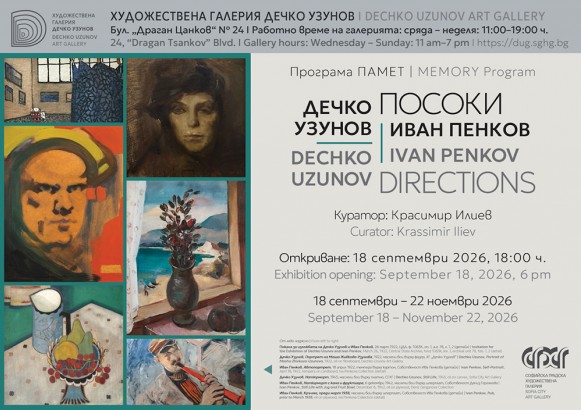 18.09.2026 - 22.11.2026
DECHKO UZUNOV/IVAN PENKOV – DIRECTIONS
Memory Programme
DECHKO UZUNOV/IVAN PENKOV – DIRECTIONS
Opening: September 18, 6:00 p.m.
The exhibition Dechko Uzunov/Ivan Penkov: Directions is part of the Memory Programme at the Dechko Uzunov Art Gallery, a branch of the Sofia City Art Gallery, which aims to contribute to raising awareness of the life and work of Dechko Uzunov by presenting research-based exhibitions that reveal different aspects of his oeuvre through artists who were part of his journey. This exhibition showcases the different paths taken by two fellow townsmen and friends during the interwar period.
In 1919, Ivan Penkov and Dechko Uzunov enrolled at the State School of Drawing; that same year, Uzunov painted a portrait of his friend that poked fun at his fascination with folk art. Three years later, the two organised a joint exhibition in Sofia to fund their studies at the Munich Art Academy. The young artists’ exhibition was noticed by Joseph Herbst, who wrote:
“Now, on the occasion of their departure abroad, the two artists had exhibited most of their works, from which their strong talents could be seen quite well. Dechko Uzunov promises to develop most in portrait painting. [...] Ivan Penkov is primarily a decorator with a strong sense of composition and a keen sensitivity to line” (J.H., Razvigor, April 1, 1922, no. 60, p. 4).
In an ironic twist of fate, the older of the two, Penkov, would go on to graduate from the Academy of Art under Prof. Uzunov. In 1939, with Uzonov’s active support, Ivan Penkov won the competition for a permanent teaching position in decorative art.
The selected works invite us to seek similarities amidst the differences between these two constantly experimenting artists during the period when Bulgarian visual arts were coming of age.
Presented in this exhibition are pieces from the collections of the Sofia City Art Gallery, the Dechko Uzunov Art Gallery, the Kazanlak Art Gallery, the Central State Archives, and private collections.
The exhibition also features the film Ivan Penkov: The Crossed-Out Classic (Bulgarian National Television, 2006), by screenwriter: Oskar Kristanov; cinematographer: Yaroslav Yachev; directors: Oskar Kristanov and Kosta Bikov; sound engineer: Petar Yosifov; music arrangement: Georgi (Johnny) Penkov. Duration: 48 min.
DECHKO UZUNOV/IVAN PENKOV – DIRECTIONS
Opening: September 18, 6:00 p.m.
The exhibition Dechko Uzunov/Ivan Penkov: Directions is part of the Memory Programme at the Dechko Uzunov Art Gallery, a branch of the Sofia City Art Gallery, which aims to contribute to raising awareness of the life and work of Dechko Uzunov by presenting research-based exhibitions that reveal different aspects of his oeuvre through artists who were part of his journey. This exhibition showcases the different paths taken by two fellow townsmen and friends during the interwar period.
In 1919, Ivan Penkov and Dechko Uzunov enrolled at the State School of Drawing; that same year, Uzunov painted a portrait of his friend that poked fun at his fascination with folk art. Three years later, the two organised a joint exhibition in Sofia to fund their studies at the Munich Art Academy. The young artists’ exhibition was noticed by Joseph Herbst, who wrote:
“Now, on the occasion of their departure abroad, the two artists had exhibited most of their works, from which their strong talents could be seen quite well. Dechko Uzunov promises to develop most in portrait painting. [...] Ivan Penkov is primarily a decorator with a strong sense of composition and a keen sensitivity to line” (J.H., Razvigor, April 1, 1922, no. 60, p. 4).
In an ironic twist of fate, the older of the two, Penkov, would go on to graduate from the Academy of Art under Prof. Uzunov. In 1939, with Uzonov’s active support, Ivan Penkov won the competition for a permanent teaching position in decorative art.
The selected works invite us to seek similarities amidst the differences between these two constantly experimenting artists during the period when Bulgarian visual arts were coming of age.
Presented in this exhibition are pieces from the collections of the Sofia City Art Gallery, the Dechko Uzunov Art Gallery, the Kazanlak Art Gallery, the Central State Archives, and private collections.
The exhibition also features the film Ivan Penkov: The Crossed-Out Classic (Bulgarian National Television, 2006), by screenwriter: Oskar Kristanov; cinematographer: Yaroslav Yachev; directors: Oskar Kristanov and Kosta Bikov; sound engineer: Petar Yosifov; music arrangement: Georgi (Johnny) Penkov. Duration: 48 min.
Exhibitions
 23.09.2026 - 18.11.2026
Piano Extravaganza Festival 2026
Within this year’s edition, Piano Extravaganza Festival will present four piano recitals and two chamber music concerts. We hope that our extraordinary artists and the variety of the repertoire for those 6 events would satisfy even the most sophisticated connoisseur. We would be delighted to welcome you at the wonderful venues of the Central Military Club and the “Bulgaria” Chamber Hall in Sofia!
Tickets at EVENTIM.
Tickets at EVENTIM.
Festivals