 English
  Български
  简体中文(中国)




Show map events
Saturday 10 October 2026
05 October 2026 - 11 October 2026
October 2026
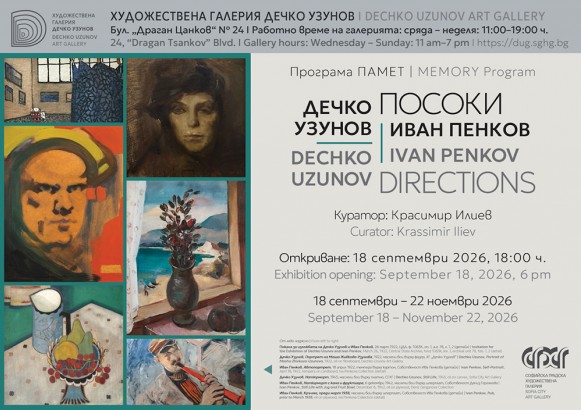 18.09.2026 - 22.11.2026
DECHKO UZUNOV/IVAN PENKOV – DIRECTIONS
Memory Programme
DECHKO UZUNOV/IVAN PENKOV – DIRECTIONS
Opening: September 18, 6:00 p.m.
The exhibition Dechko Uzunov/Ivan Penkov: Directions is part of the Memory Programme at the Dechko Uzunov Art Gallery, a branch of the Sofia City Art Gallery, which aims to contribute to raising awareness of the life and work of Dechko Uzunov by presenting research-based exhibitions that reveal different aspects of his oeuvre through artists who were part of his journey. This exhibition showcases the different paths taken by two fellow townsmen and friends during the interwar period.
In 1919, Ivan Penkov and Dechko Uzunov enrolled at the State School of Drawing; that same year, Uzunov painted a portrait of his friend that poked fun at his fascination with folk art. Three years later, the two organised a joint exhibition in Sofia to fund their studies at the Munich Art Academy. The young artists’ exhibition was noticed by Joseph Herbst, who wrote:
“Now, on the occasion of their departure abroad, the two artists had exhibited most of their works, from which their strong talents could be seen quite well. Dechko Uzunov promises to develop most in portrait painting. [...] Ivan Penkov is primarily a decorator with a strong sense of composition and a keen sensitivity to line” (J.H., Razvigor, April 1, 1922, no. 60, p. 4).
In an ironic twist of fate, the older of the two, Penkov, would go on to graduate from the Academy of Art under Prof. Uzunov. In 1939, with Uzonov’s active support, Ivan Penkov won the competition for a permanent teaching position in decorative art.
The selected works invite us to seek similarities amidst the differences between these two constantly experimenting artists during the period when Bulgarian visual arts were coming of age.
Presented in this exhibition are pieces from the collections of the Sofia City Art Gallery, the Dechko Uzunov Art Gallery, the Kazanlak Art Gallery, the Central State Archives, and private collections.
The exhibition also features the film Ivan Penkov: The Crossed-Out Classic (Bulgarian National Television, 2006), by screenwriter: Oskar Kristanov; cinematographer: Yaroslav Yachev; directors: Oskar Kristanov and Kosta Bikov; sound engineer: Petar Yosifov; music arrangement: Georgi (Johnny) Penkov. Duration: 48 min.
DECHKO UZUNOV/IVAN PENKOV – DIRECTIONS
Opening: September 18, 6:00 p.m.
The exhibition Dechko Uzunov/Ivan Penkov: Directions is part of the Memory Programme at the Dechko Uzunov Art Gallery, a branch of the Sofia City Art Gallery, which aims to contribute to raising awareness of the life and work of Dechko Uzunov by presenting research-based exhibitions that reveal different aspects of his oeuvre through artists who were part of his journey. This exhibition showcases the different paths taken by two fellow townsmen and friends during the interwar period.
In 1919, Ivan Penkov and Dechko Uzunov enrolled at the State School of Drawing; that same year, Uzunov painted a portrait of his friend that poked fun at his fascination with folk art. Three years later, the two organised a joint exhibition in Sofia to fund their studies at the Munich Art Academy. The young artists’ exhibition was noticed by Joseph Herbst, who wrote:
“Now, on the occasion of their departure abroad, the two artists had exhibited most of their works, from which their strong talents could be seen quite well. Dechko Uzunov promises to develop most in portrait painting. [...] Ivan Penkov is primarily a decorator with a strong sense of composition and a keen sensitivity to line” (J.H., Razvigor, April 1, 1922, no. 60, p. 4).
In an ironic twist of fate, the older of the two, Penkov, would go on to graduate from the Academy of Art under Prof. Uzunov. In 1939, with Uzonov’s active support, Ivan Penkov won the competition for a permanent teaching position in decorative art.
The selected works invite us to seek similarities amidst the differences between these two constantly experimenting artists during the period when Bulgarian visual arts were coming of age.
Presented in this exhibition are pieces from the collections of the Sofia City Art Gallery, the Dechko Uzunov Art Gallery, the Kazanlak Art Gallery, the Central State Archives, and private collections.
The exhibition also features the film Ivan Penkov: The Crossed-Out Classic (Bulgarian National Television, 2006), by screenwriter: Oskar Kristanov; cinematographer: Yaroslav Yachev; directors: Oskar Kristanov and Kosta Bikov; sound engineer: Petar Yosifov; music arrangement: Georgi (Johnny) Penkov. Duration: 48 min.
Exhibitions
 30.07.2026 - 04.10.2026
EUGÈNE CARRIÈRE. THE VISIONARY
The exhibition offers a novel, more conceptual look at one of the most prominent French artists of the second half of the 19th century, emphasising the influence he had on his contemporaries, as well as on the oeuvres of key figures of Early Modernism in the 20th century.
Although Eugène Carrière is well represented in the National Gallery permanent exposition at Kvadrat 500, his name remains relatively unknown to the general public. The team’s ambition is to present all his paintings, lithographs and drawings from the museum collection for the first time. During the research, it was discovered that these lithographs of high collectible worth were extremely valuable copies of unique bibliophilic compendia published in limited editions in Paris in the closing quarter of the 19th century. It is only the Metropolitan Museum in New York, the State Museum in Stuttgart, the Musée d’Orsay in Paris, the State Museum in Amsterdam, and the Cleveland Museum of Art, that can boast possession of such prints.
Carrière was among those artists who won recognition during their lifetime, and whose works were displayed in major museums. He invariably worked beyond the stylistic categories of the time without claiming to belong to any specific trend. Defying any sort of labelling, the painter, engraver and draughtsman, Carrière—a contemporary of Gustave Moreau, Odilon Redon and Paul Gauguin—soon surrounded himself with the most influential figures in the artistic and literary worlds of his time. His oeuvre influenced Picasso who drew inspiration from his monochromatic painting.
Beyond the modernity of his subjects, it is precisely in the artist’s painting style that the great adventure of his art lies. A distinguished portraitist and master of family scenes and the theme of motherhood, and precursor of Minimalism, he eliminated details transforming images into archetypes and expressions of feeling beyond the conventional framework of a specific time. Achieving a soft, monochromic sfumato allowed him to create a complex and mysterious interplay of transparency and depth. Like fleeting apparitions, elusive to the brush, his figures seem to emerge from the landscape, from the background, as if from another time-space.
Although Eugène Carrière is well represented in the National Gallery permanent exposition at Kvadrat 500, his name remains relatively unknown to the general public. The team’s ambition is to present all his paintings, lithographs and drawings from the museum collection for the first time. During the research, it was discovered that these lithographs of high collectible worth were extremely valuable copies of unique bibliophilic compendia published in limited editions in Paris in the closing quarter of the 19th century. It is only the Metropolitan Museum in New York, the State Museum in Stuttgart, the Musée d’Orsay in Paris, the State Museum in Amsterdam, and the Cleveland Museum of Art, that can boast possession of such prints.
Carrière was among those artists who won recognition during their lifetime, and whose works were displayed in major museums. He invariably worked beyond the stylistic categories of the time without claiming to belong to any specific trend. Defying any sort of labelling, the painter, engraver and draughtsman, Carrière—a contemporary of Gustave Moreau, Odilon Redon and Paul Gauguin—soon surrounded himself with the most influential figures in the artistic and literary worlds of his time. His oeuvre influenced Picasso who drew inspiration from his monochromatic painting.
Beyond the modernity of his subjects, it is precisely in the artist’s painting style that the great adventure of his art lies. A distinguished portraitist and master of family scenes and the theme of motherhood, and precursor of Minimalism, he eliminated details transforming images into archetypes and expressions of feeling beyond the conventional framework of a specific time. Achieving a soft, monochromic sfumato allowed him to create a complex and mysterious interplay of transparency and depth. Like fleeting apparitions, elusive to the brush, his figures seem to emerge from the landscape, from the background, as if from another time-space.
Exhibitions
 04.08.2026 - 21.10.2026
FRANCISCO GOYA - DREAMS OF A KEEN MIND
The Spaniard FRANCISCO GOYA (1746–1828) was one of the most prominent and influential creative figures in world culture. He produced over 1,000 paintings, as well as the graphic series titled Los Caprichos, Los Desastres de la Guerra, Tauromaquia, and Los Disparates.
His stylistic and philosophical spectrum had a strong influence on the subsequent dynamic development of art, defining him as the last of the Old Masters and one of the earliest of Modernism. His extensive output—paintings, graphics and drawings—served as a leading aesthetic principle for many artistic trends of the 19th and 20th centuries, including Impressionism, Expressionism and Surrealism.
The twenty-one prints from the National Gallery collection follow Goya’s development from his earliest etchings, influenced by Diego Velázquez’s style, to his peak achievements as a social interpreter, remarkable for his sharpness, and a chronicler of dour events and complex human characters. The high artistic level of his four graphic series has left a deep imprint on the history of art.
The National Gallery houses seven works from Los Caprichos (The Caprices) series, 1799. Satirising the institutional pillars of power, the church, the Inquisition, the parasitism of the feudal nobility, and the decay of the moral values of social classes, was the reason for the series to be banned from exhibiting.
Los Desastres de la Guerra (The Disasters of War) series, which Goya began ca. 1810, and returned to ca. 1820, was not published by the artist during his lifetime. One of the works is titled ‘Prisoner. The Custody Is as Barbarous as the Crime’. It is considered unique, as it is rarely found in other museum and private collections around the world.
La Tauromaquia (The Art of Bullfighting) series, probably created between 1815 and 1816, reflected the artist’s interest in bullfighting. These works combine the flagrant cruelty of the corrida and his admiration for the skill and exciting action of the games. Of the thirty-three prints in the series, the National Gallery owns five.
While still working on La Tauromaquia, the artist in all probability launched into another series titled Los Disparates (The Follies), the meaning in his time being along the lines of stupidity or madness. The fantastic compositions are encrypted allegories whose impressive depth fascinated artists such as Baudelaire, Hugo, and Delacroix. The National Gallery’s collection houses four of those; two of them—‘Little Bulls’ Folly’ and ‘A Way of Flying’—are emblematic of the artist’s genius.
The National Gallery also owns the etching ‘Blind Singer’, emotionally described by Nikolay Raynov, in his ‘History of the Plastic Arts’ (1939), as ‘first’ among the ‘curious and significant’ graphic works of Goya.
The exhibition also includes a work by the Spanish surrealist artist, Salvador Dali (1904–1989), dedicated to Goya and his Caprichos.
His stylistic and philosophical spectrum had a strong influence on the subsequent dynamic development of art, defining him as the last of the Old Masters and one of the earliest of Modernism. His extensive output—paintings, graphics and drawings—served as a leading aesthetic principle for many artistic trends of the 19th and 20th centuries, including Impressionism, Expressionism and Surrealism.
The twenty-one prints from the National Gallery collection follow Goya’s development from his earliest etchings, influenced by Diego Velázquez’s style, to his peak achievements as a social interpreter, remarkable for his sharpness, and a chronicler of dour events and complex human characters. The high artistic level of his four graphic series has left a deep imprint on the history of art.
The National Gallery houses seven works from Los Caprichos (The Caprices) series, 1799. Satirising the institutional pillars of power, the church, the Inquisition, the parasitism of the feudal nobility, and the decay of the moral values of social classes, was the reason for the series to be banned from exhibiting.
Los Desastres de la Guerra (The Disasters of War) series, which Goya began ca. 1810, and returned to ca. 1820, was not published by the artist during his lifetime. One of the works is titled ‘Prisoner. The Custody Is as Barbarous as the Crime’. It is considered unique, as it is rarely found in other museum and private collections around the world.
La Tauromaquia (The Art of Bullfighting) series, probably created between 1815 and 1816, reflected the artist’s interest in bullfighting. These works combine the flagrant cruelty of the corrida and his admiration for the skill and exciting action of the games. Of the thirty-three prints in the series, the National Gallery owns five.
While still working on La Tauromaquia, the artist in all probability launched into another series titled Los Disparates (The Follies), the meaning in his time being along the lines of stupidity or madness. The fantastic compositions are encrypted allegories whose impressive depth fascinated artists such as Baudelaire, Hugo, and Delacroix. The National Gallery’s collection houses four of those; two of them—‘Little Bulls’ Folly’ and ‘A Way of Flying’—are emblematic of the artist’s genius.
The National Gallery also owns the etching ‘Blind Singer’, emotionally described by Nikolay Raynov, in his ‘History of the Plastic Arts’ (1939), as ‘first’ among the ‘curious and significant’ graphic works of Goya.
The exhibition also includes a work by the Spanish surrealist artist, Salvador Dali (1904–1989), dedicated to Goya and his Caprichos.
Exhibitions
 10.09.2026 - 11.10.2026
Maya Antova – Mayoto - MACONDO
Sofia Arsenal – Museum of Contemporary Art
Maya Antova – Mayoto has transformed the exhibition space into a metaphorical Macondo, the town of solitude and magical realism in Gabriel García Márquez’s masterpiece. The exhibition is dedicated to the centenary of the birth of Ivanka Sokerova, a ‘forgotten’ and lesser-known artist whose life was a fascinating fiction.
Sokerova was an example of the triumph of the spirit: as a child, she manifested her versatile talent, but her life changed after her right hand was complete paralysed due to illness. Thus, fate directed her to devote herself to art. Her life turned into a microcosm of solitude where the borderline between reality and fantasy became invisible.
The exhibition, titled MACONDO, is here to show that solitude is not stagnation but a state of mind where art becomes the only possible language. By inverting the exhibition space, Maya Antova – Mayoto urges the viewer to look at the ‘invisible’, and to rethink Ivanka Sokerova’s persona as the architect of a magical world built on the ruins of a paralysed reality.
The exhibition, arranged in a radically different way, resembles a kind of ‘topsy-turvy world’. All objects are positioned ‘beneath the ceiling’, some reaching the floor, others hanging in the air. To observe them, the viewer must look up—a gesture of rising above earthly suffering and searching for the transcendent; a kind of gravity of the spirit.
An illusion of fiction is achieved through 3D objects replicating sculptures by Sokerova. The ‘thread-hand’ detail (a symbol of matter with no structure) serves as the leitmotif of the exhibition.
At the centre of the installation, there is an inflatable boat roaming beneath the ceiling—a symbol of transition and escape from reality. Life jackets made of paper with prints of memories are ‘floating’ around it. Paper here represents the fragile raft of knowledge that keeps the personality afloat—a reference to all intellectual activities, translations, drawings, sculptures, collages and participation in Dadaist actions, all part of Sokerova’s artistic life.
When viewers look up at the boat and the paper jackets, they do not see a ‘sinking’, but ‘rising’. They understand that escaping from reality is not desertion but an act of supreme intellectual courage.
Ivanka Sokerova did not simply translate books or model clay—she constructed life jackets from thought so as not to sink into the loneliness of her Macondo. Today, these vests hang over us as a call to seek our own haven while the world around turns topsy-turvy.
The exhibition opens with an authorial performance by Maya Antova – Mayoto, titled ‘Traveling Back’, where quotes from literary texts dedicated to Sokerova intertwine with random noises and onomatopoeic elements, creating the feeling of the fragmented world of Macondo.
…
Maya Antova – Mayoto has transformed the exhibition space into a metaphorical Macondo, the town of solitude and magical realism in Gabriel García Márquez’s masterpiece. The exhibition is dedicated to the centenary of the birth of Ivanka Sokerova, a ‘forgotten’ and lesser-known artist whose life was a fascinating fiction.
Sokerova was an example of the triumph of the spirit: as a child, she manifested her versatile talent, but her life changed after her right hand was complete paralysed due to illness. Thus, fate directed her to devote herself to art. Her life turned into a microcosm of solitude where the borderline between reality and fantasy became invisible.
The exhibition, titled MACONDO, is here to show that solitude is not stagnation but a state of mind where art becomes the only possible language. By inverting the exhibition space, Maya Antova – Mayoto urges the viewer to look at the ‘invisible’, and to rethink Ivanka Sokerova’s persona as the architect of a magical world built on the ruins of a paralysed reality.
The exhibition, arranged in a radically different way, resembles a kind of ‘topsy-turvy world’. All objects are positioned ‘beneath the ceiling’, some reaching the floor, others hanging in the air. To observe them, the viewer must look up—a gesture of rising above earthly suffering and searching for the transcendent; a kind of gravity of the spirit.
An illusion of fiction is achieved through 3D objects replicating sculptures by Sokerova. The ‘thread-hand’ detail (a symbol of matter with no structure) serves as the leitmotif of the exhibition.
At the centre of the installation, there is an inflatable boat roaming beneath the ceiling—a symbol of transition and escape from reality. Life jackets made of paper with prints of memories are ‘floating’ around it. Paper here represents the fragile raft of knowledge that keeps the personality afloat—a reference to all intellectual activities, translations, drawings, sculptures, collages and participation in Dadaist actions, all part of Sokerova’s artistic life.
When viewers look up at the boat and the paper jackets, they do not see a ‘sinking’, but ‘rising’. They understand that escaping from reality is not desertion but an act of supreme intellectual courage.
Ivanka Sokerova did not simply translate books or model clay—she constructed life jackets from thought so as not to sink into the loneliness of her Macondo. Today, these vests hang over us as a call to seek our own haven while the world around turns topsy-turvy.
The exhibition opens with an authorial performance by Maya Antova – Mayoto, titled ‘Traveling Back’, where quotes from literary texts dedicated to Sokerova intertwine with random noises and onomatopoeic elements, creating the feeling of the fragmented world of Macondo.
…
Exhibitions
 23.09.2026 - 18.11.2026
Piano Extravaganza Festival 2026
Within this year’s edition, Piano Extravaganza Festival will present four piano recitals and two chamber music concerts. We hope that our extraordinary artists and the variety of the repertoire for those 6 events would satisfy even the most sophisticated connoisseur. We would be delighted to welcome you at the wonderful venues of the Central Military Club and the “Bulgaria” Chamber Hall in Sofia!
Tickets at EVENTIM.
Tickets at EVENTIM.
Festivals
 16.06.2026 - 16.06.2027
Temporary Exhibition New Acquisitions
from 10:00 to 18:00 o'clock
Entrance with museum tickets
Entrance with museum tickets
Exhibitions
 12.02.2026 - 31.12.2026
Temporary exhibition "Copper - Ancient and Modern"
from 10:00 to 18:00 o'clock
Entrance with museum tickets.
Entrance with museum tickets.
Exhibitions
 11.04.2025 - 31.12.2026
Temporary exhibition "Minerals and Colorful Creatures. Drawings by Nature"
The Minerals of Bulgaria exposition has been expanded with a new theme: Unique mineral finds from Bulgaria, a project financed by the Ministry of culture. In 6 display cases, minerals with the most beautiful crystals, rare colors and shapes are exhibited, selected for tens of years by hundreds of geologists and collectors from all over Bulgaria.
from 10:00 to 18:00 o'clock
Entrance with museum tickets
from 10:00 to 18:00 o'clock
Entrance with museum tickets
Exhibitions
 01.04.2026 - 31.12.2026
Temporary exhibition "Natural Art from Chalcedony"
from 10:00 to 18:00 o'clock
Entrance with museum tickets.
Entrance with museum tickets.
Exhibitions
 01.01.2023 - 31.12.2026
Temporary exhibition "Smart Minerals for Smartphones"
from 10:00 to 18:00 o'clock
Entrance with museum tickets.
Entrance with museum tickets.
Exhibitions
 10.12.2025 - 30.01.2027
Zahari Zograph Immersive Exhibition
The National Gallery presents one of the most iconic figures in the history of Bulgarian art – Zahari Zograph. This first immersive exhibition introduces a new way of experiencing the masterpieces of the the museum’s collection. Harnessing new technologies, the 20-minute project, created by Senzor Studio, brings his religious and secular masterpieces to life, revealing essential elements of his creative process.
The initiative promotes Bulgarian Revival аrt, a period characterized by economic, social, and cultural growth, closely tied to the pursuit of ecclesiastical and national independence. The period traces its origins to the mid-18th century, when Paisius of Hilendar wrote Istoriya Slavyanobulgarskaya (History of the Slavs and Bulgarians) in 1762—which profoundly shaped the spiritual awakening of the population and contributed significantly to the development of national consciousness…
The exhibition features a selection of icons, drawings, copies, letters, documents, and secular portraits from the artist’s early period. It also showcases a substantive collection of murals, ranging from his earliest works—created in 1838 for the Chapel of St John the Baptist at the Church of the Holy Virgin—Annunciation in Asenovgrad—to what is considered as his “final masterpiece,” the murals adorning the narthex of the Great Lavra Monastery on Mount Athos, completed between 1851 and 1852.
Zahari Zograph emerged as a defining figure of Bulgarian Revival art. His relentlessly inquisitive artistic spirit was ahead of its era, and his extensive body of work reflects the vitality of the approaching modern age, the artistry of traditional imagery, the strength of line, and the emotive power of color.
The project is realised with the financial support of the National Culture Fund of Bulgaria under the Creation programme 2024.
Media partners: BTA / Bulgarian News Agency and SOF Connect.
The initiative promotes Bulgarian Revival аrt, a period characterized by economic, social, and cultural growth, closely tied to the pursuit of ecclesiastical and national independence. The period traces its origins to the mid-18th century, when Paisius of Hilendar wrote Istoriya Slavyanobulgarskaya (History of the Slavs and Bulgarians) in 1762—which profoundly shaped the spiritual awakening of the population and contributed significantly to the development of national consciousness…
The exhibition features a selection of icons, drawings, copies, letters, documents, and secular portraits from the artist’s early period. It also showcases a substantive collection of murals, ranging from his earliest works—created in 1838 for the Chapel of St John the Baptist at the Church of the Holy Virgin—Annunciation in Asenovgrad—to what is considered as his “final masterpiece,” the murals adorning the narthex of the Great Lavra Monastery on Mount Athos, completed between 1851 and 1852.
Zahari Zograph emerged as a defining figure of Bulgarian Revival art. His relentlessly inquisitive artistic spirit was ahead of its era, and his extensive body of work reflects the vitality of the approaching modern age, the artistry of traditional imagery, the strength of line, and the emotive power of color.
The project is realised with the financial support of the National Culture Fund of Bulgaria under the Creation programme 2024.
Media partners: BTA / Bulgarian News Agency and SOF Connect.
Exhibitions
 01.10.2026
CARMINA BURANA
Carl Orff Conductor Daniel Oren
Performance for adults Duration - 1:45
Main Hall
Children under 6 are not admitted to adult performances!
Performed in Latin
Performance for adults Duration - 1:45
Main Hall
Children under 6 are not admitted to adult performances!
Performed in Latin
Music and Dance Events
 01.10.2026
Dimitri Ashkenazy & Gudni Emilsson
Conductor
Gudni Emilsson
Solоist/s
Dimitri Ashkenazy
Ensemble
Sofia Philharmonic Orchestra
Program
Felix Mendelssohn-Bartholdy – Overture “Die Heimkehr aus der Fremde”, Op.89
Wolfgang Amadeus Mozart – Concert for Clarinet and Orchestra in A Dur, K.622
Franz Schubert – Symphony No. 4 “Tragic” in C minor, D 417
Gudni Emilsson
Solоist/s
Dimitri Ashkenazy
Ensemble
Sofia Philharmonic Orchestra
Program
Felix Mendelssohn-Bartholdy – Overture “Die Heimkehr aus der Fremde”, Op.89
Wolfgang Amadeus Mozart – Concert for Clarinet and Orchestra in A Dur, K.622
Franz Schubert – Symphony No. 4 “Tragic” in C minor, D 417
Music and Dance Events
18.09.2026 - 22.11.2026
DECHKO UZUNOV/IVAN PENKOV – DIRECTIONS
Memory Programme
DECHKO UZUNOV/IVAN PENKOV – DIRECTIONS
Opening: September 18, 6:00 p.m.
The exhibition Dechko Uzunov/Ivan Penkov: Directions is part of the Memory Programme at the Dechko Uzunov Art Gallery, a branch of the Sofia City Art Gallery, which aims to contribute to raising awareness of the life and work of Dechko Uzunov by presenting research-based exhibitions that reveal different aspects of his oeuvre through artists who were part of his journey. This exhibition showcases the different paths taken by two fellow townsmen and friends during the interwar period.
In 1919, Ivan Penkov and Dechko Uzunov enrolled at the State School of Drawing; that same year, Uzunov painted a portrait of his friend that poked fun at his fascination with folk art. Three years later, the two organised a joint exhibition in Sofia to fund their studies at the Munich Art Academy. The young artists’ exhibition was noticed by Joseph Herbst, who wrote:
“Now, on the occasion of their departure abroad, the two artists had exhibited most of their works, from which their strong talents could be seen quite well. Dechko Uzunov promises to develop most in portrait painting. [...] Ivan Penkov is primarily a decorator with a strong sense of composition and a keen sensitivity to line” (J.H., Razvigor, April 1, 1922, no. 60, p. 4).
In an ironic twist of fate, the older of the two, Penkov, would go on to graduate from the Academy of Art under Prof. Uzunov. In 1939, with Uzonov’s active support, Ivan Penkov won the competition for a permanent teaching position in decorative art.
The selected works invite us to seek similarities amidst the differences between these two constantly experimenting artists during the period when Bulgarian visual arts were coming of age.
Presented in this exhibition are pieces from the collections of the Sofia City Art Gallery, the Dechko Uzunov Art Gallery, the Kazanlak Art Gallery, the Central State Archives, and private collections.
The exhibition also features the film Ivan Penkov: The Crossed-Out Classic (Bulgarian National Television, 2006), by screenwriter: Oskar Kristanov; cinematographer: Yaroslav Yachev; directors: Oskar Kristanov and Kosta Bikov; sound engineer: Petar Yosifov; music arrangement: Georgi (Johnny) Penkov. Duration: 48 min.
DECHKO UZUNOV/IVAN PENKOV – DIRECTIONS
Opening: September 18, 6:00 p.m.
The exhibition Dechko Uzunov/Ivan Penkov: Directions is part of the Memory Programme at the Dechko Uzunov Art Gallery, a branch of the Sofia City Art Gallery, which aims to contribute to raising awareness of the life and work of Dechko Uzunov by presenting research-based exhibitions that reveal different aspects of his oeuvre through artists who were part of his journey. This exhibition showcases the different paths taken by two fellow townsmen and friends during the interwar period.
In 1919, Ivan Penkov and Dechko Uzunov enrolled at the State School of Drawing; that same year, Uzunov painted a portrait of his friend that poked fun at his fascination with folk art. Three years later, the two organised a joint exhibition in Sofia to fund their studies at the Munich Art Academy. The young artists’ exhibition was noticed by Joseph Herbst, who wrote:
“Now, on the occasion of their departure abroad, the two artists had exhibited most of their works, from which their strong talents could be seen quite well. Dechko Uzunov promises to develop most in portrait painting. [...] Ivan Penkov is primarily a decorator with a strong sense of composition and a keen sensitivity to line” (J.H., Razvigor, April 1, 1922, no. 60, p. 4).
In an ironic twist of fate, the older of the two, Penkov, would go on to graduate from the Academy of Art under Prof. Uzunov. In 1939, with Uzonov’s active support, Ivan Penkov won the competition for a permanent teaching position in decorative art.
The selected works invite us to seek similarities amidst the differences between these two constantly experimenting artists during the period when Bulgarian visual arts were coming of age.
Presented in this exhibition are pieces from the collections of the Sofia City Art Gallery, the Dechko Uzunov Art Gallery, the Kazanlak Art Gallery, the Central State Archives, and private collections.
The exhibition also features the film Ivan Penkov: The Crossed-Out Classic (Bulgarian National Television, 2006), by screenwriter: Oskar Kristanov; cinematographer: Yaroslav Yachev; directors: Oskar Kristanov and Kosta Bikov; sound engineer: Petar Yosifov; music arrangement: Georgi (Johnny) Penkov. Duration: 48 min.
Exhibitions
30.07.2026 - 04.10.2026
EUGÈNE CARRIÈRE. THE VISIONARY
The exhibition offers a novel, more conceptual look at one of the most prominent French artists of the second half of the 19th century, emphasising the influence he had on his contemporaries, as well as on the oeuvres of key figures of Early Modernism in the 20th century.
Although Eugène Carrière is well represented in the National Gallery permanent exposition at Kvadrat 500, his name remains relatively unknown to the general public. The team’s ambition is to present all his paintings, lithographs and drawings from the museum collection for the first time. During the research, it was discovered that these lithographs of high collectible worth were extremely valuable copies of unique bibliophilic compendia published in limited editions in Paris in the closing quarter of the 19th century. It is only the Metropolitan Museum in New York, the State Museum in Stuttgart, the Musée d’Orsay in Paris, the State Museum in Amsterdam, and the Cleveland Museum of Art, that can boast possession of such prints.
Carrière was among those artists who won recognition during their lifetime, and whose works were displayed in major museums. He invariably worked beyond the stylistic categories of the time without claiming to belong to any specific trend. Defying any sort of labelling, the painter, engraver and draughtsman, Carrière—a contemporary of Gustave Moreau, Odilon Redon and Paul Gauguin—soon surrounded himself with the most influential figures in the artistic and literary worlds of his time. His oeuvre influenced Picasso who drew inspiration from his monochromatic painting.
Beyond the modernity of his subjects, it is precisely in the artist’s painting style that the great adventure of his art lies. A distinguished portraitist and master of family scenes and the theme of motherhood, and precursor of Minimalism, he eliminated details transforming images into archetypes and expressions of feeling beyond the conventional framework of a specific time. Achieving a soft, monochromic sfumato allowed him to create a complex and mysterious interplay of transparency and depth. Like fleeting apparitions, elusive to the brush, his figures seem to emerge from the landscape, from the background, as if from another time-space.
Although Eugène Carrière is well represented in the National Gallery permanent exposition at Kvadrat 500, his name remains relatively unknown to the general public. The team’s ambition is to present all his paintings, lithographs and drawings from the museum collection for the first time. During the research, it was discovered that these lithographs of high collectible worth were extremely valuable copies of unique bibliophilic compendia published in limited editions in Paris in the closing quarter of the 19th century. It is only the Metropolitan Museum in New York, the State Museum in Stuttgart, the Musée d’Orsay in Paris, the State Museum in Amsterdam, and the Cleveland Museum of Art, that can boast possession of such prints.
Carrière was among those artists who won recognition during their lifetime, and whose works were displayed in major museums. He invariably worked beyond the stylistic categories of the time without claiming to belong to any specific trend. Defying any sort of labelling, the painter, engraver and draughtsman, Carrière—a contemporary of Gustave Moreau, Odilon Redon and Paul Gauguin—soon surrounded himself with the most influential figures in the artistic and literary worlds of his time. His oeuvre influenced Picasso who drew inspiration from his monochromatic painting.
Beyond the modernity of his subjects, it is precisely in the artist’s painting style that the great adventure of his art lies. A distinguished portraitist and master of family scenes and the theme of motherhood, and precursor of Minimalism, he eliminated details transforming images into archetypes and expressions of feeling beyond the conventional framework of a specific time. Achieving a soft, monochromic sfumato allowed him to create a complex and mysterious interplay of transparency and depth. Like fleeting apparitions, elusive to the brush, his figures seem to emerge from the landscape, from the background, as if from another time-space.
Exhibitions
04.08.2026 - 21.10.2026
FRANCISCO GOYA - DREAMS OF A KEEN MIND
The Spaniard FRANCISCO GOYA (1746–1828) was one of the most prominent and influential creative figures in world culture. He produced over 1,000 paintings, as well as the graphic series titled Los Caprichos, Los Desastres de la Guerra, Tauromaquia, and Los Disparates.
His stylistic and philosophical spectrum had a strong influence on the subsequent dynamic development of art, defining him as the last of the Old Masters and one of the earliest of Modernism. His extensive output—paintings, graphics and drawings—served as a leading aesthetic principle for many artistic trends of the 19th and 20th centuries, including Impressionism, Expressionism and Surrealism.
The twenty-one prints from the National Gallery collection follow Goya’s development from his earliest etchings, influenced by Diego Velázquez’s style, to his peak achievements as a social interpreter, remarkable for his sharpness, and a chronicler of dour events and complex human characters. The high artistic level of his four graphic series has left a deep imprint on the history of art.
The National Gallery houses seven works from Los Caprichos (The Caprices) series, 1799. Satirising the institutional pillars of power, the church, the Inquisition, the parasitism of the feudal nobility, and the decay of the moral values of social classes, was the reason for the series to be banned from exhibiting.
Los Desastres de la Guerra (The Disasters of War) series, which Goya began ca. 1810, and returned to ca. 1820, was not published by the artist during his lifetime. One of the works is titled ‘Prisoner. The Custody Is as Barbarous as the Crime’. It is considered unique, as it is rarely found in other museum and private collections around the world.
La Tauromaquia (The Art of Bullfighting) series, probably created between 1815 and 1816, reflected the artist’s interest in bullfighting. These works combine the flagrant cruelty of the corrida and his admiration for the skill and exciting action of the games. Of the thirty-three prints in the series, the National Gallery owns five.
While still working on La Tauromaquia, the artist in all probability launched into another series titled Los Disparates (The Follies), the meaning in his time being along the lines of stupidity or madness. The fantastic compositions are encrypted allegories whose impressive depth fascinated artists such as Baudelaire, Hugo, and Delacroix. The National Gallery’s collection houses four of those; two of them—‘Little Bulls’ Folly’ and ‘A Way of Flying’—are emblematic of the artist’s genius.
The National Gallery also owns the etching ‘Blind Singer’, emotionally described by Nikolay Raynov, in his ‘History of the Plastic Arts’ (1939), as ‘first’ among the ‘curious and significant’ graphic works of Goya.
The exhibition also includes a work by the Spanish surrealist artist, Salvador Dali (1904–1989), dedicated to Goya and his Caprichos.
His stylistic and philosophical spectrum had a strong influence on the subsequent dynamic development of art, defining him as the last of the Old Masters and one of the earliest of Modernism. His extensive output—paintings, graphics and drawings—served as a leading aesthetic principle for many artistic trends of the 19th and 20th centuries, including Impressionism, Expressionism and Surrealism.
The twenty-one prints from the National Gallery collection follow Goya’s development from his earliest etchings, influenced by Diego Velázquez’s style, to his peak achievements as a social interpreter, remarkable for his sharpness, and a chronicler of dour events and complex human characters. The high artistic level of his four graphic series has left a deep imprint on the history of art.
The National Gallery houses seven works from Los Caprichos (The Caprices) series, 1799. Satirising the institutional pillars of power, the church, the Inquisition, the parasitism of the feudal nobility, and the decay of the moral values of social classes, was the reason for the series to be banned from exhibiting.
Los Desastres de la Guerra (The Disasters of War) series, which Goya began ca. 1810, and returned to ca. 1820, was not published by the artist during his lifetime. One of the works is titled ‘Prisoner. The Custody Is as Barbarous as the Crime’. It is considered unique, as it is rarely found in other museum and private collections around the world.
La Tauromaquia (The Art of Bullfighting) series, probably created between 1815 and 1816, reflected the artist’s interest in bullfighting. These works combine the flagrant cruelty of the corrida and his admiration for the skill and exciting action of the games. Of the thirty-three prints in the series, the National Gallery owns five.
While still working on La Tauromaquia, the artist in all probability launched into another series titled Los Disparates (The Follies), the meaning in his time being along the lines of stupidity or madness. The fantastic compositions are encrypted allegories whose impressive depth fascinated artists such as Baudelaire, Hugo, and Delacroix. The National Gallery’s collection houses four of those; two of them—‘Little Bulls’ Folly’ and ‘A Way of Flying’—are emblematic of the artist’s genius.
The National Gallery also owns the etching ‘Blind Singer’, emotionally described by Nikolay Raynov, in his ‘History of the Plastic Arts’ (1939), as ‘first’ among the ‘curious and significant’ graphic works of Goya.
The exhibition also includes a work by the Spanish surrealist artist, Salvador Dali (1904–1989), dedicated to Goya and his Caprichos.
Exhibitions
10.09.2026 - 11.10.2026
Maya Antova – Mayoto - MACONDO
Sofia Arsenal – Museum of Contemporary Art
Maya Antova – Mayoto has transformed the exhibition space into a metaphorical Macondo, the town of solitude and magical realism in Gabriel García Márquez’s masterpiece. The exhibition is dedicated to the centenary of the birth of Ivanka Sokerova, a ‘forgotten’ and lesser-known artist whose life was a fascinating fiction.
Sokerova was an example of the triumph of the spirit: as a child, she manifested her versatile talent, but her life changed after her right hand was complete paralysed due to illness. Thus, fate directed her to devote herself to art. Her life turned into a microcosm of solitude where the borderline between reality and fantasy became invisible.
The exhibition, titled MACONDO, is here to show that solitude is not stagnation but a state of mind where art becomes the only possible language. By inverting the exhibition space, Maya Antova – Mayoto urges the viewer to look at the ‘invisible’, and to rethink Ivanka Sokerova’s persona as the architect of a magical world built on the ruins of a paralysed reality.
The exhibition, arranged in a radically different way, resembles a kind of ‘topsy-turvy world’. All objects are positioned ‘beneath the ceiling’, some reaching the floor, others hanging in the air. To observe them, the viewer must look up—a gesture of rising above earthly suffering and searching for the transcendent; a kind of gravity of the spirit.
An illusion of fiction is achieved through 3D objects replicating sculptures by Sokerova. The ‘thread-hand’ detail (a symbol of matter with no structure) serves as the leitmotif of the exhibition.
At the centre of the installation, there is an inflatable boat roaming beneath the ceiling—a symbol of transition and escape from reality. Life jackets made of paper with prints of memories are ‘floating’ around it. Paper here represents the fragile raft of knowledge that keeps the personality afloat—a reference to all intellectual activities, translations, drawings, sculptures, collages and participation in Dadaist actions, all part of Sokerova’s artistic life.
When viewers look up at the boat and the paper jackets, they do not see a ‘sinking’, but ‘rising’. They understand that escaping from reality is not desertion but an act of supreme intellectual courage.
Ivanka Sokerova did not simply translate books or model clay—she constructed life jackets from thought so as not to sink into the loneliness of her Macondo. Today, these vests hang over us as a call to seek our own haven while the world around turns topsy-turvy.
The exhibition opens with an authorial performance by Maya Antova – Mayoto, titled ‘Traveling Back’, where quotes from literary texts dedicated to Sokerova intertwine with random noises and onomatopoeic elements, creating the feeling of the fragmented world of Macondo.
…
Maya Antova – Mayoto has transformed the exhibition space into a metaphorical Macondo, the town of solitude and magical realism in Gabriel García Márquez’s masterpiece. The exhibition is dedicated to the centenary of the birth of Ivanka Sokerova, a ‘forgotten’ and lesser-known artist whose life was a fascinating fiction.
Sokerova was an example of the triumph of the spirit: as a child, she manifested her versatile talent, but her life changed after her right hand was complete paralysed due to illness. Thus, fate directed her to devote herself to art. Her life turned into a microcosm of solitude where the borderline between reality and fantasy became invisible.
The exhibition, titled MACONDO, is here to show that solitude is not stagnation but a state of mind where art becomes the only possible language. By inverting the exhibition space, Maya Antova – Mayoto urges the viewer to look at the ‘invisible’, and to rethink Ivanka Sokerova’s persona as the architect of a magical world built on the ruins of a paralysed reality.
The exhibition, arranged in a radically different way, resembles a kind of ‘topsy-turvy world’. All objects are positioned ‘beneath the ceiling’, some reaching the floor, others hanging in the air. To observe them, the viewer must look up—a gesture of rising above earthly suffering and searching for the transcendent; a kind of gravity of the spirit.
An illusion of fiction is achieved through 3D objects replicating sculptures by Sokerova. The ‘thread-hand’ detail (a symbol of matter with no structure) serves as the leitmotif of the exhibition.
At the centre of the installation, there is an inflatable boat roaming beneath the ceiling—a symbol of transition and escape from reality. Life jackets made of paper with prints of memories are ‘floating’ around it. Paper here represents the fragile raft of knowledge that keeps the personality afloat—a reference to all intellectual activities, translations, drawings, sculptures, collages and participation in Dadaist actions, all part of Sokerova’s artistic life.
When viewers look up at the boat and the paper jackets, they do not see a ‘sinking’, but ‘rising’. They understand that escaping from reality is not desertion but an act of supreme intellectual courage.
Ivanka Sokerova did not simply translate books or model clay—she constructed life jackets from thought so as not to sink into the loneliness of her Macondo. Today, these vests hang over us as a call to seek our own haven while the world around turns topsy-turvy.
The exhibition opens with an authorial performance by Maya Antova – Mayoto, titled ‘Traveling Back’, where quotes from literary texts dedicated to Sokerova intertwine with random noises and onomatopoeic elements, creating the feeling of the fragmented world of Macondo.
…
Exhibitions
23.09.2026 - 18.11.2026
Piano Extravaganza Festival 2026
Within this year’s edition, Piano Extravaganza Festival will present four piano recitals and two chamber music concerts. We hope that our extraordinary artists and the variety of the repertoire for those 6 events would satisfy even the most sophisticated connoisseur. We would be delighted to welcome you at the wonderful venues of the Central Military Club and the “Bulgaria” Chamber Hall in Sofia!
Tickets at EVENTIM.
Tickets at EVENTIM.
Festivals
16.06.2026 - 16.06.2027
Temporary Exhibition New Acquisitions
from 10:00 to 18:00 o'clock
Entrance with museum tickets
Entrance with museum tickets
Exhibitions
12.02.2026 - 31.12.2026
Temporary exhibition "Copper - Ancient and Modern"
from 10:00 to 18:00 o'clock
Entrance with museum tickets.
Entrance with museum tickets.
Exhibitions
11.04.2025 - 31.12.2026
Temporary exhibition "Minerals and Colorful Creatures. Drawings by Nature"
The Minerals of Bulgaria exposition has been expanded with a new theme: Unique mineral finds from Bulgaria, a project financed by the Ministry of culture. In 6 display cases, minerals with the most beautiful crystals, rare colors and shapes are exhibited, selected for tens of years by hundreds of geologists and collectors from all over Bulgaria.
from 10:00 to 18:00 o'clock
Entrance with museum tickets
from 10:00 to 18:00 o'clock
Entrance with museum tickets
Exhibitions
01.04.2026 - 31.12.2026
Temporary exhibition "Natural Art from Chalcedony"
from 10:00 to 18:00 o'clock
Entrance with museum tickets.
Entrance with museum tickets.
Exhibitions
01.01.2023 - 31.12.2026
Temporary exhibition "Smart Minerals for Smartphones"
from 10:00 to 18:00 o'clock
Entrance with museum tickets.
Entrance with museum tickets.
Exhibitions
10.12.2025 - 30.01.2027
Zahari Zograph Immersive Exhibition
The National Gallery presents one of the most iconic figures in the history of Bulgarian art – Zahari Zograph. This first immersive exhibition introduces a new way of experiencing the masterpieces of the the museum’s collection. Harnessing new technologies, the 20-minute project, created by Senzor Studio, brings his religious and secular masterpieces to life, revealing essential elements of his creative process.
The initiative promotes Bulgarian Revival аrt, a period characterized by economic, social, and cultural growth, closely tied to the pursuit of ecclesiastical and national independence. The period traces its origins to the mid-18th century, when Paisius of Hilendar wrote Istoriya Slavyanobulgarskaya (History of the Slavs and Bulgarians) in 1762—which profoundly shaped the spiritual awakening of the population and contributed significantly to the development of national consciousness…
The exhibition features a selection of icons, drawings, copies, letters, documents, and secular portraits from the artist’s early period. It also showcases a substantive collection of murals, ranging from his earliest works—created in 1838 for the Chapel of St John the Baptist at the Church of the Holy Virgin—Annunciation in Asenovgrad—to what is considered as his “final masterpiece,” the murals adorning the narthex of the Great Lavra Monastery on Mount Athos, completed between 1851 and 1852.
Zahari Zograph emerged as a defining figure of Bulgarian Revival art. His relentlessly inquisitive artistic spirit was ahead of its era, and his extensive body of work reflects the vitality of the approaching modern age, the artistry of traditional imagery, the strength of line, and the emotive power of color.
The project is realised with the financial support of the National Culture Fund of Bulgaria under the Creation programme 2024.
Media partners: BTA / Bulgarian News Agency and SOF Connect.
The initiative promotes Bulgarian Revival аrt, a period characterized by economic, social, and cultural growth, closely tied to the pursuit of ecclesiastical and national independence. The period traces its origins to the mid-18th century, when Paisius of Hilendar wrote Istoriya Slavyanobulgarskaya (History of the Slavs and Bulgarians) in 1762—which profoundly shaped the spiritual awakening of the population and contributed significantly to the development of national consciousness…
The exhibition features a selection of icons, drawings, copies, letters, documents, and secular portraits from the artist’s early period. It also showcases a substantive collection of murals, ranging from his earliest works—created in 1838 for the Chapel of St John the Baptist at the Church of the Holy Virgin—Annunciation in Asenovgrad—to what is considered as his “final masterpiece,” the murals adorning the narthex of the Great Lavra Monastery on Mount Athos, completed between 1851 and 1852.
Zahari Zograph emerged as a defining figure of Bulgarian Revival art. His relentlessly inquisitive artistic spirit was ahead of its era, and his extensive body of work reflects the vitality of the approaching modern age, the artistry of traditional imagery, the strength of line, and the emotive power of color.
The project is realised with the financial support of the National Culture Fund of Bulgaria under the Creation programme 2024.
Media partners: BTA / Bulgarian News Agency and SOF Connect.
Exhibitions
18.09.2026 - 22.11.2026
DECHKO UZUNOV/IVAN PENKOV – DIRECTIONS
Memory Programme
DECHKO UZUNOV/IVAN PENKOV – DIRECTIONS
Opening: September 18, 6:00 p.m.
The exhibition Dechko Uzunov/Ivan Penkov: Directions is part of the Memory Programme at the Dechko Uzunov Art Gallery, a branch of the Sofia City Art Gallery, which aims to contribute to raising awareness of the life and work of Dechko Uzunov by presenting research-based exhibitions that reveal different aspects of his oeuvre through artists who were part of his journey. This exhibition showcases the different paths taken by two fellow townsmen and friends during the interwar period.
In 1919, Ivan Penkov and Dechko Uzunov enrolled at the State School of Drawing; that same year, Uzunov painted a portrait of his friend that poked fun at his fascination with folk art. Three years later, the two organised a joint exhibition in Sofia to fund their studies at the Munich Art Academy. The young artists’ exhibition was noticed by Joseph Herbst, who wrote:
“Now, on the occasion of their departure abroad, the two artists had exhibited most of their works, from which their strong talents could be seen quite well. Dechko Uzunov promises to develop most in portrait painting. [...] Ivan Penkov is primarily a decorator with a strong sense of composition and a keen sensitivity to line” (J.H., Razvigor, April 1, 1922, no. 60, p. 4).
In an ironic twist of fate, the older of the two, Penkov, would go on to graduate from the Academy of Art under Prof. Uzunov. In 1939, with Uzonov’s active support, Ivan Penkov won the competition for a permanent teaching position in decorative art.
The selected works invite us to seek similarities amidst the differences between these two constantly experimenting artists during the period when Bulgarian visual arts were coming of age.
Presented in this exhibition are pieces from the collections of the Sofia City Art Gallery, the Dechko Uzunov Art Gallery, the Kazanlak Art Gallery, the Central State Archives, and private collections.
The exhibition also features the film Ivan Penkov: The Crossed-Out Classic (Bulgarian National Television, 2006), by screenwriter: Oskar Kristanov; cinematographer: Yaroslav Yachev; directors: Oskar Kristanov and Kosta Bikov; sound engineer: Petar Yosifov; music arrangement: Georgi (Johnny) Penkov. Duration: 48 min.
DECHKO UZUNOV/IVAN PENKOV – DIRECTIONS
Opening: September 18, 6:00 p.m.
The exhibition Dechko Uzunov/Ivan Penkov: Directions is part of the Memory Programme at the Dechko Uzunov Art Gallery, a branch of the Sofia City Art Gallery, which aims to contribute to raising awareness of the life and work of Dechko Uzunov by presenting research-based exhibitions that reveal different aspects of his oeuvre through artists who were part of his journey. This exhibition showcases the different paths taken by two fellow townsmen and friends during the interwar period.
In 1919, Ivan Penkov and Dechko Uzunov enrolled at the State School of Drawing; that same year, Uzunov painted a portrait of his friend that poked fun at his fascination with folk art. Three years later, the two organised a joint exhibition in Sofia to fund their studies at the Munich Art Academy. The young artists’ exhibition was noticed by Joseph Herbst, who wrote:
“Now, on the occasion of their departure abroad, the two artists had exhibited most of their works, from which their strong talents could be seen quite well. Dechko Uzunov promises to develop most in portrait painting. [...] Ivan Penkov is primarily a decorator with a strong sense of composition and a keen sensitivity to line” (J.H., Razvigor, April 1, 1922, no. 60, p. 4).
In an ironic twist of fate, the older of the two, Penkov, would go on to graduate from the Academy of Art under Prof. Uzunov. In 1939, with Uzonov’s active support, Ivan Penkov won the competition for a permanent teaching position in decorative art.
The selected works invite us to seek similarities amidst the differences between these two constantly experimenting artists during the period when Bulgarian visual arts were coming of age.
Presented in this exhibition are pieces from the collections of the Sofia City Art Gallery, the Dechko Uzunov Art Gallery, the Kazanlak Art Gallery, the Central State Archives, and private collections.
The exhibition also features the film Ivan Penkov: The Crossed-Out Classic (Bulgarian National Television, 2006), by screenwriter: Oskar Kristanov; cinematographer: Yaroslav Yachev; directors: Oskar Kristanov and Kosta Bikov; sound engineer: Petar Yosifov; music arrangement: Georgi (Johnny) Penkov. Duration: 48 min.
Exhibitions
30.07.2026 - 04.10.2026
EUGÈNE CARRIÈRE. THE VISIONARY
The exhibition offers a novel, more conceptual look at one of the most prominent French artists of the second half of the 19th century, emphasising the influence he had on his contemporaries, as well as on the oeuvres of key figures of Early Modernism in the 20th century.
Although Eugène Carrière is well represented in the National Gallery permanent exposition at Kvadrat 500, his name remains relatively unknown to the general public. The team’s ambition is to present all his paintings, lithographs and drawings from the museum collection for the first time. During the research, it was discovered that these lithographs of high collectible worth were extremely valuable copies of unique bibliophilic compendia published in limited editions in Paris in the closing quarter of the 19th century. It is only the Metropolitan Museum in New York, the State Museum in Stuttgart, the Musée d’Orsay in Paris, the State Museum in Amsterdam, and the Cleveland Museum of Art, that can boast possession of such prints.
Carrière was among those artists who won recognition during their lifetime, and whose works were displayed in major museums. He invariably worked beyond the stylistic categories of the time without claiming to belong to any specific trend. Defying any sort of labelling, the painter, engraver and draughtsman, Carrière—a contemporary of Gustave Moreau, Odilon Redon and Paul Gauguin—soon surrounded himself with the most influential figures in the artistic and literary worlds of his time. His oeuvre influenced Picasso who drew inspiration from his monochromatic painting.
Beyond the modernity of his subjects, it is precisely in the artist’s painting style that the great adventure of his art lies. A distinguished portraitist and master of family scenes and the theme of motherhood, and precursor of Minimalism, he eliminated details transforming images into archetypes and expressions of feeling beyond the conventional framework of a specific time. Achieving a soft, monochromic sfumato allowed him to create a complex and mysterious interplay of transparency and depth. Like fleeting apparitions, elusive to the brush, his figures seem to emerge from the landscape, from the background, as if from another time-space.
Although Eugène Carrière is well represented in the National Gallery permanent exposition at Kvadrat 500, his name remains relatively unknown to the general public. The team’s ambition is to present all his paintings, lithographs and drawings from the museum collection for the first time. During the research, it was discovered that these lithographs of high collectible worth were extremely valuable copies of unique bibliophilic compendia published in limited editions in Paris in the closing quarter of the 19th century. It is only the Metropolitan Museum in New York, the State Museum in Stuttgart, the Musée d’Orsay in Paris, the State Museum in Amsterdam, and the Cleveland Museum of Art, that can boast possession of such prints.
Carrière was among those artists who won recognition during their lifetime, and whose works were displayed in major museums. He invariably worked beyond the stylistic categories of the time without claiming to belong to any specific trend. Defying any sort of labelling, the painter, engraver and draughtsman, Carrière—a contemporary of Gustave Moreau, Odilon Redon and Paul Gauguin—soon surrounded himself with the most influential figures in the artistic and literary worlds of his time. His oeuvre influenced Picasso who drew inspiration from his monochromatic painting.
Beyond the modernity of his subjects, it is precisely in the artist’s painting style that the great adventure of his art lies. A distinguished portraitist and master of family scenes and the theme of motherhood, and precursor of Minimalism, he eliminated details transforming images into archetypes and expressions of feeling beyond the conventional framework of a specific time. Achieving a soft, monochromic sfumato allowed him to create a complex and mysterious interplay of transparency and depth. Like fleeting apparitions, elusive to the brush, his figures seem to emerge from the landscape, from the background, as if from another time-space.
Exhibitions
 03.10.2026
EXPO MOITEPARI
Financial conference on personal finance management, investments, and real estate.
https://expo.moitepari.bg/
https://expo.moitepari.bg/
Business Events
04.08.2026 - 21.10.2026
FRANCISCO GOYA - DREAMS OF A KEEN MIND
The Spaniard FRANCISCO GOYA (1746–1828) was one of the most prominent and influential creative figures in world culture. He produced over 1,000 paintings, as well as the graphic series titled Los Caprichos, Los Desastres de la Guerra, Tauromaquia, and Los Disparates.
His stylistic and philosophical spectrum had a strong influence on the subsequent dynamic development of art, defining him as the last of the Old Masters and one of the earliest of Modernism. His extensive output—paintings, graphics and drawings—served as a leading aesthetic principle for many artistic trends of the 19th and 20th centuries, including Impressionism, Expressionism and Surrealism.
The twenty-one prints from the National Gallery collection follow Goya’s development from his earliest etchings, influenced by Diego Velázquez’s style, to his peak achievements as a social interpreter, remarkable for his sharpness, and a chronicler of dour events and complex human characters. The high artistic level of his four graphic series has left a deep imprint on the history of art.
The National Gallery houses seven works from Los Caprichos (The Caprices) series, 1799. Satirising the institutional pillars of power, the church, the Inquisition, the parasitism of the feudal nobility, and the decay of the moral values of social classes, was the reason for the series to be banned from exhibiting.
Los Desastres de la Guerra (The Disasters of War) series, which Goya began ca. 1810, and returned to ca. 1820, was not published by the artist during his lifetime. One of the works is titled ‘Prisoner. The Custody Is as Barbarous as the Crime’. It is considered unique, as it is rarely found in other museum and private collections around the world.
La Tauromaquia (The Art of Bullfighting) series, probably created between 1815 and 1816, reflected the artist’s interest in bullfighting. These works combine the flagrant cruelty of the corrida and his admiration for the skill and exciting action of the games. Of the thirty-three prints in the series, the National Gallery owns five.
While still working on La Tauromaquia, the artist in all probability launched into another series titled Los Disparates (The Follies), the meaning in his time being along the lines of stupidity or madness. The fantastic compositions are encrypted allegories whose impressive depth fascinated artists such as Baudelaire, Hugo, and Delacroix. The National Gallery’s collection houses four of those; two of them—‘Little Bulls’ Folly’ and ‘A Way of Flying’—are emblematic of the artist’s genius.
The National Gallery also owns the etching ‘Blind Singer’, emotionally described by Nikolay Raynov, in his ‘History of the Plastic Arts’ (1939), as ‘first’ among the ‘curious and significant’ graphic works of Goya.
The exhibition also includes a work by the Spanish surrealist artist, Salvador Dali (1904–1989), dedicated to Goya and his Caprichos.
His stylistic and philosophical spectrum had a strong influence on the subsequent dynamic development of art, defining him as the last of the Old Masters and one of the earliest of Modernism. His extensive output—paintings, graphics and drawings—served as a leading aesthetic principle for many artistic trends of the 19th and 20th centuries, including Impressionism, Expressionism and Surrealism.
The twenty-one prints from the National Gallery collection follow Goya’s development from his earliest etchings, influenced by Diego Velázquez’s style, to his peak achievements as a social interpreter, remarkable for his sharpness, and a chronicler of dour events and complex human characters. The high artistic level of his four graphic series has left a deep imprint on the history of art.
The National Gallery houses seven works from Los Caprichos (The Caprices) series, 1799. Satirising the institutional pillars of power, the church, the Inquisition, the parasitism of the feudal nobility, and the decay of the moral values of social classes, was the reason for the series to be banned from exhibiting.
Los Desastres de la Guerra (The Disasters of War) series, which Goya began ca. 1810, and returned to ca. 1820, was not published by the artist during his lifetime. One of the works is titled ‘Prisoner. The Custody Is as Barbarous as the Crime’. It is considered unique, as it is rarely found in other museum and private collections around the world.
La Tauromaquia (The Art of Bullfighting) series, probably created between 1815 and 1816, reflected the artist’s interest in bullfighting. These works combine the flagrant cruelty of the corrida and his admiration for the skill and exciting action of the games. Of the thirty-three prints in the series, the National Gallery owns five.
While still working on La Tauromaquia, the artist in all probability launched into another series titled Los Disparates (The Follies), the meaning in his time being along the lines of stupidity or madness. The fantastic compositions are encrypted allegories whose impressive depth fascinated artists such as Baudelaire, Hugo, and Delacroix. The National Gallery’s collection houses four of those; two of them—‘Little Bulls’ Folly’ and ‘A Way of Flying’—are emblematic of the artist’s genius.
The National Gallery also owns the etching ‘Blind Singer’, emotionally described by Nikolay Raynov, in his ‘History of the Plastic Arts’ (1939), as ‘first’ among the ‘curious and significant’ graphic works of Goya.
The exhibition also includes a work by the Spanish surrealist artist, Salvador Dali (1904–1989), dedicated to Goya and his Caprichos.
Exhibitions
10.09.2026 - 11.10.2026
Maya Antova – Mayoto - MACONDO
Sofia Arsenal – Museum of Contemporary Art
Maya Antova – Mayoto has transformed the exhibition space into a metaphorical Macondo, the town of solitude and magical realism in Gabriel García Márquez’s masterpiece. The exhibition is dedicated to the centenary of the birth of Ivanka Sokerova, a ‘forgotten’ and lesser-known artist whose life was a fascinating fiction.
Sokerova was an example of the triumph of the spirit: as a child, she manifested her versatile talent, but her life changed after her right hand was complete paralysed due to illness. Thus, fate directed her to devote herself to art. Her life turned into a microcosm of solitude where the borderline between reality and fantasy became invisible.
The exhibition, titled MACONDO, is here to show that solitude is not stagnation but a state of mind where art becomes the only possible language. By inverting the exhibition space, Maya Antova – Mayoto urges the viewer to look at the ‘invisible’, and to rethink Ivanka Sokerova’s persona as the architect of a magical world built on the ruins of a paralysed reality.
The exhibition, arranged in a radically different way, resembles a kind of ‘topsy-turvy world’. All objects are positioned ‘beneath the ceiling’, some reaching the floor, others hanging in the air. To observe them, the viewer must look up—a gesture of rising above earthly suffering and searching for the transcendent; a kind of gravity of the spirit.
An illusion of fiction is achieved through 3D objects replicating sculptures by Sokerova. The ‘thread-hand’ detail (a symbol of matter with no structure) serves as the leitmotif of the exhibition.
At the centre of the installation, there is an inflatable boat roaming beneath the ceiling—a symbol of transition and escape from reality. Life jackets made of paper with prints of memories are ‘floating’ around it. Paper here represents the fragile raft of knowledge that keeps the personality afloat—a reference to all intellectual activities, translations, drawings, sculptures, collages and participation in Dadaist actions, all part of Sokerova’s artistic life.
When viewers look up at the boat and the paper jackets, they do not see a ‘sinking’, but ‘rising’. They understand that escaping from reality is not desertion but an act of supreme intellectual courage.
Ivanka Sokerova did not simply translate books or model clay—she constructed life jackets from thought so as not to sink into the loneliness of her Macondo. Today, these vests hang over us as a call to seek our own haven while the world around turns topsy-turvy.
The exhibition opens with an authorial performance by Maya Antova – Mayoto, titled ‘Traveling Back’, where quotes from literary texts dedicated to Sokerova intertwine with random noises and onomatopoeic elements, creating the feeling of the fragmented world of Macondo.
…
Maya Antova – Mayoto has transformed the exhibition space into a metaphorical Macondo, the town of solitude and magical realism in Gabriel García Márquez’s masterpiece. The exhibition is dedicated to the centenary of the birth of Ivanka Sokerova, a ‘forgotten’ and lesser-known artist whose life was a fascinating fiction.
Sokerova was an example of the triumph of the spirit: as a child, she manifested her versatile talent, but her life changed after her right hand was complete paralysed due to illness. Thus, fate directed her to devote herself to art. Her life turned into a microcosm of solitude where the borderline between reality and fantasy became invisible.
The exhibition, titled MACONDO, is here to show that solitude is not stagnation but a state of mind where art becomes the only possible language. By inverting the exhibition space, Maya Antova – Mayoto urges the viewer to look at the ‘invisible’, and to rethink Ivanka Sokerova’s persona as the architect of a magical world built on the ruins of a paralysed reality.
The exhibition, arranged in a radically different way, resembles a kind of ‘topsy-turvy world’. All objects are positioned ‘beneath the ceiling’, some reaching the floor, others hanging in the air. To observe them, the viewer must look up—a gesture of rising above earthly suffering and searching for the transcendent; a kind of gravity of the spirit.
An illusion of fiction is achieved through 3D objects replicating sculptures by Sokerova. The ‘thread-hand’ detail (a symbol of matter with no structure) serves as the leitmotif of the exhibition.
At the centre of the installation, there is an inflatable boat roaming beneath the ceiling—a symbol of transition and escape from reality. Life jackets made of paper with prints of memories are ‘floating’ around it. Paper here represents the fragile raft of knowledge that keeps the personality afloat—a reference to all intellectual activities, translations, drawings, sculptures, collages and participation in Dadaist actions, all part of Sokerova’s artistic life.
When viewers look up at the boat and the paper jackets, they do not see a ‘sinking’, but ‘rising’. They understand that escaping from reality is not desertion but an act of supreme intellectual courage.
Ivanka Sokerova did not simply translate books or model clay—she constructed life jackets from thought so as not to sink into the loneliness of her Macondo. Today, these vests hang over us as a call to seek our own haven while the world around turns topsy-turvy.
The exhibition opens with an authorial performance by Maya Antova – Mayoto, titled ‘Traveling Back’, where quotes from literary texts dedicated to Sokerova intertwine with random noises and onomatopoeic elements, creating the feeling of the fragmented world of Macondo.
…
Exhibitions
23.09.2026 - 18.11.2026
Piano Extravaganza Festival 2026
Within this year’s edition, Piano Extravaganza Festival will present four piano recitals and two chamber music concerts. We hope that our extraordinary artists and the variety of the repertoire for those 6 events would satisfy even the most sophisticated connoisseur. We would be delighted to welcome you at the wonderful venues of the Central Military Club and the “Bulgaria” Chamber Hall in Sofia!
Tickets at EVENTIM.
Tickets at EVENTIM.
Festivals
16.06.2026 - 16.06.2027
Temporary Exhibition New Acquisitions
from 10:00 to 18:00 o'clock
Entrance with museum tickets
Entrance with museum tickets
Exhibitions
12.02.2026 - 31.12.2026
Temporary exhibition "Copper - Ancient and Modern"
from 10:00 to 18:00 o'clock
Entrance with museum tickets.
Entrance with museum tickets.
Exhibitions
11.04.2025 - 31.12.2026
Temporary exhibition "Minerals and Colorful Creatures. Drawings by Nature"
The Minerals of Bulgaria exposition has been expanded with a new theme: Unique mineral finds from Bulgaria, a project financed by the Ministry of culture. In 6 display cases, minerals with the most beautiful crystals, rare colors and shapes are exhibited, selected for tens of years by hundreds of geologists and collectors from all over Bulgaria.
from 10:00 to 18:00 o'clock
Entrance with museum tickets
from 10:00 to 18:00 o'clock
Entrance with museum tickets
Exhibitions
01.04.2026 - 31.12.2026
Temporary exhibition "Natural Art from Chalcedony"
from 10:00 to 18:00 o'clock
Entrance with museum tickets.
Entrance with museum tickets.
Exhibitions
01.01.2023 - 31.12.2026
Temporary exhibition "Smart Minerals for Smartphones"
from 10:00 to 18:00 o'clock
Entrance with museum tickets.
Entrance with museum tickets.
Exhibitions
10.12.2025 - 30.01.2027
Zahari Zograph Immersive Exhibition
The National Gallery presents one of the most iconic figures in the history of Bulgarian art – Zahari Zograph. This first immersive exhibition introduces a new way of experiencing the masterpieces of the the museum’s collection. Harnessing new technologies, the 20-minute project, created by Senzor Studio, brings his religious and secular masterpieces to life, revealing essential elements of his creative process.
The initiative promotes Bulgarian Revival аrt, a period characterized by economic, social, and cultural growth, closely tied to the pursuit of ecclesiastical and national independence. The period traces its origins to the mid-18th century, when Paisius of Hilendar wrote Istoriya Slavyanobulgarskaya (History of the Slavs and Bulgarians) in 1762—which profoundly shaped the spiritual awakening of the population and contributed significantly to the development of national consciousness…
The exhibition features a selection of icons, drawings, copies, letters, documents, and secular portraits from the artist’s early period. It also showcases a substantive collection of murals, ranging from his earliest works—created in 1838 for the Chapel of St John the Baptist at the Church of the Holy Virgin—Annunciation in Asenovgrad—to what is considered as his “final masterpiece,” the murals adorning the narthex of the Great Lavra Monastery on Mount Athos, completed between 1851 and 1852.
Zahari Zograph emerged as a defining figure of Bulgarian Revival art. His relentlessly inquisitive artistic spirit was ahead of its era, and his extensive body of work reflects the vitality of the approaching modern age, the artistry of traditional imagery, the strength of line, and the emotive power of color.
The project is realised with the financial support of the National Culture Fund of Bulgaria under the Creation programme 2024.
Media partners: BTA / Bulgarian News Agency and SOF Connect.
The initiative promotes Bulgarian Revival аrt, a period characterized by economic, social, and cultural growth, closely tied to the pursuit of ecclesiastical and national independence. The period traces its origins to the mid-18th century, when Paisius of Hilendar wrote Istoriya Slavyanobulgarskaya (History of the Slavs and Bulgarians) in 1762—which profoundly shaped the spiritual awakening of the population and contributed significantly to the development of national consciousness…
The exhibition features a selection of icons, drawings, copies, letters, documents, and secular portraits from the artist’s early period. It also showcases a substantive collection of murals, ranging from his earliest works—created in 1838 for the Chapel of St John the Baptist at the Church of the Holy Virgin—Annunciation in Asenovgrad—to what is considered as his “final masterpiece,” the murals adorning the narthex of the Great Lavra Monastery on Mount Athos, completed between 1851 and 1852.
Zahari Zograph emerged as a defining figure of Bulgarian Revival art. His relentlessly inquisitive artistic spirit was ahead of its era, and his extensive body of work reflects the vitality of the approaching modern age, the artistry of traditional imagery, the strength of line, and the emotive power of color.
The project is realised with the financial support of the National Culture Fund of Bulgaria under the Creation programme 2024.
Media partners: BTA / Bulgarian News Agency and SOF Connect.
Exhibitions
18.09.2026 - 22.11.2026
DECHKO UZUNOV/IVAN PENKOV – DIRECTIONS
Memory Programme
DECHKO UZUNOV/IVAN PENKOV – DIRECTIONS
Opening: September 18, 6:00 p.m.
The exhibition Dechko Uzunov/Ivan Penkov: Directions is part of the Memory Programme at the Dechko Uzunov Art Gallery, a branch of the Sofia City Art Gallery, which aims to contribute to raising awareness of the life and work of Dechko Uzunov by presenting research-based exhibitions that reveal different aspects of his oeuvre through artists who were part of his journey. This exhibition showcases the different paths taken by two fellow townsmen and friends during the interwar period.
In 1919, Ivan Penkov and Dechko Uzunov enrolled at the State School of Drawing; that same year, Uzunov painted a portrait of his friend that poked fun at his fascination with folk art. Three years later, the two organised a joint exhibition in Sofia to fund their studies at the Munich Art Academy. The young artists’ exhibition was noticed by Joseph Herbst, who wrote:
“Now, on the occasion of their departure abroad, the two artists had exhibited most of their works, from which their strong talents could be seen quite well. Dechko Uzunov promises to develop most in portrait painting. [...] Ivan Penkov is primarily a decorator with a strong sense of composition and a keen sensitivity to line” (J.H., Razvigor, April 1, 1922, no. 60, p. 4).
In an ironic twist of fate, the older of the two, Penkov, would go on to graduate from the Academy of Art under Prof. Uzunov. In 1939, with Uzonov’s active support, Ivan Penkov won the competition for a permanent teaching position in decorative art.
The selected works invite us to seek similarities amidst the differences between these two constantly experimenting artists during the period when Bulgarian visual arts were coming of age.
Presented in this exhibition are pieces from the collections of the Sofia City Art Gallery, the Dechko Uzunov Art Gallery, the Kazanlak Art Gallery, the Central State Archives, and private collections.
The exhibition also features the film Ivan Penkov: The Crossed-Out Classic (Bulgarian National Television, 2006), by screenwriter: Oskar Kristanov; cinematographer: Yaroslav Yachev; directors: Oskar Kristanov and Kosta Bikov; sound engineer: Petar Yosifov; music arrangement: Georgi (Johnny) Penkov. Duration: 48 min.
DECHKO UZUNOV/IVAN PENKOV – DIRECTIONS
Opening: September 18, 6:00 p.m.
The exhibition Dechko Uzunov/Ivan Penkov: Directions is part of the Memory Programme at the Dechko Uzunov Art Gallery, a branch of the Sofia City Art Gallery, which aims to contribute to raising awareness of the life and work of Dechko Uzunov by presenting research-based exhibitions that reveal different aspects of his oeuvre through artists who were part of his journey. This exhibition showcases the different paths taken by two fellow townsmen and friends during the interwar period.
In 1919, Ivan Penkov and Dechko Uzunov enrolled at the State School of Drawing; that same year, Uzunov painted a portrait of his friend that poked fun at his fascination with folk art. Three years later, the two organised a joint exhibition in Sofia to fund their studies at the Munich Art Academy. The young artists’ exhibition was noticed by Joseph Herbst, who wrote:
“Now, on the occasion of their departure abroad, the two artists had exhibited most of their works, from which their strong talents could be seen quite well. Dechko Uzunov promises to develop most in portrait painting. [...] Ivan Penkov is primarily a decorator with a strong sense of composition and a keen sensitivity to line” (J.H., Razvigor, April 1, 1922, no. 60, p. 4).
In an ironic twist of fate, the older of the two, Penkov, would go on to graduate from the Academy of Art under Prof. Uzunov. In 1939, with Uzonov’s active support, Ivan Penkov won the competition for a permanent teaching position in decorative art.
The selected works invite us to seek similarities amidst the differences between these two constantly experimenting artists during the period when Bulgarian visual arts were coming of age.
Presented in this exhibition are pieces from the collections of the Sofia City Art Gallery, the Dechko Uzunov Art Gallery, the Kazanlak Art Gallery, the Central State Archives, and private collections.
The exhibition also features the film Ivan Penkov: The Crossed-Out Classic (Bulgarian National Television, 2006), by screenwriter: Oskar Kristanov; cinematographer: Yaroslav Yachev; directors: Oskar Kristanov and Kosta Bikov; sound engineer: Petar Yosifov; music arrangement: Georgi (Johnny) Penkov. Duration: 48 min.
Exhibitions
30.07.2026 - 04.10.2026
EUGÈNE CARRIÈRE. THE VISIONARY
The exhibition offers a novel, more conceptual look at one of the most prominent French artists of the second half of the 19th century, emphasising the influence he had on his contemporaries, as well as on the oeuvres of key figures of Early Modernism in the 20th century.
Although Eugène Carrière is well represented in the National Gallery permanent exposition at Kvadrat 500, his name remains relatively unknown to the general public. The team’s ambition is to present all his paintings, lithographs and drawings from the museum collection for the first time. During the research, it was discovered that these lithographs of high collectible worth were extremely valuable copies of unique bibliophilic compendia published in limited editions in Paris in the closing quarter of the 19th century. It is only the Metropolitan Museum in New York, the State Museum in Stuttgart, the Musée d’Orsay in Paris, the State Museum in Amsterdam, and the Cleveland Museum of Art, that can boast possession of such prints.
Carrière was among those artists who won recognition during their lifetime, and whose works were displayed in major museums. He invariably worked beyond the stylistic categories of the time without claiming to belong to any specific trend. Defying any sort of labelling, the painter, engraver and draughtsman, Carrière—a contemporary of Gustave Moreau, Odilon Redon and Paul Gauguin—soon surrounded himself with the most influential figures in the artistic and literary worlds of his time. His oeuvre influenced Picasso who drew inspiration from his monochromatic painting.
Beyond the modernity of his subjects, it is precisely in the artist’s painting style that the great adventure of his art lies. A distinguished portraitist and master of family scenes and the theme of motherhood, and precursor of Minimalism, he eliminated details transforming images into archetypes and expressions of feeling beyond the conventional framework of a specific time. Achieving a soft, monochromic sfumato allowed him to create a complex and mysterious interplay of transparency and depth. Like fleeting apparitions, elusive to the brush, his figures seem to emerge from the landscape, from the background, as if from another time-space.
Although Eugène Carrière is well represented in the National Gallery permanent exposition at Kvadrat 500, his name remains relatively unknown to the general public. The team’s ambition is to present all his paintings, lithographs and drawings from the museum collection for the first time. During the research, it was discovered that these lithographs of high collectible worth were extremely valuable copies of unique bibliophilic compendia published in limited editions in Paris in the closing quarter of the 19th century. It is only the Metropolitan Museum in New York, the State Museum in Stuttgart, the Musée d’Orsay in Paris, the State Museum in Amsterdam, and the Cleveland Museum of Art, that can boast possession of such prints.
Carrière was among those artists who won recognition during their lifetime, and whose works were displayed in major museums. He invariably worked beyond the stylistic categories of the time without claiming to belong to any specific trend. Defying any sort of labelling, the painter, engraver and draughtsman, Carrière—a contemporary of Gustave Moreau, Odilon Redon and Paul Gauguin—soon surrounded himself with the most influential figures in the artistic and literary worlds of his time. His oeuvre influenced Picasso who drew inspiration from his monochromatic painting.
Beyond the modernity of his subjects, it is precisely in the artist’s painting style that the great adventure of his art lies. A distinguished portraitist and master of family scenes and the theme of motherhood, and precursor of Minimalism, he eliminated details transforming images into archetypes and expressions of feeling beyond the conventional framework of a specific time. Achieving a soft, monochromic sfumato allowed him to create a complex and mysterious interplay of transparency and depth. Like fleeting apparitions, elusive to the brush, his figures seem to emerge from the landscape, from the background, as if from another time-space.
Exhibitions
04.08.2026 - 21.10.2026
FRANCISCO GOYA - DREAMS OF A KEEN MIND
The Spaniard FRANCISCO GOYA (1746–1828) was one of the most prominent and influential creative figures in world culture. He produced over 1,000 paintings, as well as the graphic series titled Los Caprichos, Los Desastres de la Guerra, Tauromaquia, and Los Disparates.
His stylistic and philosophical spectrum had a strong influence on the subsequent dynamic development of art, defining him as the last of the Old Masters and one of the earliest of Modernism. His extensive output—paintings, graphics and drawings—served as a leading aesthetic principle for many artistic trends of the 19th and 20th centuries, including Impressionism, Expressionism and Surrealism.
The twenty-one prints from the National Gallery collection follow Goya’s development from his earliest etchings, influenced by Diego Velázquez’s style, to his peak achievements as a social interpreter, remarkable for his sharpness, and a chronicler of dour events and complex human characters. The high artistic level of his four graphic series has left a deep imprint on the history of art.
The National Gallery houses seven works from Los Caprichos (The Caprices) series, 1799. Satirising the institutional pillars of power, the church, the Inquisition, the parasitism of the feudal nobility, and the decay of the moral values of social classes, was the reason for the series to be banned from exhibiting.
Los Desastres de la Guerra (The Disasters of War) series, which Goya began ca. 1810, and returned to ca. 1820, was not published by the artist during his lifetime. One of the works is titled ‘Prisoner. The Custody Is as Barbarous as the Crime’. It is considered unique, as it is rarely found in other museum and private collections around the world.
La Tauromaquia (The Art of Bullfighting) series, probably created between 1815 and 1816, reflected the artist’s interest in bullfighting. These works combine the flagrant cruelty of the corrida and his admiration for the skill and exciting action of the games. Of the thirty-three prints in the series, the National Gallery owns five.
While still working on La Tauromaquia, the artist in all probability launched into another series titled Los Disparates (The Follies), the meaning in his time being along the lines of stupidity or madness. The fantastic compositions are encrypted allegories whose impressive depth fascinated artists such as Baudelaire, Hugo, and Delacroix. The National Gallery’s collection houses four of those; two of them—‘Little Bulls’ Folly’ and ‘A Way of Flying’—are emblematic of the artist’s genius.
The National Gallery also owns the etching ‘Blind Singer’, emotionally described by Nikolay Raynov, in his ‘History of the Plastic Arts’ (1939), as ‘first’ among the ‘curious and significant’ graphic works of Goya.
The exhibition also includes a work by the Spanish surrealist artist, Salvador Dali (1904–1989), dedicated to Goya and his Caprichos.
His stylistic and philosophical spectrum had a strong influence on the subsequent dynamic development of art, defining him as the last of the Old Masters and one of the earliest of Modernism. His extensive output—paintings, graphics and drawings—served as a leading aesthetic principle for many artistic trends of the 19th and 20th centuries, including Impressionism, Expressionism and Surrealism.
The twenty-one prints from the National Gallery collection follow Goya’s development from his earliest etchings, influenced by Diego Velázquez’s style, to his peak achievements as a social interpreter, remarkable for his sharpness, and a chronicler of dour events and complex human characters. The high artistic level of his four graphic series has left a deep imprint on the history of art.
The National Gallery houses seven works from Los Caprichos (The Caprices) series, 1799. Satirising the institutional pillars of power, the church, the Inquisition, the parasitism of the feudal nobility, and the decay of the moral values of social classes, was the reason for the series to be banned from exhibiting.
Los Desastres de la Guerra (The Disasters of War) series, which Goya began ca. 1810, and returned to ca. 1820, was not published by the artist during his lifetime. One of the works is titled ‘Prisoner. The Custody Is as Barbarous as the Crime’. It is considered unique, as it is rarely found in other museum and private collections around the world.
La Tauromaquia (The Art of Bullfighting) series, probably created between 1815 and 1816, reflected the artist’s interest in bullfighting. These works combine the flagrant cruelty of the corrida and his admiration for the skill and exciting action of the games. Of the thirty-three prints in the series, the National Gallery owns five.
While still working on La Tauromaquia, the artist in all probability launched into another series titled Los Disparates (The Follies), the meaning in his time being along the lines of stupidity or madness. The fantastic compositions are encrypted allegories whose impressive depth fascinated artists such as Baudelaire, Hugo, and Delacroix. The National Gallery’s collection houses four of those; two of them—‘Little Bulls’ Folly’ and ‘A Way of Flying’—are emblematic of the artist’s genius.
The National Gallery also owns the etching ‘Blind Singer’, emotionally described by Nikolay Raynov, in his ‘History of the Plastic Arts’ (1939), as ‘first’ among the ‘curious and significant’ graphic works of Goya.
The exhibition also includes a work by the Spanish surrealist artist, Salvador Dali (1904–1989), dedicated to Goya and his Caprichos.
Exhibitions
10.09.2026 - 11.10.2026
Maya Antova – Mayoto - MACONDO
Sofia Arsenal – Museum of Contemporary Art
Maya Antova – Mayoto has transformed the exhibition space into a metaphorical Macondo, the town of solitude and magical realism in Gabriel García Márquez’s masterpiece. The exhibition is dedicated to the centenary of the birth of Ivanka Sokerova, a ‘forgotten’ and lesser-known artist whose life was a fascinating fiction.
Sokerova was an example of the triumph of the spirit: as a child, she manifested her versatile talent, but her life changed after her right hand was complete paralysed due to illness. Thus, fate directed her to devote herself to art. Her life turned into a microcosm of solitude where the borderline between reality and fantasy became invisible.
The exhibition, titled MACONDO, is here to show that solitude is not stagnation but a state of mind where art becomes the only possible language. By inverting the exhibition space, Maya Antova – Mayoto urges the viewer to look at the ‘invisible’, and to rethink Ivanka Sokerova’s persona as the architect of a magical world built on the ruins of a paralysed reality.
The exhibition, arranged in a radically different way, resembles a kind of ‘topsy-turvy world’. All objects are positioned ‘beneath the ceiling’, some reaching the floor, others hanging in the air. To observe them, the viewer must look up—a gesture of rising above earthly suffering and searching for the transcendent; a kind of gravity of the spirit.
An illusion of fiction is achieved through 3D objects replicating sculptures by Sokerova. The ‘thread-hand’ detail (a symbol of matter with no structure) serves as the leitmotif of the exhibition.
At the centre of the installation, there is an inflatable boat roaming beneath the ceiling—a symbol of transition and escape from reality. Life jackets made of paper with prints of memories are ‘floating’ around it. Paper here represents the fragile raft of knowledge that keeps the personality afloat—a reference to all intellectual activities, translations, drawings, sculptures, collages and participation in Dadaist actions, all part of Sokerova’s artistic life.
When viewers look up at the boat and the paper jackets, they do not see a ‘sinking’, but ‘rising’. They understand that escaping from reality is not desertion but an act of supreme intellectual courage.
Ivanka Sokerova did not simply translate books or model clay—she constructed life jackets from thought so as not to sink into the loneliness of her Macondo. Today, these vests hang over us as a call to seek our own haven while the world around turns topsy-turvy.
The exhibition opens with an authorial performance by Maya Antova – Mayoto, titled ‘Traveling Back’, where quotes from literary texts dedicated to Sokerova intertwine with random noises and onomatopoeic elements, creating the feeling of the fragmented world of Macondo.
…
Maya Antova – Mayoto has transformed the exhibition space into a metaphorical Macondo, the town of solitude and magical realism in Gabriel García Márquez’s masterpiece. The exhibition is dedicated to the centenary of the birth of Ivanka Sokerova, a ‘forgotten’ and lesser-known artist whose life was a fascinating fiction.
Sokerova was an example of the triumph of the spirit: as a child, she manifested her versatile talent, but her life changed after her right hand was complete paralysed due to illness. Thus, fate directed her to devote herself to art. Her life turned into a microcosm of solitude where the borderline between reality and fantasy became invisible.
The exhibition, titled MACONDO, is here to show that solitude is not stagnation but a state of mind where art becomes the only possible language. By inverting the exhibition space, Maya Antova – Mayoto urges the viewer to look at the ‘invisible’, and to rethink Ivanka Sokerova’s persona as the architect of a magical world built on the ruins of a paralysed reality.
The exhibition, arranged in a radically different way, resembles a kind of ‘topsy-turvy world’. All objects are positioned ‘beneath the ceiling’, some reaching the floor, others hanging in the air. To observe them, the viewer must look up—a gesture of rising above earthly suffering and searching for the transcendent; a kind of gravity of the spirit.
An illusion of fiction is achieved through 3D objects replicating sculptures by Sokerova. The ‘thread-hand’ detail (a symbol of matter with no structure) serves as the leitmotif of the exhibition.
At the centre of the installation, there is an inflatable boat roaming beneath the ceiling—a symbol of transition and escape from reality. Life jackets made of paper with prints of memories are ‘floating’ around it. Paper here represents the fragile raft of knowledge that keeps the personality afloat—a reference to all intellectual activities, translations, drawings, sculptures, collages and participation in Dadaist actions, all part of Sokerova’s artistic life.
When viewers look up at the boat and the paper jackets, they do not see a ‘sinking’, but ‘rising’. They understand that escaping from reality is not desertion but an act of supreme intellectual courage.
Ivanka Sokerova did not simply translate books or model clay—she constructed life jackets from thought so as not to sink into the loneliness of her Macondo. Today, these vests hang over us as a call to seek our own haven while the world around turns topsy-turvy.
The exhibition opens with an authorial performance by Maya Antova – Mayoto, titled ‘Traveling Back’, where quotes from literary texts dedicated to Sokerova intertwine with random noises and onomatopoeic elements, creating the feeling of the fragmented world of Macondo.
…
Exhibitions
23.09.2026 - 18.11.2026
Piano Extravaganza Festival 2026
Within this year’s edition, Piano Extravaganza Festival will present four piano recitals and two chamber music concerts. We hope that our extraordinary artists and the variety of the repertoire for those 6 events would satisfy even the most sophisticated connoisseur. We would be delighted to welcome you at the wonderful venues of the Central Military Club and the “Bulgaria” Chamber Hall in Sofia!
Tickets at EVENTIM.
Tickets at EVENTIM.
Festivals
16.06.2026 - 16.06.2027
Temporary Exhibition New Acquisitions
from 10:00 to 18:00 o'clock
Entrance with museum tickets
Entrance with museum tickets
Exhibitions
12.02.2026 - 31.12.2026
Temporary exhibition "Copper - Ancient and Modern"
from 10:00 to 18:00 o'clock
Entrance with museum tickets.
Entrance with museum tickets.
Exhibitions
11.04.2025 - 31.12.2026
Temporary exhibition "Minerals and Colorful Creatures. Drawings by Nature"
The Minerals of Bulgaria exposition has been expanded with a new theme: Unique mineral finds from Bulgaria, a project financed by the Ministry of culture. In 6 display cases, minerals with the most beautiful crystals, rare colors and shapes are exhibited, selected for tens of years by hundreds of geologists and collectors from all over Bulgaria.
from 10:00 to 18:00 o'clock
Entrance with museum tickets
from 10:00 to 18:00 o'clock
Entrance with museum tickets
Exhibitions
01.04.2026 - 31.12.2026
Temporary exhibition "Natural Art from Chalcedony"
from 10:00 to 18:00 o'clock
Entrance with museum tickets.
Entrance with museum tickets.
Exhibitions
01.01.2023 - 31.12.2026
Temporary exhibition "Smart Minerals for Smartphones"
from 10:00 to 18:00 o'clock
Entrance with museum tickets.
Entrance with museum tickets.
Exhibitions
10.12.2025 - 30.01.2027
Zahari Zograph Immersive Exhibition
The National Gallery presents one of the most iconic figures in the history of Bulgarian art – Zahari Zograph. This first immersive exhibition introduces a new way of experiencing the masterpieces of the the museum’s collection. Harnessing new technologies, the 20-minute project, created by Senzor Studio, brings his religious and secular masterpieces to life, revealing essential elements of his creative process.
The initiative promotes Bulgarian Revival аrt, a period characterized by economic, social, and cultural growth, closely tied to the pursuit of ecclesiastical and national independence. The period traces its origins to the mid-18th century, when Paisius of Hilendar wrote Istoriya Slavyanobulgarskaya (History of the Slavs and Bulgarians) in 1762—which profoundly shaped the spiritual awakening of the population and contributed significantly to the development of national consciousness…
The exhibition features a selection of icons, drawings, copies, letters, documents, and secular portraits from the artist’s early period. It also showcases a substantive collection of murals, ranging from his earliest works—created in 1838 for the Chapel of St John the Baptist at the Church of the Holy Virgin—Annunciation in Asenovgrad—to what is considered as his “final masterpiece,” the murals adorning the narthex of the Great Lavra Monastery on Mount Athos, completed between 1851 and 1852.
Zahari Zograph emerged as a defining figure of Bulgarian Revival art. His relentlessly inquisitive artistic spirit was ahead of its era, and his extensive body of work reflects the vitality of the approaching modern age, the artistry of traditional imagery, the strength of line, and the emotive power of color.
The project is realised with the financial support of the National Culture Fund of Bulgaria under the Creation programme 2024.
Media partners: BTA / Bulgarian News Agency and SOF Connect.
The initiative promotes Bulgarian Revival аrt, a period characterized by economic, social, and cultural growth, closely tied to the pursuit of ecclesiastical and national independence. The period traces its origins to the mid-18th century, when Paisius of Hilendar wrote Istoriya Slavyanobulgarskaya (History of the Slavs and Bulgarians) in 1762—which profoundly shaped the spiritual awakening of the population and contributed significantly to the development of national consciousness…
The exhibition features a selection of icons, drawings, copies, letters, documents, and secular portraits from the artist’s early period. It also showcases a substantive collection of murals, ranging from his earliest works—created in 1838 for the Chapel of St John the Baptist at the Church of the Holy Virgin—Annunciation in Asenovgrad—to what is considered as his “final masterpiece,” the murals adorning the narthex of the Great Lavra Monastery on Mount Athos, completed between 1851 and 1852.
Zahari Zograph emerged as a defining figure of Bulgarian Revival art. His relentlessly inquisitive artistic spirit was ahead of its era, and his extensive body of work reflects the vitality of the approaching modern age, the artistry of traditional imagery, the strength of line, and the emotive power of color.
The project is realised with the financial support of the National Culture Fund of Bulgaria under the Creation programme 2024.
Media partners: BTA / Bulgarian News Agency and SOF Connect.
Exhibitions
18.09.2026 - 22.11.2026
DECHKO UZUNOV/IVAN PENKOV – DIRECTIONS
Memory Programme
DECHKO UZUNOV/IVAN PENKOV – DIRECTIONS
Opening: September 18, 6:00 p.m.
The exhibition Dechko Uzunov/Ivan Penkov: Directions is part of the Memory Programme at the Dechko Uzunov Art Gallery, a branch of the Sofia City Art Gallery, which aims to contribute to raising awareness of the life and work of Dechko Uzunov by presenting research-based exhibitions that reveal different aspects of his oeuvre through artists who were part of his journey. This exhibition showcases the different paths taken by two fellow townsmen and friends during the interwar period.
In 1919, Ivan Penkov and Dechko Uzunov enrolled at the State School of Drawing; that same year, Uzunov painted a portrait of his friend that poked fun at his fascination with folk art. Three years later, the two organised a joint exhibition in Sofia to fund their studies at the Munich Art Academy. The young artists’ exhibition was noticed by Joseph Herbst, who wrote:
“Now, on the occasion of their departure abroad, the two artists had exhibited most of their works, from which their strong talents could be seen quite well. Dechko Uzunov promises to develop most in portrait painting. [...] Ivan Penkov is primarily a decorator with a strong sense of composition and a keen sensitivity to line” (J.H., Razvigor, April 1, 1922, no. 60, p. 4).
In an ironic twist of fate, the older of the two, Penkov, would go on to graduate from the Academy of Art under Prof. Uzunov. In 1939, with Uzonov’s active support, Ivan Penkov won the competition for a permanent teaching position in decorative art.
The selected works invite us to seek similarities amidst the differences between these two constantly experimenting artists during the period when Bulgarian visual arts were coming of age.
Presented in this exhibition are pieces from the collections of the Sofia City Art Gallery, the Dechko Uzunov Art Gallery, the Kazanlak Art Gallery, the Central State Archives, and private collections.
The exhibition also features the film Ivan Penkov: The Crossed-Out Classic (Bulgarian National Television, 2006), by screenwriter: Oskar Kristanov; cinematographer: Yaroslav Yachev; directors: Oskar Kristanov and Kosta Bikov; sound engineer: Petar Yosifov; music arrangement: Georgi (Johnny) Penkov. Duration: 48 min.
DECHKO UZUNOV/IVAN PENKOV – DIRECTIONS
Opening: September 18, 6:00 p.m.
The exhibition Dechko Uzunov/Ivan Penkov: Directions is part of the Memory Programme at the Dechko Uzunov Art Gallery, a branch of the Sofia City Art Gallery, which aims to contribute to raising awareness of the life and work of Dechko Uzunov by presenting research-based exhibitions that reveal different aspects of his oeuvre through artists who were part of his journey. This exhibition showcases the different paths taken by two fellow townsmen and friends during the interwar period.
In 1919, Ivan Penkov and Dechko Uzunov enrolled at the State School of Drawing; that same year, Uzunov painted a portrait of his friend that poked fun at his fascination with folk art. Three years later, the two organised a joint exhibition in Sofia to fund their studies at the Munich Art Academy. The young artists’ exhibition was noticed by Joseph Herbst, who wrote:
“Now, on the occasion of their departure abroad, the two artists had exhibited most of their works, from which their strong talents could be seen quite well. Dechko Uzunov promises to develop most in portrait painting. [...] Ivan Penkov is primarily a decorator with a strong sense of composition and a keen sensitivity to line” (J.H., Razvigor, April 1, 1922, no. 60, p. 4).
In an ironic twist of fate, the older of the two, Penkov, would go on to graduate from the Academy of Art under Prof. Uzunov. In 1939, with Uzonov’s active support, Ivan Penkov won the competition for a permanent teaching position in decorative art.
The selected works invite us to seek similarities amidst the differences between these two constantly experimenting artists during the period when Bulgarian visual arts were coming of age.
Presented in this exhibition are pieces from the collections of the Sofia City Art Gallery, the Dechko Uzunov Art Gallery, the Kazanlak Art Gallery, the Central State Archives, and private collections.
The exhibition also features the film Ivan Penkov: The Crossed-Out Classic (Bulgarian National Television, 2006), by screenwriter: Oskar Kristanov; cinematographer: Yaroslav Yachev; directors: Oskar Kristanov and Kosta Bikov; sound engineer: Petar Yosifov; music arrangement: Georgi (Johnny) Penkov. Duration: 48 min.
Exhibitions
04.08.2026 - 21.10.2026
FRANCISCO GOYA - DREAMS OF A KEEN MIND
The Spaniard FRANCISCO GOYA (1746–1828) was one of the most prominent and influential creative figures in world culture. He produced over 1,000 paintings, as well as the graphic series titled Los Caprichos, Los Desastres de la Guerra, Tauromaquia, and Los Disparates.
His stylistic and philosophical spectrum had a strong influence on the subsequent dynamic development of art, defining him as the last of the Old Masters and one of the earliest of Modernism. His extensive output—paintings, graphics and drawings—served as a leading aesthetic principle for many artistic trends of the 19th and 20th centuries, including Impressionism, Expressionism and Surrealism.
The twenty-one prints from the National Gallery collection follow Goya’s development from his earliest etchings, influenced by Diego Velázquez’s style, to his peak achievements as a social interpreter, remarkable for his sharpness, and a chronicler of dour events and complex human characters. The high artistic level of his four graphic series has left a deep imprint on the history of art.
The National Gallery houses seven works from Los Caprichos (The Caprices) series, 1799. Satirising the institutional pillars of power, the church, the Inquisition, the parasitism of the feudal nobility, and the decay of the moral values of social classes, was the reason for the series to be banned from exhibiting.
Los Desastres de la Guerra (The Disasters of War) series, which Goya began ca. 1810, and returned to ca. 1820, was not published by the artist during his lifetime. One of the works is titled ‘Prisoner. The Custody Is as Barbarous as the Crime’. It is considered unique, as it is rarely found in other museum and private collections around the world.
La Tauromaquia (The Art of Bullfighting) series, probably created between 1815 and 1816, reflected the artist’s interest in bullfighting. These works combine the flagrant cruelty of the corrida and his admiration for the skill and exciting action of the games. Of the thirty-three prints in the series, the National Gallery owns five.
While still working on La Tauromaquia, the artist in all probability launched into another series titled Los Disparates (The Follies), the meaning in his time being along the lines of stupidity or madness. The fantastic compositions are encrypted allegories whose impressive depth fascinated artists such as Baudelaire, Hugo, and Delacroix. The National Gallery’s collection houses four of those; two of them—‘Little Bulls’ Folly’ and ‘A Way of Flying’—are emblematic of the artist’s genius.
The National Gallery also owns the etching ‘Blind Singer’, emotionally described by Nikolay Raynov, in his ‘History of the Plastic Arts’ (1939), as ‘first’ among the ‘curious and significant’ graphic works of Goya.
The exhibition also includes a work by the Spanish surrealist artist, Salvador Dali (1904–1989), dedicated to Goya and his Caprichos.
His stylistic and philosophical spectrum had a strong influence on the subsequent dynamic development of art, defining him as the last of the Old Masters and one of the earliest of Modernism. His extensive output—paintings, graphics and drawings—served as a leading aesthetic principle for many artistic trends of the 19th and 20th centuries, including Impressionism, Expressionism and Surrealism.
The twenty-one prints from the National Gallery collection follow Goya’s development from his earliest etchings, influenced by Diego Velázquez’s style, to his peak achievements as a social interpreter, remarkable for his sharpness, and a chronicler of dour events and complex human characters. The high artistic level of his four graphic series has left a deep imprint on the history of art.
The National Gallery houses seven works from Los Caprichos (The Caprices) series, 1799. Satirising the institutional pillars of power, the church, the Inquisition, the parasitism of the feudal nobility, and the decay of the moral values of social classes, was the reason for the series to be banned from exhibiting.
Los Desastres de la Guerra (The Disasters of War) series, which Goya began ca. 1810, and returned to ca. 1820, was not published by the artist during his lifetime. One of the works is titled ‘Prisoner. The Custody Is as Barbarous as the Crime’. It is considered unique, as it is rarely found in other museum and private collections around the world.
La Tauromaquia (The Art of Bullfighting) series, probably created between 1815 and 1816, reflected the artist’s interest in bullfighting. These works combine the flagrant cruelty of the corrida and his admiration for the skill and exciting action of the games. Of the thirty-three prints in the series, the National Gallery owns five.
While still working on La Tauromaquia, the artist in all probability launched into another series titled Los Disparates (The Follies), the meaning in his time being along the lines of stupidity or madness. The fantastic compositions are encrypted allegories whose impressive depth fascinated artists such as Baudelaire, Hugo, and Delacroix. The National Gallery’s collection houses four of those; two of them—‘Little Bulls’ Folly’ and ‘A Way of Flying’—are emblematic of the artist’s genius.
The National Gallery also owns the etching ‘Blind Singer’, emotionally described by Nikolay Raynov, in his ‘History of the Plastic Arts’ (1939), as ‘first’ among the ‘curious and significant’ graphic works of Goya.
The exhibition also includes a work by the Spanish surrealist artist, Salvador Dali (1904–1989), dedicated to Goya and his Caprichos.
Exhibitions
10.09.2026 - 11.10.2026
Maya Antova – Mayoto - MACONDO
Sofia Arsenal – Museum of Contemporary Art
Maya Antova – Mayoto has transformed the exhibition space into a metaphorical Macondo, the town of solitude and magical realism in Gabriel García Márquez’s masterpiece. The exhibition is dedicated to the centenary of the birth of Ivanka Sokerova, a ‘forgotten’ and lesser-known artist whose life was a fascinating fiction.
Sokerova was an example of the triumph of the spirit: as a child, she manifested her versatile talent, but her life changed after her right hand was complete paralysed due to illness. Thus, fate directed her to devote herself to art. Her life turned into a microcosm of solitude where the borderline between reality and fantasy became invisible.
The exhibition, titled MACONDO, is here to show that solitude is not stagnation but a state of mind where art becomes the only possible language. By inverting the exhibition space, Maya Antova – Mayoto urges the viewer to look at the ‘invisible’, and to rethink Ivanka Sokerova’s persona as the architect of a magical world built on the ruins of a paralysed reality.
The exhibition, arranged in a radically different way, resembles a kind of ‘topsy-turvy world’. All objects are positioned ‘beneath the ceiling’, some reaching the floor, others hanging in the air. To observe them, the viewer must look up—a gesture of rising above earthly suffering and searching for the transcendent; a kind of gravity of the spirit.
An illusion of fiction is achieved through 3D objects replicating sculptures by Sokerova. The ‘thread-hand’ detail (a symbol of matter with no structure) serves as the leitmotif of the exhibition.
At the centre of the installation, there is an inflatable boat roaming beneath the ceiling—a symbol of transition and escape from reality. Life jackets made of paper with prints of memories are ‘floating’ around it. Paper here represents the fragile raft of knowledge that keeps the personality afloat—a reference to all intellectual activities, translations, drawings, sculptures, collages and participation in Dadaist actions, all part of Sokerova’s artistic life.
When viewers look up at the boat and the paper jackets, they do not see a ‘sinking’, but ‘rising’. They understand that escaping from reality is not desertion but an act of supreme intellectual courage.
Ivanka Sokerova did not simply translate books or model clay—she constructed life jackets from thought so as not to sink into the loneliness of her Macondo. Today, these vests hang over us as a call to seek our own haven while the world around turns topsy-turvy.
The exhibition opens with an authorial performance by Maya Antova – Mayoto, titled ‘Traveling Back’, where quotes from literary texts dedicated to Sokerova intertwine with random noises and onomatopoeic elements, creating the feeling of the fragmented world of Macondo.
…
Maya Antova – Mayoto has transformed the exhibition space into a metaphorical Macondo, the town of solitude and magical realism in Gabriel García Márquez’s masterpiece. The exhibition is dedicated to the centenary of the birth of Ivanka Sokerova, a ‘forgotten’ and lesser-known artist whose life was a fascinating fiction.
Sokerova was an example of the triumph of the spirit: as a child, she manifested her versatile talent, but her life changed after her right hand was complete paralysed due to illness. Thus, fate directed her to devote herself to art. Her life turned into a microcosm of solitude where the borderline between reality and fantasy became invisible.
The exhibition, titled MACONDO, is here to show that solitude is not stagnation but a state of mind where art becomes the only possible language. By inverting the exhibition space, Maya Antova – Mayoto urges the viewer to look at the ‘invisible’, and to rethink Ivanka Sokerova’s persona as the architect of a magical world built on the ruins of a paralysed reality.
The exhibition, arranged in a radically different way, resembles a kind of ‘topsy-turvy world’. All objects are positioned ‘beneath the ceiling’, some reaching the floor, others hanging in the air. To observe them, the viewer must look up—a gesture of rising above earthly suffering and searching for the transcendent; a kind of gravity of the spirit.
An illusion of fiction is achieved through 3D objects replicating sculptures by Sokerova. The ‘thread-hand’ detail (a symbol of matter with no structure) serves as the leitmotif of the exhibition.
At the centre of the installation, there is an inflatable boat roaming beneath the ceiling—a symbol of transition and escape from reality. Life jackets made of paper with prints of memories are ‘floating’ around it. Paper here represents the fragile raft of knowledge that keeps the personality afloat—a reference to all intellectual activities, translations, drawings, sculptures, collages and participation in Dadaist actions, all part of Sokerova’s artistic life.
When viewers look up at the boat and the paper jackets, they do not see a ‘sinking’, but ‘rising’. They understand that escaping from reality is not desertion but an act of supreme intellectual courage.
Ivanka Sokerova did not simply translate books or model clay—she constructed life jackets from thought so as not to sink into the loneliness of her Macondo. Today, these vests hang over us as a call to seek our own haven while the world around turns topsy-turvy.
The exhibition opens with an authorial performance by Maya Antova – Mayoto, titled ‘Traveling Back’, where quotes from literary texts dedicated to Sokerova intertwine with random noises and onomatopoeic elements, creating the feeling of the fragmented world of Macondo.
…
Exhibitions
23.09.2026 - 18.11.2026
Piano Extravaganza Festival 2026
Within this year’s edition, Piano Extravaganza Festival will present four piano recitals and two chamber music concerts. We hope that our extraordinary artists and the variety of the repertoire for those 6 events would satisfy even the most sophisticated connoisseur. We would be delighted to welcome you at the wonderful venues of the Central Military Club and the “Bulgaria” Chamber Hall in Sofia!
Tickets at EVENTIM.
Tickets at EVENTIM.
Festivals
16.06.2026 - 16.06.2027
Temporary Exhibition New Acquisitions
from 10:00 to 18:00 o'clock
Entrance with museum tickets
Entrance with museum tickets
Exhibitions
12.02.2026 - 31.12.2026
Temporary exhibition "Copper - Ancient and Modern"
from 10:00 to 18:00 o'clock
Entrance with museum tickets.
Entrance with museum tickets.
Exhibitions
11.04.2025 - 31.12.2026
Temporary exhibition "Minerals and Colorful Creatures. Drawings by Nature"
The Minerals of Bulgaria exposition has been expanded with a new theme: Unique mineral finds from Bulgaria, a project financed by the Ministry of culture. In 6 display cases, minerals with the most beautiful crystals, rare colors and shapes are exhibited, selected for tens of years by hundreds of geologists and collectors from all over Bulgaria.
from 10:00 to 18:00 o'clock
Entrance with museum tickets
from 10:00 to 18:00 o'clock
Entrance with museum tickets
Exhibitions
01.04.2026 - 31.12.2026
Temporary exhibition "Natural Art from Chalcedony"
from 10:00 to 18:00 o'clock
Entrance with museum tickets.
Entrance with museum tickets.
Exhibitions
01.01.2023 - 31.12.2026
Temporary exhibition "Smart Minerals for Smartphones"
from 10:00 to 18:00 o'clock
Entrance with museum tickets.
Entrance with museum tickets.
Exhibitions
10.12.2025 - 30.01.2027
Zahari Zograph Immersive Exhibition
The National Gallery presents one of the most iconic figures in the history of Bulgarian art – Zahari Zograph. This first immersive exhibition introduces a new way of experiencing the masterpieces of the the museum’s collection. Harnessing new technologies, the 20-minute project, created by Senzor Studio, brings his religious and secular masterpieces to life, revealing essential elements of his creative process.
The initiative promotes Bulgarian Revival аrt, a period characterized by economic, social, and cultural growth, closely tied to the pursuit of ecclesiastical and national independence. The period traces its origins to the mid-18th century, when Paisius of Hilendar wrote Istoriya Slavyanobulgarskaya (History of the Slavs and Bulgarians) in 1762—which profoundly shaped the spiritual awakening of the population and contributed significantly to the development of national consciousness…
The exhibition features a selection of icons, drawings, copies, letters, documents, and secular portraits from the artist’s early period. It also showcases a substantive collection of murals, ranging from his earliest works—created in 1838 for the Chapel of St John the Baptist at the Church of the Holy Virgin—Annunciation in Asenovgrad—to what is considered as his “final masterpiece,” the murals adorning the narthex of the Great Lavra Monastery on Mount Athos, completed between 1851 and 1852.
Zahari Zograph emerged as a defining figure of Bulgarian Revival art. His relentlessly inquisitive artistic spirit was ahead of its era, and his extensive body of work reflects the vitality of the approaching modern age, the artistry of traditional imagery, the strength of line, and the emotive power of color.
The project is realised with the financial support of the National Culture Fund of Bulgaria under the Creation programme 2024.
Media partners: BTA / Bulgarian News Agency and SOF Connect.
The initiative promotes Bulgarian Revival аrt, a period characterized by economic, social, and cultural growth, closely tied to the pursuit of ecclesiastical and national independence. The period traces its origins to the mid-18th century, when Paisius of Hilendar wrote Istoriya Slavyanobulgarskaya (History of the Slavs and Bulgarians) in 1762—which profoundly shaped the spiritual awakening of the population and contributed significantly to the development of national consciousness…
The exhibition features a selection of icons, drawings, copies, letters, documents, and secular portraits from the artist’s early period. It also showcases a substantive collection of murals, ranging from his earliest works—created in 1838 for the Chapel of St John the Baptist at the Church of the Holy Virgin—Annunciation in Asenovgrad—to what is considered as his “final masterpiece,” the murals adorning the narthex of the Great Lavra Monastery on Mount Athos, completed between 1851 and 1852.
Zahari Zograph emerged as a defining figure of Bulgarian Revival art. His relentlessly inquisitive artistic spirit was ahead of its era, and his extensive body of work reflects the vitality of the approaching modern age, the artistry of traditional imagery, the strength of line, and the emotive power of color.
The project is realised with the financial support of the National Culture Fund of Bulgaria under the Creation programme 2024.
Media partners: BTA / Bulgarian News Agency and SOF Connect.
Exhibitions
18.09.2026 - 22.11.2026
DECHKO UZUNOV/IVAN PENKOV – DIRECTIONS
Memory Programme
DECHKO UZUNOV/IVAN PENKOV – DIRECTIONS
Opening: September 18, 6:00 p.m.
The exhibition Dechko Uzunov/Ivan Penkov: Directions is part of the Memory Programme at the Dechko Uzunov Art Gallery, a branch of the Sofia City Art Gallery, which aims to contribute to raising awareness of the life and work of Dechko Uzunov by presenting research-based exhibitions that reveal different aspects of his oeuvre through artists who were part of his journey. This exhibition showcases the different paths taken by two fellow townsmen and friends during the interwar period.
In 1919, Ivan Penkov and Dechko Uzunov enrolled at the State School of Drawing; that same year, Uzunov painted a portrait of his friend that poked fun at his fascination with folk art. Three years later, the two organised a joint exhibition in Sofia to fund their studies at the Munich Art Academy. The young artists’ exhibition was noticed by Joseph Herbst, who wrote:
“Now, on the occasion of their departure abroad, the two artists had exhibited most of their works, from which their strong talents could be seen quite well. Dechko Uzunov promises to develop most in portrait painting. [...] Ivan Penkov is primarily a decorator with a strong sense of composition and a keen sensitivity to line” (J.H., Razvigor, April 1, 1922, no. 60, p. 4).
In an ironic twist of fate, the older of the two, Penkov, would go on to graduate from the Academy of Art under Prof. Uzunov. In 1939, with Uzonov’s active support, Ivan Penkov won the competition for a permanent teaching position in decorative art.
The selected works invite us to seek similarities amidst the differences between these two constantly experimenting artists during the period when Bulgarian visual arts were coming of age.
Presented in this exhibition are pieces from the collections of the Sofia City Art Gallery, the Dechko Uzunov Art Gallery, the Kazanlak Art Gallery, the Central State Archives, and private collections.
The exhibition also features the film Ivan Penkov: The Crossed-Out Classic (Bulgarian National Television, 2006), by screenwriter: Oskar Kristanov; cinematographer: Yaroslav Yachev; directors: Oskar Kristanov and Kosta Bikov; sound engineer: Petar Yosifov; music arrangement: Georgi (Johnny) Penkov. Duration: 48 min.
DECHKO UZUNOV/IVAN PENKOV – DIRECTIONS
Opening: September 18, 6:00 p.m.
The exhibition Dechko Uzunov/Ivan Penkov: Directions is part of the Memory Programme at the Dechko Uzunov Art Gallery, a branch of the Sofia City Art Gallery, which aims to contribute to raising awareness of the life and work of Dechko Uzunov by presenting research-based exhibitions that reveal different aspects of his oeuvre through artists who were part of his journey. This exhibition showcases the different paths taken by two fellow townsmen and friends during the interwar period.
In 1919, Ivan Penkov and Dechko Uzunov enrolled at the State School of Drawing; that same year, Uzunov painted a portrait of his friend that poked fun at his fascination with folk art. Three years later, the two organised a joint exhibition in Sofia to fund their studies at the Munich Art Academy. The young artists’ exhibition was noticed by Joseph Herbst, who wrote:
“Now, on the occasion of their departure abroad, the two artists had exhibited most of their works, from which their strong talents could be seen quite well. Dechko Uzunov promises to develop most in portrait painting. [...] Ivan Penkov is primarily a decorator with a strong sense of composition and a keen sensitivity to line” (J.H., Razvigor, April 1, 1922, no. 60, p. 4).
In an ironic twist of fate, the older of the two, Penkov, would go on to graduate from the Academy of Art under Prof. Uzunov. In 1939, with Uzonov’s active support, Ivan Penkov won the competition for a permanent teaching position in decorative art.
The selected works invite us to seek similarities amidst the differences between these two constantly experimenting artists during the period when Bulgarian visual arts were coming of age.
Presented in this exhibition are pieces from the collections of the Sofia City Art Gallery, the Dechko Uzunov Art Gallery, the Kazanlak Art Gallery, the Central State Archives, and private collections.
The exhibition also features the film Ivan Penkov: The Crossed-Out Classic (Bulgarian National Television, 2006), by screenwriter: Oskar Kristanov; cinematographer: Yaroslav Yachev; directors: Oskar Kristanov and Kosta Bikov; sound engineer: Petar Yosifov; music arrangement: Georgi (Johnny) Penkov. Duration: 48 min.
Exhibitions
04.08.2026 - 21.10.2026
FRANCISCO GOYA - DREAMS OF A KEEN MIND
The Spaniard FRANCISCO GOYA (1746–1828) was one of the most prominent and influential creative figures in world culture. He produced over 1,000 paintings, as well as the graphic series titled Los Caprichos, Los Desastres de la Guerra, Tauromaquia, and Los Disparates.
His stylistic and philosophical spectrum had a strong influence on the subsequent dynamic development of art, defining him as the last of the Old Masters and one of the earliest of Modernism. His extensive output—paintings, graphics and drawings—served as a leading aesthetic principle for many artistic trends of the 19th and 20th centuries, including Impressionism, Expressionism and Surrealism.
The twenty-one prints from the National Gallery collection follow Goya’s development from his earliest etchings, influenced by Diego Velázquez’s style, to his peak achievements as a social interpreter, remarkable for his sharpness, and a chronicler of dour events and complex human characters. The high artistic level of his four graphic series has left a deep imprint on the history of art.
The National Gallery houses seven works from Los Caprichos (The Caprices) series, 1799. Satirising the institutional pillars of power, the church, the Inquisition, the parasitism of the feudal nobility, and the decay of the moral values of social classes, was the reason for the series to be banned from exhibiting.
Los Desastres de la Guerra (The Disasters of War) series, which Goya began ca. 1810, and returned to ca. 1820, was not published by the artist during his lifetime. One of the works is titled ‘Prisoner. The Custody Is as Barbarous as the Crime’. It is considered unique, as it is rarely found in other museum and private collections around the world.
La Tauromaquia (The Art of Bullfighting) series, probably created between 1815 and 1816, reflected the artist’s interest in bullfighting. These works combine the flagrant cruelty of the corrida and his admiration for the skill and exciting action of the games. Of the thirty-three prints in the series, the National Gallery owns five.
While still working on La Tauromaquia, the artist in all probability launched into another series titled Los Disparates (The Follies), the meaning in his time being along the lines of stupidity or madness. The fantastic compositions are encrypted allegories whose impressive depth fascinated artists such as Baudelaire, Hugo, and Delacroix. The National Gallery’s collection houses four of those; two of them—‘Little Bulls’ Folly’ and ‘A Way of Flying’—are emblematic of the artist’s genius.
The National Gallery also owns the etching ‘Blind Singer’, emotionally described by Nikolay Raynov, in his ‘History of the Plastic Arts’ (1939), as ‘first’ among the ‘curious and significant’ graphic works of Goya.
The exhibition also includes a work by the Spanish surrealist artist, Salvador Dali (1904–1989), dedicated to Goya and his Caprichos.
His stylistic and philosophical spectrum had a strong influence on the subsequent dynamic development of art, defining him as the last of the Old Masters and one of the earliest of Modernism. His extensive output—paintings, graphics and drawings—served as a leading aesthetic principle for many artistic trends of the 19th and 20th centuries, including Impressionism, Expressionism and Surrealism.
The twenty-one prints from the National Gallery collection follow Goya’s development from his earliest etchings, influenced by Diego Velázquez’s style, to his peak achievements as a social interpreter, remarkable for his sharpness, and a chronicler of dour events and complex human characters. The high artistic level of his four graphic series has left a deep imprint on the history of art.
The National Gallery houses seven works from Los Caprichos (The Caprices) series, 1799. Satirising the institutional pillars of power, the church, the Inquisition, the parasitism of the feudal nobility, and the decay of the moral values of social classes, was the reason for the series to be banned from exhibiting.
Los Desastres de la Guerra (The Disasters of War) series, which Goya began ca. 1810, and returned to ca. 1820, was not published by the artist during his lifetime. One of the works is titled ‘Prisoner. The Custody Is as Barbarous as the Crime’. It is considered unique, as it is rarely found in other museum and private collections around the world.
La Tauromaquia (The Art of Bullfighting) series, probably created between 1815 and 1816, reflected the artist’s interest in bullfighting. These works combine the flagrant cruelty of the corrida and his admiration for the skill and exciting action of the games. Of the thirty-three prints in the series, the National Gallery owns five.
While still working on La Tauromaquia, the artist in all probability launched into another series titled Los Disparates (The Follies), the meaning in his time being along the lines of stupidity or madness. The fantastic compositions are encrypted allegories whose impressive depth fascinated artists such as Baudelaire, Hugo, and Delacroix. The National Gallery’s collection houses four of those; two of them—‘Little Bulls’ Folly’ and ‘A Way of Flying’—are emblematic of the artist’s genius.
The National Gallery also owns the etching ‘Blind Singer’, emotionally described by Nikolay Raynov, in his ‘History of the Plastic Arts’ (1939), as ‘first’ among the ‘curious and significant’ graphic works of Goya.
The exhibition also includes a work by the Spanish surrealist artist, Salvador Dali (1904–1989), dedicated to Goya and his Caprichos.
Exhibitions
 06.10.2026 - 09.10.2026
INTER DRONE EXPO
Air mobility, smart cities, electromobility, digitalization, cybersecurity & safety.
Business Events
 06.10.2026 - 09.10.2026
MACHTECH & INNOTECH EXPO
International exhibition for machinery and technologies in metalworking industry.
Business Events
10.09.2026 - 11.10.2026
Maya Antova – Mayoto - MACONDO
Sofia Arsenal – Museum of Contemporary Art
Maya Antova – Mayoto has transformed the exhibition space into a metaphorical Macondo, the town of solitude and magical realism in Gabriel García Márquez’s masterpiece. The exhibition is dedicated to the centenary of the birth of Ivanka Sokerova, a ‘forgotten’ and lesser-known artist whose life was a fascinating fiction.
Sokerova was an example of the triumph of the spirit: as a child, she manifested her versatile talent, but her life changed after her right hand was complete paralysed due to illness. Thus, fate directed her to devote herself to art. Her life turned into a microcosm of solitude where the borderline between reality and fantasy became invisible.
The exhibition, titled MACONDO, is here to show that solitude is not stagnation but a state of mind where art becomes the only possible language. By inverting the exhibition space, Maya Antova – Mayoto urges the viewer to look at the ‘invisible’, and to rethink Ivanka Sokerova’s persona as the architect of a magical world built on the ruins of a paralysed reality.
The exhibition, arranged in a radically different way, resembles a kind of ‘topsy-turvy world’. All objects are positioned ‘beneath the ceiling’, some reaching the floor, others hanging in the air. To observe them, the viewer must look up—a gesture of rising above earthly suffering and searching for the transcendent; a kind of gravity of the spirit.
An illusion of fiction is achieved through 3D objects replicating sculptures by Sokerova. The ‘thread-hand’ detail (a symbol of matter with no structure) serves as the leitmotif of the exhibition.
At the centre of the installation, there is an inflatable boat roaming beneath the ceiling—a symbol of transition and escape from reality. Life jackets made of paper with prints of memories are ‘floating’ around it. Paper here represents the fragile raft of knowledge that keeps the personality afloat—a reference to all intellectual activities, translations, drawings, sculptures, collages and participation in Dadaist actions, all part of Sokerova’s artistic life.
When viewers look up at the boat and the paper jackets, they do not see a ‘sinking’, but ‘rising’. They understand that escaping from reality is not desertion but an act of supreme intellectual courage.
Ivanka Sokerova did not simply translate books or model clay—she constructed life jackets from thought so as not to sink into the loneliness of her Macondo. Today, these vests hang over us as a call to seek our own haven while the world around turns topsy-turvy.
The exhibition opens with an authorial performance by Maya Antova – Mayoto, titled ‘Traveling Back’, where quotes from literary texts dedicated to Sokerova intertwine with random noises and onomatopoeic elements, creating the feeling of the fragmented world of Macondo.
…
Maya Antova – Mayoto has transformed the exhibition space into a metaphorical Macondo, the town of solitude and magical realism in Gabriel García Márquez’s masterpiece. The exhibition is dedicated to the centenary of the birth of Ivanka Sokerova, a ‘forgotten’ and lesser-known artist whose life was a fascinating fiction.
Sokerova was an example of the triumph of the spirit: as a child, she manifested her versatile talent, but her life changed after her right hand was complete paralysed due to illness. Thus, fate directed her to devote herself to art. Her life turned into a microcosm of solitude where the borderline between reality and fantasy became invisible.
The exhibition, titled MACONDO, is here to show that solitude is not stagnation but a state of mind where art becomes the only possible language. By inverting the exhibition space, Maya Antova – Mayoto urges the viewer to look at the ‘invisible’, and to rethink Ivanka Sokerova’s persona as the architect of a magical world built on the ruins of a paralysed reality.
The exhibition, arranged in a radically different way, resembles a kind of ‘topsy-turvy world’. All objects are positioned ‘beneath the ceiling’, some reaching the floor, others hanging in the air. To observe them, the viewer must look up—a gesture of rising above earthly suffering and searching for the transcendent; a kind of gravity of the spirit.
An illusion of fiction is achieved through 3D objects replicating sculptures by Sokerova. The ‘thread-hand’ detail (a symbol of matter with no structure) serves as the leitmotif of the exhibition.
At the centre of the installation, there is an inflatable boat roaming beneath the ceiling—a symbol of transition and escape from reality. Life jackets made of paper with prints of memories are ‘floating’ around it. Paper here represents the fragile raft of knowledge that keeps the personality afloat—a reference to all intellectual activities, translations, drawings, sculptures, collages and participation in Dadaist actions, all part of Sokerova’s artistic life.
When viewers look up at the boat and the paper jackets, they do not see a ‘sinking’, but ‘rising’. They understand that escaping from reality is not desertion but an act of supreme intellectual courage.
Ivanka Sokerova did not simply translate books or model clay—she constructed life jackets from thought so as not to sink into the loneliness of her Macondo. Today, these vests hang over us as a call to seek our own haven while the world around turns topsy-turvy.
The exhibition opens with an authorial performance by Maya Antova – Mayoto, titled ‘Traveling Back’, where quotes from literary texts dedicated to Sokerova intertwine with random noises and onomatopoeic elements, creating the feeling of the fragmented world of Macondo.
…
Exhibitions
23.09.2026 - 18.11.2026
Piano Extravaganza Festival 2026
Within this year’s edition, Piano Extravaganza Festival will present four piano recitals and two chamber music concerts. We hope that our extraordinary artists and the variety of the repertoire for those 6 events would satisfy even the most sophisticated connoisseur. We would be delighted to welcome you at the wonderful venues of the Central Military Club and the “Bulgaria” Chamber Hall in Sofia!
Tickets at EVENTIM.
Tickets at EVENTIM.
Festivals
16.06.2026 - 16.06.2027
Temporary Exhibition New Acquisitions
from 10:00 to 18:00 o'clock
Entrance with museum tickets
Entrance with museum tickets
Exhibitions
12.02.2026 - 31.12.2026
Temporary exhibition "Copper - Ancient and Modern"
from 10:00 to 18:00 o'clock
Entrance with museum tickets.
Entrance with museum tickets.
Exhibitions
11.04.2025 - 31.12.2026
Temporary exhibition "Minerals and Colorful Creatures. Drawings by Nature"
The Minerals of Bulgaria exposition has been expanded with a new theme: Unique mineral finds from Bulgaria, a project financed by the Ministry of culture. In 6 display cases, minerals with the most beautiful crystals, rare colors and shapes are exhibited, selected for tens of years by hundreds of geologists and collectors from all over Bulgaria.
from 10:00 to 18:00 o'clock
Entrance with museum tickets
from 10:00 to 18:00 o'clock
Entrance with museum tickets
Exhibitions
01.04.2026 - 31.12.2026
Temporary exhibition "Natural Art from Chalcedony"
from 10:00 to 18:00 o'clock
Entrance with museum tickets.
Entrance with museum tickets.
Exhibitions
01.01.2023 - 31.12.2026
Temporary exhibition "Smart Minerals for Smartphones"
from 10:00 to 18:00 o'clock
Entrance with museum tickets.
Entrance with museum tickets.
Exhibitions
10.12.2025 - 30.01.2027
Zahari Zograph Immersive Exhibition
The National Gallery presents one of the most iconic figures in the history of Bulgarian art – Zahari Zograph. This first immersive exhibition introduces a new way of experiencing the masterpieces of the the museum’s collection. Harnessing new technologies, the 20-minute project, created by Senzor Studio, brings his religious and secular masterpieces to life, revealing essential elements of his creative process.
The initiative promotes Bulgarian Revival аrt, a period characterized by economic, social, and cultural growth, closely tied to the pursuit of ecclesiastical and national independence. The period traces its origins to the mid-18th century, when Paisius of Hilendar wrote Istoriya Slavyanobulgarskaya (History of the Slavs and Bulgarians) in 1762—which profoundly shaped the spiritual awakening of the population and contributed significantly to the development of national consciousness…
The exhibition features a selection of icons, drawings, copies, letters, documents, and secular portraits from the artist’s early period. It also showcases a substantive collection of murals, ranging from his earliest works—created in 1838 for the Chapel of St John the Baptist at the Church of the Holy Virgin—Annunciation in Asenovgrad—to what is considered as his “final masterpiece,” the murals adorning the narthex of the Great Lavra Monastery on Mount Athos, completed between 1851 and 1852.
Zahari Zograph emerged as a defining figure of Bulgarian Revival art. His relentlessly inquisitive artistic spirit was ahead of its era, and his extensive body of work reflects the vitality of the approaching modern age, the artistry of traditional imagery, the strength of line, and the emotive power of color.
The project is realised with the financial support of the National Culture Fund of Bulgaria under the Creation programme 2024.
Media partners: BTA / Bulgarian News Agency and SOF Connect.
The initiative promotes Bulgarian Revival аrt, a period characterized by economic, social, and cultural growth, closely tied to the pursuit of ecclesiastical and national independence. The period traces its origins to the mid-18th century, when Paisius of Hilendar wrote Istoriya Slavyanobulgarskaya (History of the Slavs and Bulgarians) in 1762—which profoundly shaped the spiritual awakening of the population and contributed significantly to the development of national consciousness…
The exhibition features a selection of icons, drawings, copies, letters, documents, and secular portraits from the artist’s early period. It also showcases a substantive collection of murals, ranging from his earliest works—created in 1838 for the Chapel of St John the Baptist at the Church of the Holy Virgin—Annunciation in Asenovgrad—to what is considered as his “final masterpiece,” the murals adorning the narthex of the Great Lavra Monastery on Mount Athos, completed between 1851 and 1852.
Zahari Zograph emerged as a defining figure of Bulgarian Revival art. His relentlessly inquisitive artistic spirit was ahead of its era, and his extensive body of work reflects the vitality of the approaching modern age, the artistry of traditional imagery, the strength of line, and the emotive power of color.
The project is realised with the financial support of the National Culture Fund of Bulgaria under the Creation programme 2024.
Media partners: BTA / Bulgarian News Agency and SOF Connect.
Exhibitions
 06.10.2026
Business Events
18.09.2026 - 22.11.2026
DECHKO UZUNOV/IVAN PENKOV – DIRECTIONS
Memory Programme
DECHKO UZUNOV/IVAN PENKOV – DIRECTIONS
Opening: September 18, 6:00 p.m.
The exhibition Dechko Uzunov/Ivan Penkov: Directions is part of the Memory Programme at the Dechko Uzunov Art Gallery, a branch of the Sofia City Art Gallery, which aims to contribute to raising awareness of the life and work of Dechko Uzunov by presenting research-based exhibitions that reveal different aspects of his oeuvre through artists who were part of his journey. This exhibition showcases the different paths taken by two fellow townsmen and friends during the interwar period.
In 1919, Ivan Penkov and Dechko Uzunov enrolled at the State School of Drawing; that same year, Uzunov painted a portrait of his friend that poked fun at his fascination with folk art. Three years later, the two organised a joint exhibition in Sofia to fund their studies at the Munich Art Academy. The young artists’ exhibition was noticed by Joseph Herbst, who wrote:
“Now, on the occasion of their departure abroad, the two artists had exhibited most of their works, from which their strong talents could be seen quite well. Dechko Uzunov promises to develop most in portrait painting. [...] Ivan Penkov is primarily a decorator with a strong sense of composition and a keen sensitivity to line” (J.H., Razvigor, April 1, 1922, no. 60, p. 4).
In an ironic twist of fate, the older of the two, Penkov, would go on to graduate from the Academy of Art under Prof. Uzunov. In 1939, with Uzonov’s active support, Ivan Penkov won the competition for a permanent teaching position in decorative art.
The selected works invite us to seek similarities amidst the differences between these two constantly experimenting artists during the period when Bulgarian visual arts were coming of age.
Presented in this exhibition are pieces from the collections of the Sofia City Art Gallery, the Dechko Uzunov Art Gallery, the Kazanlak Art Gallery, the Central State Archives, and private collections.
The exhibition also features the film Ivan Penkov: The Crossed-Out Classic (Bulgarian National Television, 2006), by screenwriter: Oskar Kristanov; cinematographer: Yaroslav Yachev; directors: Oskar Kristanov and Kosta Bikov; sound engineer: Petar Yosifov; music arrangement: Georgi (Johnny) Penkov. Duration: 48 min.
DECHKO UZUNOV/IVAN PENKOV – DIRECTIONS
Opening: September 18, 6:00 p.m.
The exhibition Dechko Uzunov/Ivan Penkov: Directions is part of the Memory Programme at the Dechko Uzunov Art Gallery, a branch of the Sofia City Art Gallery, which aims to contribute to raising awareness of the life and work of Dechko Uzunov by presenting research-based exhibitions that reveal different aspects of his oeuvre through artists who were part of his journey. This exhibition showcases the different paths taken by two fellow townsmen and friends during the interwar period.
In 1919, Ivan Penkov and Dechko Uzunov enrolled at the State School of Drawing; that same year, Uzunov painted a portrait of his friend that poked fun at his fascination with folk art. Three years later, the two organised a joint exhibition in Sofia to fund their studies at the Munich Art Academy. The young artists’ exhibition was noticed by Joseph Herbst, who wrote:
“Now, on the occasion of their departure abroad, the two artists had exhibited most of their works, from which their strong talents could be seen quite well. Dechko Uzunov promises to develop most in portrait painting. [...] Ivan Penkov is primarily a decorator with a strong sense of composition and a keen sensitivity to line” (J.H., Razvigor, April 1, 1922, no. 60, p. 4).
In an ironic twist of fate, the older of the two, Penkov, would go on to graduate from the Academy of Art under Prof. Uzunov. In 1939, with Uzonov’s active support, Ivan Penkov won the competition for a permanent teaching position in decorative art.
The selected works invite us to seek similarities amidst the differences between these two constantly experimenting artists during the period when Bulgarian visual arts were coming of age.
Presented in this exhibition are pieces from the collections of the Sofia City Art Gallery, the Dechko Uzunov Art Gallery, the Kazanlak Art Gallery, the Central State Archives, and private collections.
The exhibition also features the film Ivan Penkov: The Crossed-Out Classic (Bulgarian National Television, 2006), by screenwriter: Oskar Kristanov; cinematographer: Yaroslav Yachev; directors: Oskar Kristanov and Kosta Bikov; sound engineer: Petar Yosifov; music arrangement: Georgi (Johnny) Penkov. Duration: 48 min.
Exhibitions
04.08.2026 - 21.10.2026
FRANCISCO GOYA - DREAMS OF A KEEN MIND
The Spaniard FRANCISCO GOYA (1746–1828) was one of the most prominent and influential creative figures in world culture. He produced over 1,000 paintings, as well as the graphic series titled Los Caprichos, Los Desastres de la Guerra, Tauromaquia, and Los Disparates.
His stylistic and philosophical spectrum had a strong influence on the subsequent dynamic development of art, defining him as the last of the Old Masters and one of the earliest of Modernism. His extensive output—paintings, graphics and drawings—served as a leading aesthetic principle for many artistic trends of the 19th and 20th centuries, including Impressionism, Expressionism and Surrealism.
The twenty-one prints from the National Gallery collection follow Goya’s development from his earliest etchings, influenced by Diego Velázquez’s style, to his peak achievements as a social interpreter, remarkable for his sharpness, and a chronicler of dour events and complex human characters. The high artistic level of his four graphic series has left a deep imprint on the history of art.
The National Gallery houses seven works from Los Caprichos (The Caprices) series, 1799. Satirising the institutional pillars of power, the church, the Inquisition, the parasitism of the feudal nobility, and the decay of the moral values of social classes, was the reason for the series to be banned from exhibiting.
Los Desastres de la Guerra (The Disasters of War) series, which Goya began ca. 1810, and returned to ca. 1820, was not published by the artist during his lifetime. One of the works is titled ‘Prisoner. The Custody Is as Barbarous as the Crime’. It is considered unique, as it is rarely found in other museum and private collections around the world.
La Tauromaquia (The Art of Bullfighting) series, probably created between 1815 and 1816, reflected the artist’s interest in bullfighting. These works combine the flagrant cruelty of the corrida and his admiration for the skill and exciting action of the games. Of the thirty-three prints in the series, the National Gallery owns five.
While still working on La Tauromaquia, the artist in all probability launched into another series titled Los Disparates (The Follies), the meaning in his time being along the lines of stupidity or madness. The fantastic compositions are encrypted allegories whose impressive depth fascinated artists such as Baudelaire, Hugo, and Delacroix. The National Gallery’s collection houses four of those; two of them—‘Little Bulls’ Folly’ and ‘A Way of Flying’—are emblematic of the artist’s genius.
The National Gallery also owns the etching ‘Blind Singer’, emotionally described by Nikolay Raynov, in his ‘History of the Plastic Arts’ (1939), as ‘first’ among the ‘curious and significant’ graphic works of Goya.
The exhibition also includes a work by the Spanish surrealist artist, Salvador Dali (1904–1989), dedicated to Goya and his Caprichos.
His stylistic and philosophical spectrum had a strong influence on the subsequent dynamic development of art, defining him as the last of the Old Masters and one of the earliest of Modernism. His extensive output—paintings, graphics and drawings—served as a leading aesthetic principle for many artistic trends of the 19th and 20th centuries, including Impressionism, Expressionism and Surrealism.
The twenty-one prints from the National Gallery collection follow Goya’s development from his earliest etchings, influenced by Diego Velázquez’s style, to his peak achievements as a social interpreter, remarkable for his sharpness, and a chronicler of dour events and complex human characters. The high artistic level of his four graphic series has left a deep imprint on the history of art.
The National Gallery houses seven works from Los Caprichos (The Caprices) series, 1799. Satirising the institutional pillars of power, the church, the Inquisition, the parasitism of the feudal nobility, and the decay of the moral values of social classes, was the reason for the series to be banned from exhibiting.
Los Desastres de la Guerra (The Disasters of War) series, which Goya began ca. 1810, and returned to ca. 1820, was not published by the artist during his lifetime. One of the works is titled ‘Prisoner. The Custody Is as Barbarous as the Crime’. It is considered unique, as it is rarely found in other museum and private collections around the world.
La Tauromaquia (The Art of Bullfighting) series, probably created between 1815 and 1816, reflected the artist’s interest in bullfighting. These works combine the flagrant cruelty of the corrida and his admiration for the skill and exciting action of the games. Of the thirty-three prints in the series, the National Gallery owns five.
While still working on La Tauromaquia, the artist in all probability launched into another series titled Los Disparates (The Follies), the meaning in his time being along the lines of stupidity or madness. The fantastic compositions are encrypted allegories whose impressive depth fascinated artists such as Baudelaire, Hugo, and Delacroix. The National Gallery’s collection houses four of those; two of them—‘Little Bulls’ Folly’ and ‘A Way of Flying’—are emblematic of the artist’s genius.
The National Gallery also owns the etching ‘Blind Singer’, emotionally described by Nikolay Raynov, in his ‘History of the Plastic Arts’ (1939), as ‘first’ among the ‘curious and significant’ graphic works of Goya.
The exhibition also includes a work by the Spanish surrealist artist, Salvador Dali (1904–1989), dedicated to Goya and his Caprichos.
Exhibitions
06.10.2026 - 09.10.2026
INTER DRONE EXPO
Air mobility, smart cities, electromobility, digitalization, cybersecurity & safety.
Business Events
06.10.2026 - 09.10.2026
MACHTECH & INNOTECH EXPO
International exhibition for machinery and technologies in metalworking industry.
Business Events
10.09.2026 - 11.10.2026
Maya Antova – Mayoto - MACONDO
Sofia Arsenal – Museum of Contemporary Art
Maya Antova – Mayoto has transformed the exhibition space into a metaphorical Macondo, the town of solitude and magical realism in Gabriel García Márquez’s masterpiece. The exhibition is dedicated to the centenary of the birth of Ivanka Sokerova, a ‘forgotten’ and lesser-known artist whose life was a fascinating fiction.
Sokerova was an example of the triumph of the spirit: as a child, she manifested her versatile talent, but her life changed after her right hand was complete paralysed due to illness. Thus, fate directed her to devote herself to art. Her life turned into a microcosm of solitude where the borderline between reality and fantasy became invisible.
The exhibition, titled MACONDO, is here to show that solitude is not stagnation but a state of mind where art becomes the only possible language. By inverting the exhibition space, Maya Antova – Mayoto urges the viewer to look at the ‘invisible’, and to rethink Ivanka Sokerova’s persona as the architect of a magical world built on the ruins of a paralysed reality.
The exhibition, arranged in a radically different way, resembles a kind of ‘topsy-turvy world’. All objects are positioned ‘beneath the ceiling’, some reaching the floor, others hanging in the air. To observe them, the viewer must look up—a gesture of rising above earthly suffering and searching for the transcendent; a kind of gravity of the spirit.
An illusion of fiction is achieved through 3D objects replicating sculptures by Sokerova. The ‘thread-hand’ detail (a symbol of matter with no structure) serves as the leitmotif of the exhibition.
At the centre of the installation, there is an inflatable boat roaming beneath the ceiling—a symbol of transition and escape from reality. Life jackets made of paper with prints of memories are ‘floating’ around it. Paper here represents the fragile raft of knowledge that keeps the personality afloat—a reference to all intellectual activities, translations, drawings, sculptures, collages and participation in Dadaist actions, all part of Sokerova’s artistic life.
When viewers look up at the boat and the paper jackets, they do not see a ‘sinking’, but ‘rising’. They understand that escaping from reality is not desertion but an act of supreme intellectual courage.
Ivanka Sokerova did not simply translate books or model clay—she constructed life jackets from thought so as not to sink into the loneliness of her Macondo. Today, these vests hang over us as a call to seek our own haven while the world around turns topsy-turvy.
The exhibition opens with an authorial performance by Maya Antova – Mayoto, titled ‘Traveling Back’, where quotes from literary texts dedicated to Sokerova intertwine with random noises and onomatopoeic elements, creating the feeling of the fragmented world of Macondo.
…
Maya Antova – Mayoto has transformed the exhibition space into a metaphorical Macondo, the town of solitude and magical realism in Gabriel García Márquez’s masterpiece. The exhibition is dedicated to the centenary of the birth of Ivanka Sokerova, a ‘forgotten’ and lesser-known artist whose life was a fascinating fiction.
Sokerova was an example of the triumph of the spirit: as a child, she manifested her versatile talent, but her life changed after her right hand was complete paralysed due to illness. Thus, fate directed her to devote herself to art. Her life turned into a microcosm of solitude where the borderline between reality and fantasy became invisible.
The exhibition, titled MACONDO, is here to show that solitude is not stagnation but a state of mind where art becomes the only possible language. By inverting the exhibition space, Maya Antova – Mayoto urges the viewer to look at the ‘invisible’, and to rethink Ivanka Sokerova’s persona as the architect of a magical world built on the ruins of a paralysed reality.
The exhibition, arranged in a radically different way, resembles a kind of ‘topsy-turvy world’. All objects are positioned ‘beneath the ceiling’, some reaching the floor, others hanging in the air. To observe them, the viewer must look up—a gesture of rising above earthly suffering and searching for the transcendent; a kind of gravity of the spirit.
An illusion of fiction is achieved through 3D objects replicating sculptures by Sokerova. The ‘thread-hand’ detail (a symbol of matter with no structure) serves as the leitmotif of the exhibition.
At the centre of the installation, there is an inflatable boat roaming beneath the ceiling—a symbol of transition and escape from reality. Life jackets made of paper with prints of memories are ‘floating’ around it. Paper here represents the fragile raft of knowledge that keeps the personality afloat—a reference to all intellectual activities, translations, drawings, sculptures, collages and participation in Dadaist actions, all part of Sokerova’s artistic life.
When viewers look up at the boat and the paper jackets, they do not see a ‘sinking’, but ‘rising’. They understand that escaping from reality is not desertion but an act of supreme intellectual courage.
Ivanka Sokerova did not simply translate books or model clay—she constructed life jackets from thought so as not to sink into the loneliness of her Macondo. Today, these vests hang over us as a call to seek our own haven while the world around turns topsy-turvy.
The exhibition opens with an authorial performance by Maya Antova – Mayoto, titled ‘Traveling Back’, where quotes from literary texts dedicated to Sokerova intertwine with random noises and onomatopoeic elements, creating the feeling of the fragmented world of Macondo.
…
Exhibitions
23.09.2026 - 18.11.2026
Piano Extravaganza Festival 2026
Within this year’s edition, Piano Extravaganza Festival will present four piano recitals and two chamber music concerts. We hope that our extraordinary artists and the variety of the repertoire for those 6 events would satisfy even the most sophisticated connoisseur. We would be delighted to welcome you at the wonderful venues of the Central Military Club and the “Bulgaria” Chamber Hall in Sofia!
Tickets at EVENTIM.
Tickets at EVENTIM.
Festivals
16.06.2026 - 16.06.2027
Temporary Exhibition New Acquisitions
from 10:00 to 18:00 o'clock
Entrance with museum tickets
Entrance with museum tickets
Exhibitions
12.02.2026 - 31.12.2026
Temporary exhibition "Copper - Ancient and Modern"
from 10:00 to 18:00 o'clock
Entrance with museum tickets.
Entrance with museum tickets.
Exhibitions
11.04.2025 - 31.12.2026
Temporary exhibition "Minerals and Colorful Creatures. Drawings by Nature"
The Minerals of Bulgaria exposition has been expanded with a new theme: Unique mineral finds from Bulgaria, a project financed by the Ministry of culture. In 6 display cases, minerals with the most beautiful crystals, rare colors and shapes are exhibited, selected for tens of years by hundreds of geologists and collectors from all over Bulgaria.
from 10:00 to 18:00 o'clock
Entrance with museum tickets
from 10:00 to 18:00 o'clock
Entrance with museum tickets
Exhibitions
01.04.2026 - 31.12.2026
Temporary exhibition "Natural Art from Chalcedony"
from 10:00 to 18:00 o'clock
Entrance with museum tickets.
Entrance with museum tickets.
Exhibitions
01.01.2023 - 31.12.2026
Temporary exhibition "Smart Minerals for Smartphones"
from 10:00 to 18:00 o'clock
Entrance with museum tickets.
Entrance with museum tickets.
Exhibitions
10.12.2025 - 30.01.2027
Zahari Zograph Immersive Exhibition
The National Gallery presents one of the most iconic figures in the history of Bulgarian art – Zahari Zograph. This first immersive exhibition introduces a new way of experiencing the masterpieces of the the museum’s collection. Harnessing new technologies, the 20-minute project, created by Senzor Studio, brings his religious and secular masterpieces to life, revealing essential elements of his creative process.
The initiative promotes Bulgarian Revival аrt, a period characterized by economic, social, and cultural growth, closely tied to the pursuit of ecclesiastical and national independence. The period traces its origins to the mid-18th century, when Paisius of Hilendar wrote Istoriya Slavyanobulgarskaya (History of the Slavs and Bulgarians) in 1762—which profoundly shaped the spiritual awakening of the population and contributed significantly to the development of national consciousness…
The exhibition features a selection of icons, drawings, copies, letters, documents, and secular portraits from the artist’s early period. It also showcases a substantive collection of murals, ranging from his earliest works—created in 1838 for the Chapel of St John the Baptist at the Church of the Holy Virgin—Annunciation in Asenovgrad—to what is considered as his “final masterpiece,” the murals adorning the narthex of the Great Lavra Monastery on Mount Athos, completed between 1851 and 1852.
Zahari Zograph emerged as a defining figure of Bulgarian Revival art. His relentlessly inquisitive artistic spirit was ahead of its era, and his extensive body of work reflects the vitality of the approaching modern age, the artistry of traditional imagery, the strength of line, and the emotive power of color.
The project is realised with the financial support of the National Culture Fund of Bulgaria under the Creation programme 2024.
Media partners: BTA / Bulgarian News Agency and SOF Connect.
The initiative promotes Bulgarian Revival аrt, a period characterized by economic, social, and cultural growth, closely tied to the pursuit of ecclesiastical and national independence. The period traces its origins to the mid-18th century, when Paisius of Hilendar wrote Istoriya Slavyanobulgarskaya (History of the Slavs and Bulgarians) in 1762—which profoundly shaped the spiritual awakening of the population and contributed significantly to the development of national consciousness…
The exhibition features a selection of icons, drawings, copies, letters, documents, and secular portraits from the artist’s early period. It also showcases a substantive collection of murals, ranging from his earliest works—created in 1838 for the Chapel of St John the Baptist at the Church of the Holy Virgin—Annunciation in Asenovgrad—to what is considered as his “final masterpiece,” the murals adorning the narthex of the Great Lavra Monastery on Mount Athos, completed between 1851 and 1852.
Zahari Zograph emerged as a defining figure of Bulgarian Revival art. His relentlessly inquisitive artistic spirit was ahead of its era, and his extensive body of work reflects the vitality of the approaching modern age, the artistry of traditional imagery, the strength of line, and the emotive power of color.
The project is realised with the financial support of the National Culture Fund of Bulgaria under the Creation programme 2024.
Media partners: BTA / Bulgarian News Agency and SOF Connect.
Exhibitions
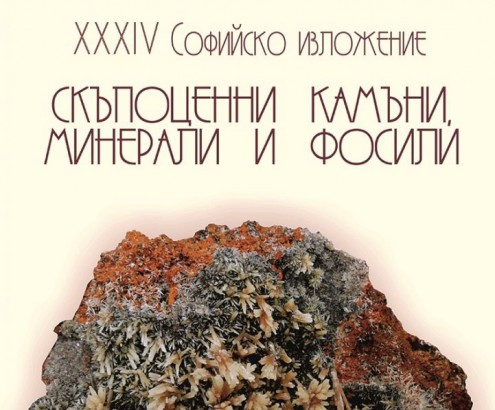 07.10.2026
34th Sofia Exhibition of Minerals, Fossils and Precious Stones
on 9, 10 and 11 October, from 10:00 to 19:00 o'clock
Entrance with museum tickets
Entrance with museum tickets
Exhibitions
 07.10.2026
OFFICIAL CHANGE OF THE GUARD IN FRONT OF THE PRESIDENCY
In front of the Presidency
The ceremonial change of the guard in front of the Presidency marks the national and public holidays in Bulgaria. The officialchange of the guard takes place on the first Wednesday of every month at 12:00 o’clock.
Festivals
 07.10.2026
GALA CONCERT
XXIV International master class of RAINA KABAIVANSKA
Main Hall
Children under 6 are not admitted to adult performances!
Main Hall
Children under 6 are not admitted to adult performances!
Music and Dance Events
18.09.2026 - 22.11.2026
DECHKO UZUNOV/IVAN PENKOV – DIRECTIONS
Memory Programme
DECHKO UZUNOV/IVAN PENKOV – DIRECTIONS
Opening: September 18, 6:00 p.m.
The exhibition Dechko Uzunov/Ivan Penkov: Directions is part of the Memory Programme at the Dechko Uzunov Art Gallery, a branch of the Sofia City Art Gallery, which aims to contribute to raising awareness of the life and work of Dechko Uzunov by presenting research-based exhibitions that reveal different aspects of his oeuvre through artists who were part of his journey. This exhibition showcases the different paths taken by two fellow townsmen and friends during the interwar period.
In 1919, Ivan Penkov and Dechko Uzunov enrolled at the State School of Drawing; that same year, Uzunov painted a portrait of his friend that poked fun at his fascination with folk art. Three years later, the two organised a joint exhibition in Sofia to fund their studies at the Munich Art Academy. The young artists’ exhibition was noticed by Joseph Herbst, who wrote:
“Now, on the occasion of their departure abroad, the two artists had exhibited most of their works, from which their strong talents could be seen quite well. Dechko Uzunov promises to develop most in portrait painting. [...] Ivan Penkov is primarily a decorator with a strong sense of composition and a keen sensitivity to line” (J.H., Razvigor, April 1, 1922, no. 60, p. 4).
In an ironic twist of fate, the older of the two, Penkov, would go on to graduate from the Academy of Art under Prof. Uzunov. In 1939, with Uzonov’s active support, Ivan Penkov won the competition for a permanent teaching position in decorative art.
The selected works invite us to seek similarities amidst the differences between these two constantly experimenting artists during the period when Bulgarian visual arts were coming of age.
Presented in this exhibition are pieces from the collections of the Sofia City Art Gallery, the Dechko Uzunov Art Gallery, the Kazanlak Art Gallery, the Central State Archives, and private collections.
The exhibition also features the film Ivan Penkov: The Crossed-Out Classic (Bulgarian National Television, 2006), by screenwriter: Oskar Kristanov; cinematographer: Yaroslav Yachev; directors: Oskar Kristanov and Kosta Bikov; sound engineer: Petar Yosifov; music arrangement: Georgi (Johnny) Penkov. Duration: 48 min.
DECHKO UZUNOV/IVAN PENKOV – DIRECTIONS
Opening: September 18, 6:00 p.m.
The exhibition Dechko Uzunov/Ivan Penkov: Directions is part of the Memory Programme at the Dechko Uzunov Art Gallery, a branch of the Sofia City Art Gallery, which aims to contribute to raising awareness of the life and work of Dechko Uzunov by presenting research-based exhibitions that reveal different aspects of his oeuvre through artists who were part of his journey. This exhibition showcases the different paths taken by two fellow townsmen and friends during the interwar period.
In 1919, Ivan Penkov and Dechko Uzunov enrolled at the State School of Drawing; that same year, Uzunov painted a portrait of his friend that poked fun at his fascination with folk art. Three years later, the two organised a joint exhibition in Sofia to fund their studies at the Munich Art Academy. The young artists’ exhibition was noticed by Joseph Herbst, who wrote:
“Now, on the occasion of their departure abroad, the two artists had exhibited most of their works, from which their strong talents could be seen quite well. Dechko Uzunov promises to develop most in portrait painting. [...] Ivan Penkov is primarily a decorator with a strong sense of composition and a keen sensitivity to line” (J.H., Razvigor, April 1, 1922, no. 60, p. 4).
In an ironic twist of fate, the older of the two, Penkov, would go on to graduate from the Academy of Art under Prof. Uzunov. In 1939, with Uzonov’s active support, Ivan Penkov won the competition for a permanent teaching position in decorative art.
The selected works invite us to seek similarities amidst the differences between these two constantly experimenting artists during the period when Bulgarian visual arts were coming of age.
Presented in this exhibition are pieces from the collections of the Sofia City Art Gallery, the Dechko Uzunov Art Gallery, the Kazanlak Art Gallery, the Central State Archives, and private collections.
The exhibition also features the film Ivan Penkov: The Crossed-Out Classic (Bulgarian National Television, 2006), by screenwriter: Oskar Kristanov; cinematographer: Yaroslav Yachev; directors: Oskar Kristanov and Kosta Bikov; sound engineer: Petar Yosifov; music arrangement: Georgi (Johnny) Penkov. Duration: 48 min.
Exhibitions
 04.08.2026 - 21.10.2026
FRANCISCO GOYA - DREAMS OF A KEEN MIND
The Spaniard FRANCISCO GOYA (1746–1828) was one of the most prominent and influential creative figures in world culture. He produced over 1,000 paintings, as well as the graphic series titled Los Caprichos, Los Desastres de la Guerra, Tauromaquia, and Los Disparates.
His stylistic and philosophical spectrum had a strong influence on the subsequent dynamic development of art, defining him as the last of the Old Masters and one of the earliest of Modernism. His extensive output—paintings, graphics and drawings—served as a leading aesthetic principle for many artistic trends of the 19th and 20th centuries, including Impressionism, Expressionism and Surrealism.
The twenty-one prints from the National Gallery collection follow Goya’s development from his earliest etchings, influenced by Diego Velázquez’s style, to his peak achievements as a social interpreter, remarkable for his sharpness, and a chronicler of dour events and complex human characters. The high artistic level of his four graphic series has left a deep imprint on the history of art.
The National Gallery houses seven works from Los Caprichos (The Caprices) series, 1799. Satirising the institutional pillars of power, the church, the Inquisition, the parasitism of the feudal nobility, and the decay of the moral values of social classes, was the reason for the series to be banned from exhibiting.
Los Desastres de la Guerra (The Disasters of War) series, which Goya began ca. 1810, and returned to ca. 1820, was not published by the artist during his lifetime. One of the works is titled ‘Prisoner. The Custody Is as Barbarous as the Crime’. It is considered unique, as it is rarely found in other museum and private collections around the world.
La Tauromaquia (The Art of Bullfighting) series, probably created between 1815 and 1816, reflected the artist’s interest in bullfighting. These works combine the flagrant cruelty of the corrida and his admiration for the skill and exciting action of the games. Of the thirty-three prints in the series, the National Gallery owns five.
While still working on La Tauromaquia, the artist in all probability launched into another series titled Los Disparates (The Follies), the meaning in his time being along the lines of stupidity or madness. The fantastic compositions are encrypted allegories whose impressive depth fascinated artists such as Baudelaire, Hugo, and Delacroix. The National Gallery’s collection houses four of those; two of them—‘Little Bulls’ Folly’ and ‘A Way of Flying’—are emblematic of the artist’s genius.
The National Gallery also owns the etching ‘Blind Singer’, emotionally described by Nikolay Raynov, in his ‘History of the Plastic Arts’ (1939), as ‘first’ among the ‘curious and significant’ graphic works of Goya.
The exhibition also includes a work by the Spanish surrealist artist, Salvador Dali (1904–1989), dedicated to Goya and his Caprichos.
His stylistic and philosophical spectrum had a strong influence on the subsequent dynamic development of art, defining him as the last of the Old Masters and one of the earliest of Modernism. His extensive output—paintings, graphics and drawings—served as a leading aesthetic principle for many artistic trends of the 19th and 20th centuries, including Impressionism, Expressionism and Surrealism.
The twenty-one prints from the National Gallery collection follow Goya’s development from his earliest etchings, influenced by Diego Velázquez’s style, to his peak achievements as a social interpreter, remarkable for his sharpness, and a chronicler of dour events and complex human characters. The high artistic level of his four graphic series has left a deep imprint on the history of art.
The National Gallery houses seven works from Los Caprichos (The Caprices) series, 1799. Satirising the institutional pillars of power, the church, the Inquisition, the parasitism of the feudal nobility, and the decay of the moral values of social classes, was the reason for the series to be banned from exhibiting.
Los Desastres de la Guerra (The Disasters of War) series, which Goya began ca. 1810, and returned to ca. 1820, was not published by the artist during his lifetime. One of the works is titled ‘Prisoner. The Custody Is as Barbarous as the Crime’. It is considered unique, as it is rarely found in other museum and private collections around the world.
La Tauromaquia (The Art of Bullfighting) series, probably created between 1815 and 1816, reflected the artist’s interest in bullfighting. These works combine the flagrant cruelty of the corrida and his admiration for the skill and exciting action of the games. Of the thirty-three prints in the series, the National Gallery owns five.
While still working on La Tauromaquia, the artist in all probability launched into another series titled Los Disparates (The Follies), the meaning in his time being along the lines of stupidity or madness. The fantastic compositions are encrypted allegories whose impressive depth fascinated artists such as Baudelaire, Hugo, and Delacroix. The National Gallery’s collection houses four of those; two of them—‘Little Bulls’ Folly’ and ‘A Way of Flying’—are emblematic of the artist’s genius.
The National Gallery also owns the etching ‘Blind Singer’, emotionally described by Nikolay Raynov, in his ‘History of the Plastic Arts’ (1939), as ‘first’ among the ‘curious and significant’ graphic works of Goya.
The exhibition also includes a work by the Spanish surrealist artist, Salvador Dali (1904–1989), dedicated to Goya and his Caprichos.
Exhibitions
06.10.2026 - 09.10.2026
INTER DRONE EXPO
Air mobility, smart cities, electromobility, digitalization, cybersecurity & safety.
Business Events
06.10.2026 - 09.10.2026
MACHTECH & INNOTECH EXPO
International exhibition for machinery and technologies in metalworking industry.
Business Events
10.09.2026 - 11.10.2026
Maya Antova – Mayoto - MACONDO
Sofia Arsenal – Museum of Contemporary Art
Maya Antova – Mayoto has transformed the exhibition space into a metaphorical Macondo, the town of solitude and magical realism in Gabriel García Márquez’s masterpiece. The exhibition is dedicated to the centenary of the birth of Ivanka Sokerova, a ‘forgotten’ and lesser-known artist whose life was a fascinating fiction.
Sokerova was an example of the triumph of the spirit: as a child, she manifested her versatile talent, but her life changed after her right hand was complete paralysed due to illness. Thus, fate directed her to devote herself to art. Her life turned into a microcosm of solitude where the borderline between reality and fantasy became invisible.
The exhibition, titled MACONDO, is here to show that solitude is not stagnation but a state of mind where art becomes the only possible language. By inverting the exhibition space, Maya Antova – Mayoto urges the viewer to look at the ‘invisible’, and to rethink Ivanka Sokerova’s persona as the architect of a magical world built on the ruins of a paralysed reality.
The exhibition, arranged in a radically different way, resembles a kind of ‘topsy-turvy world’. All objects are positioned ‘beneath the ceiling’, some reaching the floor, others hanging in the air. To observe them, the viewer must look up—a gesture of rising above earthly suffering and searching for the transcendent; a kind of gravity of the spirit.
An illusion of fiction is achieved through 3D objects replicating sculptures by Sokerova. The ‘thread-hand’ detail (a symbol of matter with no structure) serves as the leitmotif of the exhibition.
At the centre of the installation, there is an inflatable boat roaming beneath the ceiling—a symbol of transition and escape from reality. Life jackets made of paper with prints of memories are ‘floating’ around it. Paper here represents the fragile raft of knowledge that keeps the personality afloat—a reference to all intellectual activities, translations, drawings, sculptures, collages and participation in Dadaist actions, all part of Sokerova’s artistic life.
When viewers look up at the boat and the paper jackets, they do not see a ‘sinking’, but ‘rising’. They understand that escaping from reality is not desertion but an act of supreme intellectual courage.
Ivanka Sokerova did not simply translate books or model clay—she constructed life jackets from thought so as not to sink into the loneliness of her Macondo. Today, these vests hang over us as a call to seek our own haven while the world around turns topsy-turvy.
The exhibition opens with an authorial performance by Maya Antova – Mayoto, titled ‘Traveling Back’, where quotes from literary texts dedicated to Sokerova intertwine with random noises and onomatopoeic elements, creating the feeling of the fragmented world of Macondo.
…
Maya Antova – Mayoto has transformed the exhibition space into a metaphorical Macondo, the town of solitude and magical realism in Gabriel García Márquez’s masterpiece. The exhibition is dedicated to the centenary of the birth of Ivanka Sokerova, a ‘forgotten’ and lesser-known artist whose life was a fascinating fiction.
Sokerova was an example of the triumph of the spirit: as a child, she manifested her versatile talent, but her life changed after her right hand was complete paralysed due to illness. Thus, fate directed her to devote herself to art. Her life turned into a microcosm of solitude where the borderline between reality and fantasy became invisible.
The exhibition, titled MACONDO, is here to show that solitude is not stagnation but a state of mind where art becomes the only possible language. By inverting the exhibition space, Maya Antova – Mayoto urges the viewer to look at the ‘invisible’, and to rethink Ivanka Sokerova’s persona as the architect of a magical world built on the ruins of a paralysed reality.
The exhibition, arranged in a radically different way, resembles a kind of ‘topsy-turvy world’. All objects are positioned ‘beneath the ceiling’, some reaching the floor, others hanging in the air. To observe them, the viewer must look up—a gesture of rising above earthly suffering and searching for the transcendent; a kind of gravity of the spirit.
An illusion of fiction is achieved through 3D objects replicating sculptures by Sokerova. The ‘thread-hand’ detail (a symbol of matter with no structure) serves as the leitmotif of the exhibition.
At the centre of the installation, there is an inflatable boat roaming beneath the ceiling—a symbol of transition and escape from reality. Life jackets made of paper with prints of memories are ‘floating’ around it. Paper here represents the fragile raft of knowledge that keeps the personality afloat—a reference to all intellectual activities, translations, drawings, sculptures, collages and participation in Dadaist actions, all part of Sokerova’s artistic life.
When viewers look up at the boat and the paper jackets, they do not see a ‘sinking’, but ‘rising’. They understand that escaping from reality is not desertion but an act of supreme intellectual courage.
Ivanka Sokerova did not simply translate books or model clay—she constructed life jackets from thought so as not to sink into the loneliness of her Macondo. Today, these vests hang over us as a call to seek our own haven while the world around turns topsy-turvy.
The exhibition opens with an authorial performance by Maya Antova – Mayoto, titled ‘Traveling Back’, where quotes from literary texts dedicated to Sokerova intertwine with random noises and onomatopoeic elements, creating the feeling of the fragmented world of Macondo.
…
Exhibitions
23.09.2026 - 18.11.2026
Piano Extravaganza Festival 2026
Within this year’s edition, Piano Extravaganza Festival will present four piano recitals and two chamber music concerts. We hope that our extraordinary artists and the variety of the repertoire for those 6 events would satisfy even the most sophisticated connoisseur. We would be delighted to welcome you at the wonderful venues of the Central Military Club and the “Bulgaria” Chamber Hall in Sofia!
Tickets at EVENTIM.
Tickets at EVENTIM.
Festivals
16.06.2026 - 16.06.2027
Temporary Exhibition New Acquisitions
from 10:00 to 18:00 o'clock
Entrance with museum tickets
Entrance with museum tickets
Exhibitions
12.02.2026 - 31.12.2026
Temporary exhibition "Copper - Ancient and Modern"
from 10:00 to 18:00 o'clock
Entrance with museum tickets.
Entrance with museum tickets.
Exhibitions
11.04.2025 - 31.12.2026
Temporary exhibition "Minerals and Colorful Creatures. Drawings by Nature"
The Minerals of Bulgaria exposition has been expanded with a new theme: Unique mineral finds from Bulgaria, a project financed by the Ministry of culture. In 6 display cases, minerals with the most beautiful crystals, rare colors and shapes are exhibited, selected for tens of years by hundreds of geologists and collectors from all over Bulgaria.
from 10:00 to 18:00 o'clock
Entrance with museum tickets
from 10:00 to 18:00 o'clock
Entrance with museum tickets
Exhibitions
01.04.2026 - 31.12.2026
Temporary exhibition "Natural Art from Chalcedony"
from 10:00 to 18:00 o'clock
Entrance with museum tickets.
Entrance with museum tickets.
Exhibitions
01.01.2023 - 31.12.2026
Temporary exhibition "Smart Minerals for Smartphones"
from 10:00 to 18:00 o'clock
Entrance with museum tickets.
Entrance with museum tickets.
Exhibitions
10.12.2025 - 30.01.2027
Zahari Zograph Immersive Exhibition
The National Gallery presents one of the most iconic figures in the history of Bulgarian art – Zahari Zograph. This first immersive exhibition introduces a new way of experiencing the masterpieces of the the museum’s collection. Harnessing new technologies, the 20-minute project, created by Senzor Studio, brings his religious and secular masterpieces to life, revealing essential elements of his creative process.
The initiative promotes Bulgarian Revival аrt, a period characterized by economic, social, and cultural growth, closely tied to the pursuit of ecclesiastical and national independence. The period traces its origins to the mid-18th century, when Paisius of Hilendar wrote Istoriya Slavyanobulgarskaya (History of the Slavs and Bulgarians) in 1762—which profoundly shaped the spiritual awakening of the population and contributed significantly to the development of national consciousness…
The exhibition features a selection of icons, drawings, copies, letters, documents, and secular portraits from the artist’s early period. It also showcases a substantive collection of murals, ranging from his earliest works—created in 1838 for the Chapel of St John the Baptist at the Church of the Holy Virgin—Annunciation in Asenovgrad—to what is considered as his “final masterpiece,” the murals adorning the narthex of the Great Lavra Monastery on Mount Athos, completed between 1851 and 1852.
Zahari Zograph emerged as a defining figure of Bulgarian Revival art. His relentlessly inquisitive artistic spirit was ahead of its era, and his extensive body of work reflects the vitality of the approaching modern age, the artistry of traditional imagery, the strength of line, and the emotive power of color.
The project is realised with the financial support of the National Culture Fund of Bulgaria under the Creation programme 2024.
Media partners: BTA / Bulgarian News Agency and SOF Connect.
The initiative promotes Bulgarian Revival аrt, a period characterized by economic, social, and cultural growth, closely tied to the pursuit of ecclesiastical and national independence. The period traces its origins to the mid-18th century, when Paisius of Hilendar wrote Istoriya Slavyanobulgarskaya (History of the Slavs and Bulgarians) in 1762—which profoundly shaped the spiritual awakening of the population and contributed significantly to the development of national consciousness…
The exhibition features a selection of icons, drawings, copies, letters, documents, and secular portraits from the artist’s early period. It also showcases a substantive collection of murals, ranging from his earliest works—created in 1838 for the Chapel of St John the Baptist at the Church of the Holy Virgin—Annunciation in Asenovgrad—to what is considered as his “final masterpiece,” the murals adorning the narthex of the Great Lavra Monastery on Mount Athos, completed between 1851 and 1852.
Zahari Zograph emerged as a defining figure of Bulgarian Revival art. His relentlessly inquisitive artistic spirit was ahead of its era, and his extensive body of work reflects the vitality of the approaching modern age, the artistry of traditional imagery, the strength of line, and the emotive power of color.
The project is realised with the financial support of the National Culture Fund of Bulgaria under the Creation programme 2024.
Media partners: BTA / Bulgarian News Agency and SOF Connect.
Exhibitions
 08.10.2026
Gustav Kuhn Presents
Conductor
Gustav Kuhn
Solоist/s
Ania Vegry
Maria Radoeva
Ferdinand von Bothmer
Franz Hawlata
Ensemble
Sofia Philharmonic Orchestra
National Philharmonic Choir
Program
Joseph Haydn – “The Creation” – Oratorio for Soloists, Choir and Orchestra
Gustav Kuhn
Solоist/s
Ania Vegry
Maria Radoeva
Ferdinand von Bothmer
Franz Hawlata
Ensemble
Sofia Philharmonic Orchestra
National Philharmonic Choir
Program
Joseph Haydn – “The Creation” – Oratorio for Soloists, Choir and Orchestra
Music and Dance Events
 08.10.2026
ROMЕ́O ET JULIETTE
Ballet to the music of Sergei Prokofiev
Duration 3:10 Intermission 2
Main Hall
Children under 6 are not admitted to adult performances!
Duration 3:10 Intermission 2
Main Hall
Children under 6 are not admitted to adult performances!
Music and Dance Events
18.09.2026 - 22.11.2026
DECHKO UZUNOV/IVAN PENKOV – DIRECTIONS
Memory Programme
DECHKO UZUNOV/IVAN PENKOV – DIRECTIONS
Opening: September 18, 6:00 p.m.
The exhibition Dechko Uzunov/Ivan Penkov: Directions is part of the Memory Programme at the Dechko Uzunov Art Gallery, a branch of the Sofia City Art Gallery, which aims to contribute to raising awareness of the life and work of Dechko Uzunov by presenting research-based exhibitions that reveal different aspects of his oeuvre through artists who were part of his journey. This exhibition showcases the different paths taken by two fellow townsmen and friends during the interwar period.
In 1919, Ivan Penkov and Dechko Uzunov enrolled at the State School of Drawing; that same year, Uzunov painted a portrait of his friend that poked fun at his fascination with folk art. Three years later, the two organised a joint exhibition in Sofia to fund their studies at the Munich Art Academy. The young artists’ exhibition was noticed by Joseph Herbst, who wrote:
“Now, on the occasion of their departure abroad, the two artists had exhibited most of their works, from which their strong talents could be seen quite well. Dechko Uzunov promises to develop most in portrait painting. [...] Ivan Penkov is primarily a decorator with a strong sense of composition and a keen sensitivity to line” (J.H., Razvigor, April 1, 1922, no. 60, p. 4).
In an ironic twist of fate, the older of the two, Penkov, would go on to graduate from the Academy of Art under Prof. Uzunov. In 1939, with Uzonov’s active support, Ivan Penkov won the competition for a permanent teaching position in decorative art.
The selected works invite us to seek similarities amidst the differences between these two constantly experimenting artists during the period when Bulgarian visual arts were coming of age.
Presented in this exhibition are pieces from the collections of the Sofia City Art Gallery, the Dechko Uzunov Art Gallery, the Kazanlak Art Gallery, the Central State Archives, and private collections.
The exhibition also features the film Ivan Penkov: The Crossed-Out Classic (Bulgarian National Television, 2006), by screenwriter: Oskar Kristanov; cinematographer: Yaroslav Yachev; directors: Oskar Kristanov and Kosta Bikov; sound engineer: Petar Yosifov; music arrangement: Georgi (Johnny) Penkov. Duration: 48 min.
DECHKO UZUNOV/IVAN PENKOV – DIRECTIONS
Opening: September 18, 6:00 p.m.
The exhibition Dechko Uzunov/Ivan Penkov: Directions is part of the Memory Programme at the Dechko Uzunov Art Gallery, a branch of the Sofia City Art Gallery, which aims to contribute to raising awareness of the life and work of Dechko Uzunov by presenting research-based exhibitions that reveal different aspects of his oeuvre through artists who were part of his journey. This exhibition showcases the different paths taken by two fellow townsmen and friends during the interwar period.
In 1919, Ivan Penkov and Dechko Uzunov enrolled at the State School of Drawing; that same year, Uzunov painted a portrait of his friend that poked fun at his fascination with folk art. Three years later, the two organised a joint exhibition in Sofia to fund their studies at the Munich Art Academy. The young artists’ exhibition was noticed by Joseph Herbst, who wrote:
“Now, on the occasion of their departure abroad, the two artists had exhibited most of their works, from which their strong talents could be seen quite well. Dechko Uzunov promises to develop most in portrait painting. [...] Ivan Penkov is primarily a decorator with a strong sense of composition and a keen sensitivity to line” (J.H., Razvigor, April 1, 1922, no. 60, p. 4).
In an ironic twist of fate, the older of the two, Penkov, would go on to graduate from the Academy of Art under Prof. Uzunov. In 1939, with Uzonov’s active support, Ivan Penkov won the competition for a permanent teaching position in decorative art.
The selected works invite us to seek similarities amidst the differences between these two constantly experimenting artists during the period when Bulgarian visual arts were coming of age.
Presented in this exhibition are pieces from the collections of the Sofia City Art Gallery, the Dechko Uzunov Art Gallery, the Kazanlak Art Gallery, the Central State Archives, and private collections.
The exhibition also features the film Ivan Penkov: The Crossed-Out Classic (Bulgarian National Television, 2006), by screenwriter: Oskar Kristanov; cinematographer: Yaroslav Yachev; directors: Oskar Kristanov and Kosta Bikov; sound engineer: Petar Yosifov; music arrangement: Georgi (Johnny) Penkov. Duration: 48 min.
Exhibitions
04.08.2026 - 21.10.2026
FRANCISCO GOYA - DREAMS OF A KEEN MIND
The Spaniard FRANCISCO GOYA (1746–1828) was one of the most prominent and influential creative figures in world culture. He produced over 1,000 paintings, as well as the graphic series titled Los Caprichos, Los Desastres de la Guerra, Tauromaquia, and Los Disparates.
His stylistic and philosophical spectrum had a strong influence on the subsequent dynamic development of art, defining him as the last of the Old Masters and one of the earliest of Modernism. His extensive output—paintings, graphics and drawings—served as a leading aesthetic principle for many artistic trends of the 19th and 20th centuries, including Impressionism, Expressionism and Surrealism.
The twenty-one prints from the National Gallery collection follow Goya’s development from his earliest etchings, influenced by Diego Velázquez’s style, to his peak achievements as a social interpreter, remarkable for his sharpness, and a chronicler of dour events and complex human characters. The high artistic level of his four graphic series has left a deep imprint on the history of art.
The National Gallery houses seven works from Los Caprichos (The Caprices) series, 1799. Satirising the institutional pillars of power, the church, the Inquisition, the parasitism of the feudal nobility, and the decay of the moral values of social classes, was the reason for the series to be banned from exhibiting.
Los Desastres de la Guerra (The Disasters of War) series, which Goya began ca. 1810, and returned to ca. 1820, was not published by the artist during his lifetime. One of the works is titled ‘Prisoner. The Custody Is as Barbarous as the Crime’. It is considered unique, as it is rarely found in other museum and private collections around the world.
La Tauromaquia (The Art of Bullfighting) series, probably created between 1815 and 1816, reflected the artist’s interest in bullfighting. These works combine the flagrant cruelty of the corrida and his admiration for the skill and exciting action of the games. Of the thirty-three prints in the series, the National Gallery owns five.
While still working on La Tauromaquia, the artist in all probability launched into another series titled Los Disparates (The Follies), the meaning in his time being along the lines of stupidity or madness. The fantastic compositions are encrypted allegories whose impressive depth fascinated artists such as Baudelaire, Hugo, and Delacroix. The National Gallery’s collection houses four of those; two of them—‘Little Bulls’ Folly’ and ‘A Way of Flying’—are emblematic of the artist’s genius.
The National Gallery also owns the etching ‘Blind Singer’, emotionally described by Nikolay Raynov, in his ‘History of the Plastic Arts’ (1939), as ‘first’ among the ‘curious and significant’ graphic works of Goya.
The exhibition also includes a work by the Spanish surrealist artist, Salvador Dali (1904–1989), dedicated to Goya and his Caprichos.
His stylistic and philosophical spectrum had a strong influence on the subsequent dynamic development of art, defining him as the last of the Old Masters and one of the earliest of Modernism. His extensive output—paintings, graphics and drawings—served as a leading aesthetic principle for many artistic trends of the 19th and 20th centuries, including Impressionism, Expressionism and Surrealism.
The twenty-one prints from the National Gallery collection follow Goya’s development from his earliest etchings, influenced by Diego Velázquez’s style, to his peak achievements as a social interpreter, remarkable for his sharpness, and a chronicler of dour events and complex human characters. The high artistic level of his four graphic series has left a deep imprint on the history of art.
The National Gallery houses seven works from Los Caprichos (The Caprices) series, 1799. Satirising the institutional pillars of power, the church, the Inquisition, the parasitism of the feudal nobility, and the decay of the moral values of social classes, was the reason for the series to be banned from exhibiting.
Los Desastres de la Guerra (The Disasters of War) series, which Goya began ca. 1810, and returned to ca. 1820, was not published by the artist during his lifetime. One of the works is titled ‘Prisoner. The Custody Is as Barbarous as the Crime’. It is considered unique, as it is rarely found in other museum and private collections around the world.
La Tauromaquia (The Art of Bullfighting) series, probably created between 1815 and 1816, reflected the artist’s interest in bullfighting. These works combine the flagrant cruelty of the corrida and his admiration for the skill and exciting action of the games. Of the thirty-three prints in the series, the National Gallery owns five.
While still working on La Tauromaquia, the artist in all probability launched into another series titled Los Disparates (The Follies), the meaning in his time being along the lines of stupidity or madness. The fantastic compositions are encrypted allegories whose impressive depth fascinated artists such as Baudelaire, Hugo, and Delacroix. The National Gallery’s collection houses four of those; two of them—‘Little Bulls’ Folly’ and ‘A Way of Flying’—are emblematic of the artist’s genius.
The National Gallery also owns the etching ‘Blind Singer’, emotionally described by Nikolay Raynov, in his ‘History of the Plastic Arts’ (1939), as ‘first’ among the ‘curious and significant’ graphic works of Goya.
The exhibition also includes a work by the Spanish surrealist artist, Salvador Dali (1904–1989), dedicated to Goya and his Caprichos.
Exhibitions
06.10.2026 - 09.10.2026
INTER DRONE EXPO
Air mobility, smart cities, electromobility, digitalization, cybersecurity & safety.
Business Events
06.10.2026 - 09.10.2026
MACHTECH & INNOTECH EXPO
International exhibition for machinery and technologies in metalworking industry.
Business Events
10.09.2026 - 11.10.2026
Maya Antova – Mayoto - MACONDO
Sofia Arsenal – Museum of Contemporary Art
Maya Antova – Mayoto has transformed the exhibition space into a metaphorical Macondo, the town of solitude and magical realism in Gabriel García Márquez’s masterpiece. The exhibition is dedicated to the centenary of the birth of Ivanka Sokerova, a ‘forgotten’ and lesser-known artist whose life was a fascinating fiction.
Sokerova was an example of the triumph of the spirit: as a child, she manifested her versatile talent, but her life changed after her right hand was complete paralysed due to illness. Thus, fate directed her to devote herself to art. Her life turned into a microcosm of solitude where the borderline between reality and fantasy became invisible.
The exhibition, titled MACONDO, is here to show that solitude is not stagnation but a state of mind where art becomes the only possible language. By inverting the exhibition space, Maya Antova – Mayoto urges the viewer to look at the ‘invisible’, and to rethink Ivanka Sokerova’s persona as the architect of a magical world built on the ruins of a paralysed reality.
The exhibition, arranged in a radically different way, resembles a kind of ‘topsy-turvy world’. All objects are positioned ‘beneath the ceiling’, some reaching the floor, others hanging in the air. To observe them, the viewer must look up—a gesture of rising above earthly suffering and searching for the transcendent; a kind of gravity of the spirit.
An illusion of fiction is achieved through 3D objects replicating sculptures by Sokerova. The ‘thread-hand’ detail (a symbol of matter with no structure) serves as the leitmotif of the exhibition.
At the centre of the installation, there is an inflatable boat roaming beneath the ceiling—a symbol of transition and escape from reality. Life jackets made of paper with prints of memories are ‘floating’ around it. Paper here represents the fragile raft of knowledge that keeps the personality afloat—a reference to all intellectual activities, translations, drawings, sculptures, collages and participation in Dadaist actions, all part of Sokerova’s artistic life.
When viewers look up at the boat and the paper jackets, they do not see a ‘sinking’, but ‘rising’. They understand that escaping from reality is not desertion but an act of supreme intellectual courage.
Ivanka Sokerova did not simply translate books or model clay—she constructed life jackets from thought so as not to sink into the loneliness of her Macondo. Today, these vests hang over us as a call to seek our own haven while the world around turns topsy-turvy.
The exhibition opens with an authorial performance by Maya Antova – Mayoto, titled ‘Traveling Back’, where quotes from literary texts dedicated to Sokerova intertwine with random noises and onomatopoeic elements, creating the feeling of the fragmented world of Macondo.
…
Maya Antova – Mayoto has transformed the exhibition space into a metaphorical Macondo, the town of solitude and magical realism in Gabriel García Márquez’s masterpiece. The exhibition is dedicated to the centenary of the birth of Ivanka Sokerova, a ‘forgotten’ and lesser-known artist whose life was a fascinating fiction.
Sokerova was an example of the triumph of the spirit: as a child, she manifested her versatile talent, but her life changed after her right hand was complete paralysed due to illness. Thus, fate directed her to devote herself to art. Her life turned into a microcosm of solitude where the borderline between reality and fantasy became invisible.
The exhibition, titled MACONDO, is here to show that solitude is not stagnation but a state of mind where art becomes the only possible language. By inverting the exhibition space, Maya Antova – Mayoto urges the viewer to look at the ‘invisible’, and to rethink Ivanka Sokerova’s persona as the architect of a magical world built on the ruins of a paralysed reality.
The exhibition, arranged in a radically different way, resembles a kind of ‘topsy-turvy world’. All objects are positioned ‘beneath the ceiling’, some reaching the floor, others hanging in the air. To observe them, the viewer must look up—a gesture of rising above earthly suffering and searching for the transcendent; a kind of gravity of the spirit.
An illusion of fiction is achieved through 3D objects replicating sculptures by Sokerova. The ‘thread-hand’ detail (a symbol of matter with no structure) serves as the leitmotif of the exhibition.
At the centre of the installation, there is an inflatable boat roaming beneath the ceiling—a symbol of transition and escape from reality. Life jackets made of paper with prints of memories are ‘floating’ around it. Paper here represents the fragile raft of knowledge that keeps the personality afloat—a reference to all intellectual activities, translations, drawings, sculptures, collages and participation in Dadaist actions, all part of Sokerova’s artistic life.
When viewers look up at the boat and the paper jackets, they do not see a ‘sinking’, but ‘rising’. They understand that escaping from reality is not desertion but an act of supreme intellectual courage.
Ivanka Sokerova did not simply translate books or model clay—she constructed life jackets from thought so as not to sink into the loneliness of her Macondo. Today, these vests hang over us as a call to seek our own haven while the world around turns topsy-turvy.
The exhibition opens with an authorial performance by Maya Antova – Mayoto, titled ‘Traveling Back’, where quotes from literary texts dedicated to Sokerova intertwine with random noises and onomatopoeic elements, creating the feeling of the fragmented world of Macondo.
…
Exhibitions
23.09.2026 - 18.11.2026
Piano Extravaganza Festival 2026
Within this year’s edition, Piano Extravaganza Festival will present four piano recitals and two chamber music concerts. We hope that our extraordinary artists and the variety of the repertoire for those 6 events would satisfy even the most sophisticated connoisseur. We would be delighted to welcome you at the wonderful venues of the Central Military Club and the “Bulgaria” Chamber Hall in Sofia!
Tickets at EVENTIM.
Tickets at EVENTIM.
Festivals
16.06.2026 - 16.06.2027
Temporary Exhibition New Acquisitions
from 10:00 to 18:00 o'clock
Entrance with museum tickets
Entrance with museum tickets
Exhibitions
12.02.2026 - 31.12.2026
Temporary exhibition "Copper - Ancient and Modern"
from 10:00 to 18:00 o'clock
Entrance with museum tickets.
Entrance with museum tickets.
Exhibitions
11.04.2025 - 31.12.2026
Temporary exhibition "Minerals and Colorful Creatures. Drawings by Nature"
The Minerals of Bulgaria exposition has been expanded with a new theme: Unique mineral finds from Bulgaria, a project financed by the Ministry of culture. In 6 display cases, minerals with the most beautiful crystals, rare colors and shapes are exhibited, selected for tens of years by hundreds of geologists and collectors from all over Bulgaria.
from 10:00 to 18:00 o'clock
Entrance with museum tickets
from 10:00 to 18:00 o'clock
Entrance with museum tickets
Exhibitions
01.04.2026 - 31.12.2026
Temporary exhibition "Natural Art from Chalcedony"
from 10:00 to 18:00 o'clock
Entrance with museum tickets.
Entrance with museum tickets.
Exhibitions
01.01.2023 - 31.12.2026
Temporary exhibition "Smart Minerals for Smartphones"
from 10:00 to 18:00 o'clock
Entrance with museum tickets.
Entrance with museum tickets.
Exhibitions
10.12.2025 - 30.01.2027
Zahari Zograph Immersive Exhibition
The National Gallery presents one of the most iconic figures in the history of Bulgarian art – Zahari Zograph. This first immersive exhibition introduces a new way of experiencing the masterpieces of the the museum’s collection. Harnessing new technologies, the 20-minute project, created by Senzor Studio, brings his religious and secular masterpieces to life, revealing essential elements of his creative process.
The initiative promotes Bulgarian Revival аrt, a period characterized by economic, social, and cultural growth, closely tied to the pursuit of ecclesiastical and national independence. The period traces its origins to the mid-18th century, when Paisius of Hilendar wrote Istoriya Slavyanobulgarskaya (History of the Slavs and Bulgarians) in 1762—which profoundly shaped the spiritual awakening of the population and contributed significantly to the development of national consciousness…
The exhibition features a selection of icons, drawings, copies, letters, documents, and secular portraits from the artist’s early period. It also showcases a substantive collection of murals, ranging from his earliest works—created in 1838 for the Chapel of St John the Baptist at the Church of the Holy Virgin—Annunciation in Asenovgrad—to what is considered as his “final masterpiece,” the murals adorning the narthex of the Great Lavra Monastery on Mount Athos, completed between 1851 and 1852.
Zahari Zograph emerged as a defining figure of Bulgarian Revival art. His relentlessly inquisitive artistic spirit was ahead of its era, and his extensive body of work reflects the vitality of the approaching modern age, the artistry of traditional imagery, the strength of line, and the emotive power of color.
The project is realised with the financial support of the National Culture Fund of Bulgaria under the Creation programme 2024.
Media partners: BTA / Bulgarian News Agency and SOF Connect.
The initiative promotes Bulgarian Revival аrt, a period characterized by economic, social, and cultural growth, closely tied to the pursuit of ecclesiastical and national independence. The period traces its origins to the mid-18th century, when Paisius of Hilendar wrote Istoriya Slavyanobulgarskaya (History of the Slavs and Bulgarians) in 1762—which profoundly shaped the spiritual awakening of the population and contributed significantly to the development of national consciousness…
The exhibition features a selection of icons, drawings, copies, letters, documents, and secular portraits from the artist’s early period. It also showcases a substantive collection of murals, ranging from his earliest works—created in 1838 for the Chapel of St John the Baptist at the Church of the Holy Virgin—Annunciation in Asenovgrad—to what is considered as his “final masterpiece,” the murals adorning the narthex of the Great Lavra Monastery on Mount Athos, completed between 1851 and 1852.
Zahari Zograph emerged as a defining figure of Bulgarian Revival art. His relentlessly inquisitive artistic spirit was ahead of its era, and his extensive body of work reflects the vitality of the approaching modern age, the artistry of traditional imagery, the strength of line, and the emotive power of color.
The project is realised with the financial support of the National Culture Fund of Bulgaria under the Creation programme 2024.
Media partners: BTA / Bulgarian News Agency and SOF Connect.
Exhibitions
 09.10.2026
LA CENERENTOLA
Opera by Gioachino Rossini
Duration 2:45 Intermission 1
Main Hall
Children under 6 are not admitted to adult performances!
Performed in italian, with bulgarian and english subtitles
Duration 2:45 Intermission 1
Main Hall
Children under 6 are not admitted to adult performances!
Performed in italian, with bulgarian and english subtitles
Music and Dance Events
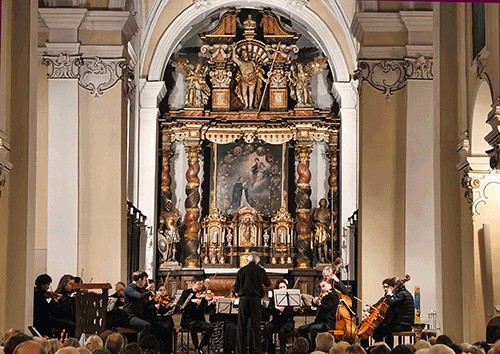 09.10.2026
Piano Extravaganza Festival 2026 - Concert of Hannover Chamber Orchestra (Germany)
Conductor: Hans-Christian Euler. Soloists: Massimo Mercelli, flute (Italy) and Davide Alogna, violin (Italy).
Works of Mendelssohn, Hofmann, Schumann/Godard, Schubert, Saint-Saens.
The concert is part of the Cultural Calendar of the Ministry of Culture for 2026.
Works of Mendelssohn, Hofmann, Schumann/Godard, Schubert, Saint-Saens.
The concert is part of the Cultural Calendar of the Ministry of Culture for 2026.
Festivals
 10.10.2026
10 Steps to a Brilliant Presentation
Desi Stoyanova will share with you 10 clear steps to follow so that your presentations achieve their goals, while at the same time are an exciting experience for the audience.
Business Events
18.09.2026 - 22.11.2026
DECHKO UZUNOV/IVAN PENKOV – DIRECTIONS
Memory Programme
DECHKO UZUNOV/IVAN PENKOV – DIRECTIONS
Opening: September 18, 6:00 p.m.
The exhibition Dechko Uzunov/Ivan Penkov: Directions is part of the Memory Programme at the Dechko Uzunov Art Gallery, a branch of the Sofia City Art Gallery, which aims to contribute to raising awareness of the life and work of Dechko Uzunov by presenting research-based exhibitions that reveal different aspects of his oeuvre through artists who were part of his journey. This exhibition showcases the different paths taken by two fellow townsmen and friends during the interwar period.
In 1919, Ivan Penkov and Dechko Uzunov enrolled at the State School of Drawing; that same year, Uzunov painted a portrait of his friend that poked fun at his fascination with folk art. Three years later, the two organised a joint exhibition in Sofia to fund their studies at the Munich Art Academy. The young artists’ exhibition was noticed by Joseph Herbst, who wrote:
“Now, on the occasion of their departure abroad, the two artists had exhibited most of their works, from which their strong talents could be seen quite well. Dechko Uzunov promises to develop most in portrait painting. [...] Ivan Penkov is primarily a decorator with a strong sense of composition and a keen sensitivity to line” (J.H., Razvigor, April 1, 1922, no. 60, p. 4).
In an ironic twist of fate, the older of the two, Penkov, would go on to graduate from the Academy of Art under Prof. Uzunov. In 1939, with Uzonov’s active support, Ivan Penkov won the competition for a permanent teaching position in decorative art.
The selected works invite us to seek similarities amidst the differences between these two constantly experimenting artists during the period when Bulgarian visual arts were coming of age.
Presented in this exhibition are pieces from the collections of the Sofia City Art Gallery, the Dechko Uzunov Art Gallery, the Kazanlak Art Gallery, the Central State Archives, and private collections.
The exhibition also features the film Ivan Penkov: The Crossed-Out Classic (Bulgarian National Television, 2006), by screenwriter: Oskar Kristanov; cinematographer: Yaroslav Yachev; directors: Oskar Kristanov and Kosta Bikov; sound engineer: Petar Yosifov; music arrangement: Georgi (Johnny) Penkov. Duration: 48 min.
DECHKO UZUNOV/IVAN PENKOV – DIRECTIONS
Opening: September 18, 6:00 p.m.
The exhibition Dechko Uzunov/Ivan Penkov: Directions is part of the Memory Programme at the Dechko Uzunov Art Gallery, a branch of the Sofia City Art Gallery, which aims to contribute to raising awareness of the life and work of Dechko Uzunov by presenting research-based exhibitions that reveal different aspects of his oeuvre through artists who were part of his journey. This exhibition showcases the different paths taken by two fellow townsmen and friends during the interwar period.
In 1919, Ivan Penkov and Dechko Uzunov enrolled at the State School of Drawing; that same year, Uzunov painted a portrait of his friend that poked fun at his fascination with folk art. Three years later, the two organised a joint exhibition in Sofia to fund their studies at the Munich Art Academy. The young artists’ exhibition was noticed by Joseph Herbst, who wrote:
“Now, on the occasion of their departure abroad, the two artists had exhibited most of their works, from which their strong talents could be seen quite well. Dechko Uzunov promises to develop most in portrait painting. [...] Ivan Penkov is primarily a decorator with a strong sense of composition and a keen sensitivity to line” (J.H., Razvigor, April 1, 1922, no. 60, p. 4).
In an ironic twist of fate, the older of the two, Penkov, would go on to graduate from the Academy of Art under Prof. Uzunov. In 1939, with Uzonov’s active support, Ivan Penkov won the competition for a permanent teaching position in decorative art.
The selected works invite us to seek similarities amidst the differences between these two constantly experimenting artists during the period when Bulgarian visual arts were coming of age.
Presented in this exhibition are pieces from the collections of the Sofia City Art Gallery, the Dechko Uzunov Art Gallery, the Kazanlak Art Gallery, the Central State Archives, and private collections.
The exhibition also features the film Ivan Penkov: The Crossed-Out Classic (Bulgarian National Television, 2006), by screenwriter: Oskar Kristanov; cinematographer: Yaroslav Yachev; directors: Oskar Kristanov and Kosta Bikov; sound engineer: Petar Yosifov; music arrangement: Georgi (Johnny) Penkov. Duration: 48 min.
Exhibitions
04.08.2026 - 21.10.2026
FRANCISCO GOYA - DREAMS OF A KEEN MIND
The Spaniard FRANCISCO GOYA (1746–1828) was one of the most prominent and influential creative figures in world culture. He produced over 1,000 paintings, as well as the graphic series titled Los Caprichos, Los Desastres de la Guerra, Tauromaquia, and Los Disparates.
His stylistic and philosophical spectrum had a strong influence on the subsequent dynamic development of art, defining him as the last of the Old Masters and one of the earliest of Modernism. His extensive output—paintings, graphics and drawings—served as a leading aesthetic principle for many artistic trends of the 19th and 20th centuries, including Impressionism, Expressionism and Surrealism.
The twenty-one prints from the National Gallery collection follow Goya’s development from his earliest etchings, influenced by Diego Velázquez’s style, to his peak achievements as a social interpreter, remarkable for his sharpness, and a chronicler of dour events and complex human characters. The high artistic level of his four graphic series has left a deep imprint on the history of art.
The National Gallery houses seven works from Los Caprichos (The Caprices) series, 1799. Satirising the institutional pillars of power, the church, the Inquisition, the parasitism of the feudal nobility, and the decay of the moral values of social classes, was the reason for the series to be banned from exhibiting.
Los Desastres de la Guerra (The Disasters of War) series, which Goya began ca. 1810, and returned to ca. 1820, was not published by the artist during his lifetime. One of the works is titled ‘Prisoner. The Custody Is as Barbarous as the Crime’. It is considered unique, as it is rarely found in other museum and private collections around the world.
La Tauromaquia (The Art of Bullfighting) series, probably created between 1815 and 1816, reflected the artist’s interest in bullfighting. These works combine the flagrant cruelty of the corrida and his admiration for the skill and exciting action of the games. Of the thirty-three prints in the series, the National Gallery owns five.
While still working on La Tauromaquia, the artist in all probability launched into another series titled Los Disparates (The Follies), the meaning in his time being along the lines of stupidity or madness. The fantastic compositions are encrypted allegories whose impressive depth fascinated artists such as Baudelaire, Hugo, and Delacroix. The National Gallery’s collection houses four of those; two of them—‘Little Bulls’ Folly’ and ‘A Way of Flying’—are emblematic of the artist’s genius.
The National Gallery also owns the etching ‘Blind Singer’, emotionally described by Nikolay Raynov, in his ‘History of the Plastic Arts’ (1939), as ‘first’ among the ‘curious and significant’ graphic works of Goya.
The exhibition also includes a work by the Spanish surrealist artist, Salvador Dali (1904–1989), dedicated to Goya and his Caprichos.
His stylistic and philosophical spectrum had a strong influence on the subsequent dynamic development of art, defining him as the last of the Old Masters and one of the earliest of Modernism. His extensive output—paintings, graphics and drawings—served as a leading aesthetic principle for many artistic trends of the 19th and 20th centuries, including Impressionism, Expressionism and Surrealism.
The twenty-one prints from the National Gallery collection follow Goya’s development from his earliest etchings, influenced by Diego Velázquez’s style, to his peak achievements as a social interpreter, remarkable for his sharpness, and a chronicler of dour events and complex human characters. The high artistic level of his four graphic series has left a deep imprint on the history of art.
The National Gallery houses seven works from Los Caprichos (The Caprices) series, 1799. Satirising the institutional pillars of power, the church, the Inquisition, the parasitism of the feudal nobility, and the decay of the moral values of social classes, was the reason for the series to be banned from exhibiting.
Los Desastres de la Guerra (The Disasters of War) series, which Goya began ca. 1810, and returned to ca. 1820, was not published by the artist during his lifetime. One of the works is titled ‘Prisoner. The Custody Is as Barbarous as the Crime’. It is considered unique, as it is rarely found in other museum and private collections around the world.
La Tauromaquia (The Art of Bullfighting) series, probably created between 1815 and 1816, reflected the artist’s interest in bullfighting. These works combine the flagrant cruelty of the corrida and his admiration for the skill and exciting action of the games. Of the thirty-three prints in the series, the National Gallery owns five.
While still working on La Tauromaquia, the artist in all probability launched into another series titled Los Disparates (The Follies), the meaning in his time being along the lines of stupidity or madness. The fantastic compositions are encrypted allegories whose impressive depth fascinated artists such as Baudelaire, Hugo, and Delacroix. The National Gallery’s collection houses four of those; two of them—‘Little Bulls’ Folly’ and ‘A Way of Flying’—are emblematic of the artist’s genius.
The National Gallery also owns the etching ‘Blind Singer’, emotionally described by Nikolay Raynov, in his ‘History of the Plastic Arts’ (1939), as ‘first’ among the ‘curious and significant’ graphic works of Goya.
The exhibition also includes a work by the Spanish surrealist artist, Salvador Dali (1904–1989), dedicated to Goya and his Caprichos.
Exhibitions
10.09.2026 - 11.10.2026
Maya Antova – Mayoto - MACONDO
Sofia Arsenal – Museum of Contemporary Art
Maya Antova – Mayoto has transformed the exhibition space into a metaphorical Macondo, the town of solitude and magical realism in Gabriel García Márquez’s masterpiece. The exhibition is dedicated to the centenary of the birth of Ivanka Sokerova, a ‘forgotten’ and lesser-known artist whose life was a fascinating fiction.
Sokerova was an example of the triumph of the spirit: as a child, she manifested her versatile talent, but her life changed after her right hand was complete paralysed due to illness. Thus, fate directed her to devote herself to art. Her life turned into a microcosm of solitude where the borderline between reality and fantasy became invisible.
The exhibition, titled MACONDO, is here to show that solitude is not stagnation but a state of mind where art becomes the only possible language. By inverting the exhibition space, Maya Antova – Mayoto urges the viewer to look at the ‘invisible’, and to rethink Ivanka Sokerova’s persona as the architect of a magical world built on the ruins of a paralysed reality.
The exhibition, arranged in a radically different way, resembles a kind of ‘topsy-turvy world’. All objects are positioned ‘beneath the ceiling’, some reaching the floor, others hanging in the air. To observe them, the viewer must look up—a gesture of rising above earthly suffering and searching for the transcendent; a kind of gravity of the spirit.
An illusion of fiction is achieved through 3D objects replicating sculptures by Sokerova. The ‘thread-hand’ detail (a symbol of matter with no structure) serves as the leitmotif of the exhibition.
At the centre of the installation, there is an inflatable boat roaming beneath the ceiling—a symbol of transition and escape from reality. Life jackets made of paper with prints of memories are ‘floating’ around it. Paper here represents the fragile raft of knowledge that keeps the personality afloat—a reference to all intellectual activities, translations, drawings, sculptures, collages and participation in Dadaist actions, all part of Sokerova’s artistic life.
When viewers look up at the boat and the paper jackets, they do not see a ‘sinking’, but ‘rising’. They understand that escaping from reality is not desertion but an act of supreme intellectual courage.
Ivanka Sokerova did not simply translate books or model clay—she constructed life jackets from thought so as not to sink into the loneliness of her Macondo. Today, these vests hang over us as a call to seek our own haven while the world around turns topsy-turvy.
The exhibition opens with an authorial performance by Maya Antova – Mayoto, titled ‘Traveling Back’, where quotes from literary texts dedicated to Sokerova intertwine with random noises and onomatopoeic elements, creating the feeling of the fragmented world of Macondo.
…
Maya Antova – Mayoto has transformed the exhibition space into a metaphorical Macondo, the town of solitude and magical realism in Gabriel García Márquez’s masterpiece. The exhibition is dedicated to the centenary of the birth of Ivanka Sokerova, a ‘forgotten’ and lesser-known artist whose life was a fascinating fiction.
Sokerova was an example of the triumph of the spirit: as a child, she manifested her versatile talent, but her life changed after her right hand was complete paralysed due to illness. Thus, fate directed her to devote herself to art. Her life turned into a microcosm of solitude where the borderline between reality and fantasy became invisible.
The exhibition, titled MACONDO, is here to show that solitude is not stagnation but a state of mind where art becomes the only possible language. By inverting the exhibition space, Maya Antova – Mayoto urges the viewer to look at the ‘invisible’, and to rethink Ivanka Sokerova’s persona as the architect of a magical world built on the ruins of a paralysed reality.
The exhibition, arranged in a radically different way, resembles a kind of ‘topsy-turvy world’. All objects are positioned ‘beneath the ceiling’, some reaching the floor, others hanging in the air. To observe them, the viewer must look up—a gesture of rising above earthly suffering and searching for the transcendent; a kind of gravity of the spirit.
An illusion of fiction is achieved through 3D objects replicating sculptures by Sokerova. The ‘thread-hand’ detail (a symbol of matter with no structure) serves as the leitmotif of the exhibition.
At the centre of the installation, there is an inflatable boat roaming beneath the ceiling—a symbol of transition and escape from reality. Life jackets made of paper with prints of memories are ‘floating’ around it. Paper here represents the fragile raft of knowledge that keeps the personality afloat—a reference to all intellectual activities, translations, drawings, sculptures, collages and participation in Dadaist actions, all part of Sokerova’s artistic life.
When viewers look up at the boat and the paper jackets, they do not see a ‘sinking’, but ‘rising’. They understand that escaping from reality is not desertion but an act of supreme intellectual courage.
Ivanka Sokerova did not simply translate books or model clay—she constructed life jackets from thought so as not to sink into the loneliness of her Macondo. Today, these vests hang over us as a call to seek our own haven while the world around turns topsy-turvy.
The exhibition opens with an authorial performance by Maya Antova – Mayoto, titled ‘Traveling Back’, where quotes from literary texts dedicated to Sokerova intertwine with random noises and onomatopoeic elements, creating the feeling of the fragmented world of Macondo.
…
Exhibitions
23.09.2026 - 18.11.2026
Piano Extravaganza Festival 2026
Within this year’s edition, Piano Extravaganza Festival will present four piano recitals and two chamber music concerts. We hope that our extraordinary artists and the variety of the repertoire for those 6 events would satisfy even the most sophisticated connoisseur. We would be delighted to welcome you at the wonderful venues of the Central Military Club and the “Bulgaria” Chamber Hall in Sofia!
Tickets at EVENTIM.
Tickets at EVENTIM.
Festivals
16.06.2026 - 16.06.2027
Temporary Exhibition New Acquisitions
from 10:00 to 18:00 o'clock
Entrance with museum tickets
Entrance with museum tickets
Exhibitions
12.02.2026 - 31.12.2026
Temporary exhibition "Copper - Ancient and Modern"
from 10:00 to 18:00 o'clock
Entrance with museum tickets.
Entrance with museum tickets.
Exhibitions
11.04.2025 - 31.12.2026
Temporary exhibition "Minerals and Colorful Creatures. Drawings by Nature"
The Minerals of Bulgaria exposition has been expanded with a new theme: Unique mineral finds from Bulgaria, a project financed by the Ministry of culture. In 6 display cases, minerals with the most beautiful crystals, rare colors and shapes are exhibited, selected for tens of years by hundreds of geologists and collectors from all over Bulgaria.
from 10:00 to 18:00 o'clock
Entrance with museum tickets
from 10:00 to 18:00 o'clock
Entrance with museum tickets
Exhibitions
01.04.2026 - 31.12.2026
Temporary exhibition "Natural Art from Chalcedony"
from 10:00 to 18:00 o'clock
Entrance with museum tickets.
Entrance with museum tickets.
Exhibitions
01.01.2023 - 31.12.2026
Temporary exhibition "Smart Minerals for Smartphones"
from 10:00 to 18:00 o'clock
Entrance with museum tickets.
Entrance with museum tickets.
Exhibitions
10.12.2025 - 30.01.2027
Zahari Zograph Immersive Exhibition
The National Gallery presents one of the most iconic figures in the history of Bulgarian art – Zahari Zograph. This first immersive exhibition introduces a new way of experiencing the masterpieces of the the museum’s collection. Harnessing new technologies, the 20-minute project, created by Senzor Studio, brings his religious and secular masterpieces to life, revealing essential elements of his creative process.
The initiative promotes Bulgarian Revival аrt, a period characterized by economic, social, and cultural growth, closely tied to the pursuit of ecclesiastical and national independence. The period traces its origins to the mid-18th century, when Paisius of Hilendar wrote Istoriya Slavyanobulgarskaya (History of the Slavs and Bulgarians) in 1762—which profoundly shaped the spiritual awakening of the population and contributed significantly to the development of national consciousness…
The exhibition features a selection of icons, drawings, copies, letters, documents, and secular portraits from the artist’s early period. It also showcases a substantive collection of murals, ranging from his earliest works—created in 1838 for the Chapel of St John the Baptist at the Church of the Holy Virgin—Annunciation in Asenovgrad—to what is considered as his “final masterpiece,” the murals adorning the narthex of the Great Lavra Monastery on Mount Athos, completed between 1851 and 1852.
Zahari Zograph emerged as a defining figure of Bulgarian Revival art. His relentlessly inquisitive artistic spirit was ahead of its era, and his extensive body of work reflects the vitality of the approaching modern age, the artistry of traditional imagery, the strength of line, and the emotive power of color.
The project is realised with the financial support of the National Culture Fund of Bulgaria under the Creation programme 2024.
Media partners: BTA / Bulgarian News Agency and SOF Connect.
The initiative promotes Bulgarian Revival аrt, a period characterized by economic, social, and cultural growth, closely tied to the pursuit of ecclesiastical and national independence. The period traces its origins to the mid-18th century, when Paisius of Hilendar wrote Istoriya Slavyanobulgarskaya (History of the Slavs and Bulgarians) in 1762—which profoundly shaped the spiritual awakening of the population and contributed significantly to the development of national consciousness…
The exhibition features a selection of icons, drawings, copies, letters, documents, and secular portraits from the artist’s early period. It also showcases a substantive collection of murals, ranging from his earliest works—created in 1838 for the Chapel of St John the Baptist at the Church of the Holy Virgin—Annunciation in Asenovgrad—to what is considered as his “final masterpiece,” the murals adorning the narthex of the Great Lavra Monastery on Mount Athos, completed between 1851 and 1852.
Zahari Zograph emerged as a defining figure of Bulgarian Revival art. His relentlessly inquisitive artistic spirit was ahead of its era, and his extensive body of work reflects the vitality of the approaching modern age, the artistry of traditional imagery, the strength of line, and the emotive power of color.
The project is realised with the financial support of the National Culture Fund of Bulgaria under the Creation programme 2024.
Media partners: BTA / Bulgarian News Agency and SOF Connect.
Exhibitions
10.10.2026
ROMЕ́O ET JULIETTE
Ballet to the music of Sergei Prokofiev
Duration 3:10 Intermission 2
Main Hall
Children under 6 are not admitted to adult performances!
Duration 3:10 Intermission 2
Main Hall
Children under 6 are not admitted to adult performances!
Music and Dance Events
18.09.2026 - 22.11.2026
DECHKO UZUNOV/IVAN PENKOV – DIRECTIONS
Memory Programme
DECHKO UZUNOV/IVAN PENKOV – DIRECTIONS
Opening: September 18, 6:00 p.m.
The exhibition Dechko Uzunov/Ivan Penkov: Directions is part of the Memory Programme at the Dechko Uzunov Art Gallery, a branch of the Sofia City Art Gallery, which aims to contribute to raising awareness of the life and work of Dechko Uzunov by presenting research-based exhibitions that reveal different aspects of his oeuvre through artists who were part of his journey. This exhibition showcases the different paths taken by two fellow townsmen and friends during the interwar period.
In 1919, Ivan Penkov and Dechko Uzunov enrolled at the State School of Drawing; that same year, Uzunov painted a portrait of his friend that poked fun at his fascination with folk art. Three years later, the two organised a joint exhibition in Sofia to fund their studies at the Munich Art Academy. The young artists’ exhibition was noticed by Joseph Herbst, who wrote:
“Now, on the occasion of their departure abroad, the two artists had exhibited most of their works, from which their strong talents could be seen quite well. Dechko Uzunov promises to develop most in portrait painting. [...] Ivan Penkov is primarily a decorator with a strong sense of composition and a keen sensitivity to line” (J.H., Razvigor, April 1, 1922, no. 60, p. 4).
In an ironic twist of fate, the older of the two, Penkov, would go on to graduate from the Academy of Art under Prof. Uzunov. In 1939, with Uzonov’s active support, Ivan Penkov won the competition for a permanent teaching position in decorative art.
The selected works invite us to seek similarities amidst the differences between these two constantly experimenting artists during the period when Bulgarian visual arts were coming of age.
Presented in this exhibition are pieces from the collections of the Sofia City Art Gallery, the Dechko Uzunov Art Gallery, the Kazanlak Art Gallery, the Central State Archives, and private collections.
The exhibition also features the film Ivan Penkov: The Crossed-Out Classic (Bulgarian National Television, 2006), by screenwriter: Oskar Kristanov; cinematographer: Yaroslav Yachev; directors: Oskar Kristanov and Kosta Bikov; sound engineer: Petar Yosifov; music arrangement: Georgi (Johnny) Penkov. Duration: 48 min.
DECHKO UZUNOV/IVAN PENKOV – DIRECTIONS
Opening: September 18, 6:00 p.m.
The exhibition Dechko Uzunov/Ivan Penkov: Directions is part of the Memory Programme at the Dechko Uzunov Art Gallery, a branch of the Sofia City Art Gallery, which aims to contribute to raising awareness of the life and work of Dechko Uzunov by presenting research-based exhibitions that reveal different aspects of his oeuvre through artists who were part of his journey. This exhibition showcases the different paths taken by two fellow townsmen and friends during the interwar period.
In 1919, Ivan Penkov and Dechko Uzunov enrolled at the State School of Drawing; that same year, Uzunov painted a portrait of his friend that poked fun at his fascination with folk art. Three years later, the two organised a joint exhibition in Sofia to fund their studies at the Munich Art Academy. The young artists’ exhibition was noticed by Joseph Herbst, who wrote:
“Now, on the occasion of their departure abroad, the two artists had exhibited most of their works, from which their strong talents could be seen quite well. Dechko Uzunov promises to develop most in portrait painting. [...] Ivan Penkov is primarily a decorator with a strong sense of composition and a keen sensitivity to line” (J.H., Razvigor, April 1, 1922, no. 60, p. 4).
In an ironic twist of fate, the older of the two, Penkov, would go on to graduate from the Academy of Art under Prof. Uzunov. In 1939, with Uzonov’s active support, Ivan Penkov won the competition for a permanent teaching position in decorative art.
The selected works invite us to seek similarities amidst the differences between these two constantly experimenting artists during the period when Bulgarian visual arts were coming of age.
Presented in this exhibition are pieces from the collections of the Sofia City Art Gallery, the Dechko Uzunov Art Gallery, the Kazanlak Art Gallery, the Central State Archives, and private collections.
The exhibition also features the film Ivan Penkov: The Crossed-Out Classic (Bulgarian National Television, 2006), by screenwriter: Oskar Kristanov; cinematographer: Yaroslav Yachev; directors: Oskar Kristanov and Kosta Bikov; sound engineer: Petar Yosifov; music arrangement: Georgi (Johnny) Penkov. Duration: 48 min.
Exhibitions
04.08.2026 - 21.10.2026
FRANCISCO GOYA - DREAMS OF A KEEN MIND
The Spaniard FRANCISCO GOYA (1746–1828) was one of the most prominent and influential creative figures in world culture. He produced over 1,000 paintings, as well as the graphic series titled Los Caprichos, Los Desastres de la Guerra, Tauromaquia, and Los Disparates.
His stylistic and philosophical spectrum had a strong influence on the subsequent dynamic development of art, defining him as the last of the Old Masters and one of the earliest of Modernism. His extensive output—paintings, graphics and drawings—served as a leading aesthetic principle for many artistic trends of the 19th and 20th centuries, including Impressionism, Expressionism and Surrealism.
The twenty-one prints from the National Gallery collection follow Goya’s development from his earliest etchings, influenced by Diego Velázquez’s style, to his peak achievements as a social interpreter, remarkable for his sharpness, and a chronicler of dour events and complex human characters. The high artistic level of his four graphic series has left a deep imprint on the history of art.
The National Gallery houses seven works from Los Caprichos (The Caprices) series, 1799. Satirising the institutional pillars of power, the church, the Inquisition, the parasitism of the feudal nobility, and the decay of the moral values of social classes, was the reason for the series to be banned from exhibiting.
Los Desastres de la Guerra (The Disasters of War) series, which Goya began ca. 1810, and returned to ca. 1820, was not published by the artist during his lifetime. One of the works is titled ‘Prisoner. The Custody Is as Barbarous as the Crime’. It is considered unique, as it is rarely found in other museum and private collections around the world.
La Tauromaquia (The Art of Bullfighting) series, probably created between 1815 and 1816, reflected the artist’s interest in bullfighting. These works combine the flagrant cruelty of the corrida and his admiration for the skill and exciting action of the games. Of the thirty-three prints in the series, the National Gallery owns five.
While still working on La Tauromaquia, the artist in all probability launched into another series titled Los Disparates (The Follies), the meaning in his time being along the lines of stupidity or madness. The fantastic compositions are encrypted allegories whose impressive depth fascinated artists such as Baudelaire, Hugo, and Delacroix. The National Gallery’s collection houses four of those; two of them—‘Little Bulls’ Folly’ and ‘A Way of Flying’—are emblematic of the artist’s genius.
The National Gallery also owns the etching ‘Blind Singer’, emotionally described by Nikolay Raynov, in his ‘History of the Plastic Arts’ (1939), as ‘first’ among the ‘curious and significant’ graphic works of Goya.
The exhibition also includes a work by the Spanish surrealist artist, Salvador Dali (1904–1989), dedicated to Goya and his Caprichos.
His stylistic and philosophical spectrum had a strong influence on the subsequent dynamic development of art, defining him as the last of the Old Masters and one of the earliest of Modernism. His extensive output—paintings, graphics and drawings—served as a leading aesthetic principle for many artistic trends of the 19th and 20th centuries, including Impressionism, Expressionism and Surrealism.
The twenty-one prints from the National Gallery collection follow Goya’s development from his earliest etchings, influenced by Diego Velázquez’s style, to his peak achievements as a social interpreter, remarkable for his sharpness, and a chronicler of dour events and complex human characters. The high artistic level of his four graphic series has left a deep imprint on the history of art.
The National Gallery houses seven works from Los Caprichos (The Caprices) series, 1799. Satirising the institutional pillars of power, the church, the Inquisition, the parasitism of the feudal nobility, and the decay of the moral values of social classes, was the reason for the series to be banned from exhibiting.
Los Desastres de la Guerra (The Disasters of War) series, which Goya began ca. 1810, and returned to ca. 1820, was not published by the artist during his lifetime. One of the works is titled ‘Prisoner. The Custody Is as Barbarous as the Crime’. It is considered unique, as it is rarely found in other museum and private collections around the world.
La Tauromaquia (The Art of Bullfighting) series, probably created between 1815 and 1816, reflected the artist’s interest in bullfighting. These works combine the flagrant cruelty of the corrida and his admiration for the skill and exciting action of the games. Of the thirty-three prints in the series, the National Gallery owns five.
While still working on La Tauromaquia, the artist in all probability launched into another series titled Los Disparates (The Follies), the meaning in his time being along the lines of stupidity or madness. The fantastic compositions are encrypted allegories whose impressive depth fascinated artists such as Baudelaire, Hugo, and Delacroix. The National Gallery’s collection houses four of those; two of them—‘Little Bulls’ Folly’ and ‘A Way of Flying’—are emblematic of the artist’s genius.
The National Gallery also owns the etching ‘Blind Singer’, emotionally described by Nikolay Raynov, in his ‘History of the Plastic Arts’ (1939), as ‘first’ among the ‘curious and significant’ graphic works of Goya.
The exhibition also includes a work by the Spanish surrealist artist, Salvador Dali (1904–1989), dedicated to Goya and his Caprichos.
Exhibitions
10.09.2026 - 11.10.2026
Maya Antova – Mayoto - MACONDO
Sofia Arsenal – Museum of Contemporary Art
Maya Antova – Mayoto has transformed the exhibition space into a metaphorical Macondo, the town of solitude and magical realism in Gabriel García Márquez’s masterpiece. The exhibition is dedicated to the centenary of the birth of Ivanka Sokerova, a ‘forgotten’ and lesser-known artist whose life was a fascinating fiction.
Sokerova was an example of the triumph of the spirit: as a child, she manifested her versatile talent, but her life changed after her right hand was complete paralysed due to illness. Thus, fate directed her to devote herself to art. Her life turned into a microcosm of solitude where the borderline between reality and fantasy became invisible.
The exhibition, titled MACONDO, is here to show that solitude is not stagnation but a state of mind where art becomes the only possible language. By inverting the exhibition space, Maya Antova – Mayoto urges the viewer to look at the ‘invisible’, and to rethink Ivanka Sokerova’s persona as the architect of a magical world built on the ruins of a paralysed reality.
The exhibition, arranged in a radically different way, resembles a kind of ‘topsy-turvy world’. All objects are positioned ‘beneath the ceiling’, some reaching the floor, others hanging in the air. To observe them, the viewer must look up—a gesture of rising above earthly suffering and searching for the transcendent; a kind of gravity of the spirit.
An illusion of fiction is achieved through 3D objects replicating sculptures by Sokerova. The ‘thread-hand’ detail (a symbol of matter with no structure) serves as the leitmotif of the exhibition.
At the centre of the installation, there is an inflatable boat roaming beneath the ceiling—a symbol of transition and escape from reality. Life jackets made of paper with prints of memories are ‘floating’ around it. Paper here represents the fragile raft of knowledge that keeps the personality afloat—a reference to all intellectual activities, translations, drawings, sculptures, collages and participation in Dadaist actions, all part of Sokerova’s artistic life.
When viewers look up at the boat and the paper jackets, they do not see a ‘sinking’, but ‘rising’. They understand that escaping from reality is not desertion but an act of supreme intellectual courage.
Ivanka Sokerova did not simply translate books or model clay—she constructed life jackets from thought so as not to sink into the loneliness of her Macondo. Today, these vests hang over us as a call to seek our own haven while the world around turns topsy-turvy.
The exhibition opens with an authorial performance by Maya Antova – Mayoto, titled ‘Traveling Back’, where quotes from literary texts dedicated to Sokerova intertwine with random noises and onomatopoeic elements, creating the feeling of the fragmented world of Macondo.
…
Maya Antova – Mayoto has transformed the exhibition space into a metaphorical Macondo, the town of solitude and magical realism in Gabriel García Márquez’s masterpiece. The exhibition is dedicated to the centenary of the birth of Ivanka Sokerova, a ‘forgotten’ and lesser-known artist whose life was a fascinating fiction.
Sokerova was an example of the triumph of the spirit: as a child, she manifested her versatile talent, but her life changed after her right hand was complete paralysed due to illness. Thus, fate directed her to devote herself to art. Her life turned into a microcosm of solitude where the borderline between reality and fantasy became invisible.
The exhibition, titled MACONDO, is here to show that solitude is not stagnation but a state of mind where art becomes the only possible language. By inverting the exhibition space, Maya Antova – Mayoto urges the viewer to look at the ‘invisible’, and to rethink Ivanka Sokerova’s persona as the architect of a magical world built on the ruins of a paralysed reality.
The exhibition, arranged in a radically different way, resembles a kind of ‘topsy-turvy world’. All objects are positioned ‘beneath the ceiling’, some reaching the floor, others hanging in the air. To observe them, the viewer must look up—a gesture of rising above earthly suffering and searching for the transcendent; a kind of gravity of the spirit.
An illusion of fiction is achieved through 3D objects replicating sculptures by Sokerova. The ‘thread-hand’ detail (a symbol of matter with no structure) serves as the leitmotif of the exhibition.
At the centre of the installation, there is an inflatable boat roaming beneath the ceiling—a symbol of transition and escape from reality. Life jackets made of paper with prints of memories are ‘floating’ around it. Paper here represents the fragile raft of knowledge that keeps the personality afloat—a reference to all intellectual activities, translations, drawings, sculptures, collages and participation in Dadaist actions, all part of Sokerova’s artistic life.
When viewers look up at the boat and the paper jackets, they do not see a ‘sinking’, but ‘rising’. They understand that escaping from reality is not desertion but an act of supreme intellectual courage.
Ivanka Sokerova did not simply translate books or model clay—she constructed life jackets from thought so as not to sink into the loneliness of her Macondo. Today, these vests hang over us as a call to seek our own haven while the world around turns topsy-turvy.
The exhibition opens with an authorial performance by Maya Antova – Mayoto, titled ‘Traveling Back’, where quotes from literary texts dedicated to Sokerova intertwine with random noises and onomatopoeic elements, creating the feeling of the fragmented world of Macondo.
…
Exhibitions
23.09.2026 - 18.11.2026
Piano Extravaganza Festival 2026
Within this year’s edition, Piano Extravaganza Festival will present four piano recitals and two chamber music concerts. We hope that our extraordinary artists and the variety of the repertoire for those 6 events would satisfy even the most sophisticated connoisseur. We would be delighted to welcome you at the wonderful venues of the Central Military Club and the “Bulgaria” Chamber Hall in Sofia!
Tickets at EVENTIM.
Tickets at EVENTIM.
Festivals
16.06.2026 - 16.06.2027
Temporary Exhibition New Acquisitions
from 10:00 to 18:00 o'clock
Entrance with museum tickets
Entrance with museum tickets
Exhibitions
12.02.2026 - 31.12.2026
Temporary exhibition "Copper - Ancient and Modern"
from 10:00 to 18:00 o'clock
Entrance with museum tickets.
Entrance with museum tickets.
Exhibitions
11.04.2025 - 31.12.2026
Temporary exhibition "Minerals and Colorful Creatures. Drawings by Nature"
The Minerals of Bulgaria exposition has been expanded with a new theme: Unique mineral finds from Bulgaria, a project financed by the Ministry of culture. In 6 display cases, minerals with the most beautiful crystals, rare colors and shapes are exhibited, selected for tens of years by hundreds of geologists and collectors from all over Bulgaria.
from 10:00 to 18:00 o'clock
Entrance with museum tickets
from 10:00 to 18:00 o'clock
Entrance with museum tickets
Exhibitions
01.04.2026 - 31.12.2026
Temporary exhibition "Natural Art from Chalcedony"
from 10:00 to 18:00 o'clock
Entrance with museum tickets.
Entrance with museum tickets.
Exhibitions
01.01.2023 - 31.12.2026
Temporary exhibition "Smart Minerals for Smartphones"
from 10:00 to 18:00 o'clock
Entrance with museum tickets.
Entrance with museum tickets.
Exhibitions
10.12.2025 - 30.01.2027
Zahari Zograph Immersive Exhibition
The National Gallery presents one of the most iconic figures in the history of Bulgarian art – Zahari Zograph. This first immersive exhibition introduces a new way of experiencing the masterpieces of the the museum’s collection. Harnessing new technologies, the 20-minute project, created by Senzor Studio, brings his religious and secular masterpieces to life, revealing essential elements of his creative process.
The initiative promotes Bulgarian Revival аrt, a period characterized by economic, social, and cultural growth, closely tied to the pursuit of ecclesiastical and national independence. The period traces its origins to the mid-18th century, when Paisius of Hilendar wrote Istoriya Slavyanobulgarskaya (History of the Slavs and Bulgarians) in 1762—which profoundly shaped the spiritual awakening of the population and contributed significantly to the development of national consciousness…
The exhibition features a selection of icons, drawings, copies, letters, documents, and secular portraits from the artist’s early period. It also showcases a substantive collection of murals, ranging from his earliest works—created in 1838 for the Chapel of St John the Baptist at the Church of the Holy Virgin—Annunciation in Asenovgrad—to what is considered as his “final masterpiece,” the murals adorning the narthex of the Great Lavra Monastery on Mount Athos, completed between 1851 and 1852.
Zahari Zograph emerged as a defining figure of Bulgarian Revival art. His relentlessly inquisitive artistic spirit was ahead of its era, and his extensive body of work reflects the vitality of the approaching modern age, the artistry of traditional imagery, the strength of line, and the emotive power of color.
The project is realised with the financial support of the National Culture Fund of Bulgaria under the Creation programme 2024.
Media partners: BTA / Bulgarian News Agency and SOF Connect.
The initiative promotes Bulgarian Revival аrt, a period characterized by economic, social, and cultural growth, closely tied to the pursuit of ecclesiastical and national independence. The period traces its origins to the mid-18th century, when Paisius of Hilendar wrote Istoriya Slavyanobulgarskaya (History of the Slavs and Bulgarians) in 1762—which profoundly shaped the spiritual awakening of the population and contributed significantly to the development of national consciousness…
The exhibition features a selection of icons, drawings, copies, letters, documents, and secular portraits from the artist’s early period. It also showcases a substantive collection of murals, ranging from his earliest works—created in 1838 for the Chapel of St John the Baptist at the Church of the Holy Virgin—Annunciation in Asenovgrad—to what is considered as his “final masterpiece,” the murals adorning the narthex of the Great Lavra Monastery on Mount Athos, completed between 1851 and 1852.
Zahari Zograph emerged as a defining figure of Bulgarian Revival art. His relentlessly inquisitive artistic spirit was ahead of its era, and his extensive body of work reflects the vitality of the approaching modern age, the artistry of traditional imagery, the strength of line, and the emotive power of color.
The project is realised with the financial support of the National Culture Fund of Bulgaria under the Creation programme 2024.
Media partners: BTA / Bulgarian News Agency and SOF Connect.
Exhibitions
11.10.2026
ROMЕ́O ET JULIETTE
Ballet to the music of Sergei Prokofiev
Duration 3:10 Intermission 2
Main Hall
Children under 6 are not admitted to adult performances!
Duration 3:10 Intermission 2
Main Hall
Children under 6 are not admitted to adult performances!
Music and Dance Events
 11.10.2026
Fortissimo Academy: Grieg
Conductor
Lyubomir Denev Jr.
Solоist/s
Anthony Sintow-Behrens
Ensemble
Sofia Philharmonic Orchestra
Lyubomir Denev Jr.
Solоist/s
Anthony Sintow-Behrens
Ensemble
Sofia Philharmonic Orchestra
Music and Dance Events
18.09.2026 - 22.11.2026
DECHKO UZUNOV/IVAN PENKOV – DIRECTIONS
Memory Programme
DECHKO UZUNOV/IVAN PENKOV – DIRECTIONS
Opening: September 18, 6:00 p.m.
The exhibition Dechko Uzunov/Ivan Penkov: Directions is part of the Memory Programme at the Dechko Uzunov Art Gallery, a branch of the Sofia City Art Gallery, which aims to contribute to raising awareness of the life and work of Dechko Uzunov by presenting research-based exhibitions that reveal different aspects of his oeuvre through artists who were part of his journey. This exhibition showcases the different paths taken by two fellow townsmen and friends during the interwar period.
In 1919, Ivan Penkov and Dechko Uzunov enrolled at the State School of Drawing; that same year, Uzunov painted a portrait of his friend that poked fun at his fascination with folk art. Three years later, the two organised a joint exhibition in Sofia to fund their studies at the Munich Art Academy. The young artists’ exhibition was noticed by Joseph Herbst, who wrote:
“Now, on the occasion of their departure abroad, the two artists had exhibited most of their works, from which their strong talents could be seen quite well. Dechko Uzunov promises to develop most in portrait painting. [...] Ivan Penkov is primarily a decorator with a strong sense of composition and a keen sensitivity to line” (J.H., Razvigor, April 1, 1922, no. 60, p. 4).
In an ironic twist of fate, the older of the two, Penkov, would go on to graduate from the Academy of Art under Prof. Uzunov. In 1939, with Uzonov’s active support, Ivan Penkov won the competition for a permanent teaching position in decorative art.
The selected works invite us to seek similarities amidst the differences between these two constantly experimenting artists during the period when Bulgarian visual arts were coming of age.
Presented in this exhibition are pieces from the collections of the Sofia City Art Gallery, the Dechko Uzunov Art Gallery, the Kazanlak Art Gallery, the Central State Archives, and private collections.
The exhibition also features the film Ivan Penkov: The Crossed-Out Classic (Bulgarian National Television, 2006), by screenwriter: Oskar Kristanov; cinematographer: Yaroslav Yachev; directors: Oskar Kristanov and Kosta Bikov; sound engineer: Petar Yosifov; music arrangement: Georgi (Johnny) Penkov. Duration: 48 min.
DECHKO UZUNOV/IVAN PENKOV – DIRECTIONS
Opening: September 18, 6:00 p.m.
The exhibition Dechko Uzunov/Ivan Penkov: Directions is part of the Memory Programme at the Dechko Uzunov Art Gallery, a branch of the Sofia City Art Gallery, which aims to contribute to raising awareness of the life and work of Dechko Uzunov by presenting research-based exhibitions that reveal different aspects of his oeuvre through artists who were part of his journey. This exhibition showcases the different paths taken by two fellow townsmen and friends during the interwar period.
In 1919, Ivan Penkov and Dechko Uzunov enrolled at the State School of Drawing; that same year, Uzunov painted a portrait of his friend that poked fun at his fascination with folk art. Three years later, the two organised a joint exhibition in Sofia to fund their studies at the Munich Art Academy. The young artists’ exhibition was noticed by Joseph Herbst, who wrote:
“Now, on the occasion of their departure abroad, the two artists had exhibited most of their works, from which their strong talents could be seen quite well. Dechko Uzunov promises to develop most in portrait painting. [...] Ivan Penkov is primarily a decorator with a strong sense of composition and a keen sensitivity to line” (J.H., Razvigor, April 1, 1922, no. 60, p. 4).
In an ironic twist of fate, the older of the two, Penkov, would go on to graduate from the Academy of Art under Prof. Uzunov. In 1939, with Uzonov’s active support, Ivan Penkov won the competition for a permanent teaching position in decorative art.
The selected works invite us to seek similarities amidst the differences between these two constantly experimenting artists during the period when Bulgarian visual arts were coming of age.
Presented in this exhibition are pieces from the collections of the Sofia City Art Gallery, the Dechko Uzunov Art Gallery, the Kazanlak Art Gallery, the Central State Archives, and private collections.
The exhibition also features the film Ivan Penkov: The Crossed-Out Classic (Bulgarian National Television, 2006), by screenwriter: Oskar Kristanov; cinematographer: Yaroslav Yachev; directors: Oskar Kristanov and Kosta Bikov; sound engineer: Petar Yosifov; music arrangement: Georgi (Johnny) Penkov. Duration: 48 min.
Exhibitions
04.08.2026 - 21.10.2026
FRANCISCO GOYA - DREAMS OF A KEEN MIND
The Spaniard FRANCISCO GOYA (1746–1828) was one of the most prominent and influential creative figures in world culture. He produced over 1,000 paintings, as well as the graphic series titled Los Caprichos, Los Desastres de la Guerra, Tauromaquia, and Los Disparates.
His stylistic and philosophical spectrum had a strong influence on the subsequent dynamic development of art, defining him as the last of the Old Masters and one of the earliest of Modernism. His extensive output—paintings, graphics and drawings—served as a leading aesthetic principle for many artistic trends of the 19th and 20th centuries, including Impressionism, Expressionism and Surrealism.
The twenty-one prints from the National Gallery collection follow Goya’s development from his earliest etchings, influenced by Diego Velázquez’s style, to his peak achievements as a social interpreter, remarkable for his sharpness, and a chronicler of dour events and complex human characters. The high artistic level of his four graphic series has left a deep imprint on the history of art.
The National Gallery houses seven works from Los Caprichos (The Caprices) series, 1799. Satirising the institutional pillars of power, the church, the Inquisition, the parasitism of the feudal nobility, and the decay of the moral values of social classes, was the reason for the series to be banned from exhibiting.
Los Desastres de la Guerra (The Disasters of War) series, which Goya began ca. 1810, and returned to ca. 1820, was not published by the artist during his lifetime. One of the works is titled ‘Prisoner. The Custody Is as Barbarous as the Crime’. It is considered unique, as it is rarely found in other museum and private collections around the world.
La Tauromaquia (The Art of Bullfighting) series, probably created between 1815 and 1816, reflected the artist’s interest in bullfighting. These works combine the flagrant cruelty of the corrida and his admiration for the skill and exciting action of the games. Of the thirty-three prints in the series, the National Gallery owns five.
While still working on La Tauromaquia, the artist in all probability launched into another series titled Los Disparates (The Follies), the meaning in his time being along the lines of stupidity or madness. The fantastic compositions are encrypted allegories whose impressive depth fascinated artists such as Baudelaire, Hugo, and Delacroix. The National Gallery’s collection houses four of those; two of them—‘Little Bulls’ Folly’ and ‘A Way of Flying’—are emblematic of the artist’s genius.
The National Gallery also owns the etching ‘Blind Singer’, emotionally described by Nikolay Raynov, in his ‘History of the Plastic Arts’ (1939), as ‘first’ among the ‘curious and significant’ graphic works of Goya.
The exhibition also includes a work by the Spanish surrealist artist, Salvador Dali (1904–1989), dedicated to Goya and his Caprichos.
His stylistic and philosophical spectrum had a strong influence on the subsequent dynamic development of art, defining him as the last of the Old Masters and one of the earliest of Modernism. His extensive output—paintings, graphics and drawings—served as a leading aesthetic principle for many artistic trends of the 19th and 20th centuries, including Impressionism, Expressionism and Surrealism.
The twenty-one prints from the National Gallery collection follow Goya’s development from his earliest etchings, influenced by Diego Velázquez’s style, to his peak achievements as a social interpreter, remarkable for his sharpness, and a chronicler of dour events and complex human characters. The high artistic level of his four graphic series has left a deep imprint on the history of art.
The National Gallery houses seven works from Los Caprichos (The Caprices) series, 1799. Satirising the institutional pillars of power, the church, the Inquisition, the parasitism of the feudal nobility, and the decay of the moral values of social classes, was the reason for the series to be banned from exhibiting.
Los Desastres de la Guerra (The Disasters of War) series, which Goya began ca. 1810, and returned to ca. 1820, was not published by the artist during his lifetime. One of the works is titled ‘Prisoner. The Custody Is as Barbarous as the Crime’. It is considered unique, as it is rarely found in other museum and private collections around the world.
La Tauromaquia (The Art of Bullfighting) series, probably created between 1815 and 1816, reflected the artist’s interest in bullfighting. These works combine the flagrant cruelty of the corrida and his admiration for the skill and exciting action of the games. Of the thirty-three prints in the series, the National Gallery owns five.
While still working on La Tauromaquia, the artist in all probability launched into another series titled Los Disparates (The Follies), the meaning in his time being along the lines of stupidity or madness. The fantastic compositions are encrypted allegories whose impressive depth fascinated artists such as Baudelaire, Hugo, and Delacroix. The National Gallery’s collection houses four of those; two of them—‘Little Bulls’ Folly’ and ‘A Way of Flying’—are emblematic of the artist’s genius.
The National Gallery also owns the etching ‘Blind Singer’, emotionally described by Nikolay Raynov, in his ‘History of the Plastic Arts’ (1939), as ‘first’ among the ‘curious and significant’ graphic works of Goya.
The exhibition also includes a work by the Spanish surrealist artist, Salvador Dali (1904–1989), dedicated to Goya and his Caprichos.
Exhibitions
23.09.2026 - 18.11.2026
Piano Extravaganza Festival 2026
Within this year’s edition, Piano Extravaganza Festival will present four piano recitals and two chamber music concerts. We hope that our extraordinary artists and the variety of the repertoire for those 6 events would satisfy even the most sophisticated connoisseur. We would be delighted to welcome you at the wonderful venues of the Central Military Club and the “Bulgaria” Chamber Hall in Sofia!
Tickets at EVENTIM.
Tickets at EVENTIM.
Festivals
16.06.2026 - 16.06.2027
Temporary Exhibition New Acquisitions
from 10:00 to 18:00 o'clock
Entrance with museum tickets
Entrance with museum tickets
Exhibitions
12.02.2026 - 31.12.2026
Temporary exhibition "Copper - Ancient and Modern"
from 10:00 to 18:00 o'clock
Entrance with museum tickets.
Entrance with museum tickets.
Exhibitions
11.04.2025 - 31.12.2026
Temporary exhibition "Minerals and Colorful Creatures. Drawings by Nature"
The Minerals of Bulgaria exposition has been expanded with a new theme: Unique mineral finds from Bulgaria, a project financed by the Ministry of culture. In 6 display cases, minerals with the most beautiful crystals, rare colors and shapes are exhibited, selected for tens of years by hundreds of geologists and collectors from all over Bulgaria.
from 10:00 to 18:00 o'clock
Entrance with museum tickets
from 10:00 to 18:00 o'clock
Entrance with museum tickets
Exhibitions
01.04.2026 - 31.12.2026
Temporary exhibition "Natural Art from Chalcedony"
from 10:00 to 18:00 o'clock
Entrance with museum tickets.
Entrance with museum tickets.
Exhibitions
01.01.2023 - 31.12.2026
Temporary exhibition "Smart Minerals for Smartphones"
from 10:00 to 18:00 o'clock
Entrance with museum tickets.
Entrance with museum tickets.
Exhibitions
10.12.2025 - 30.01.2027
Zahari Zograph Immersive Exhibition
The National Gallery presents one of the most iconic figures in the history of Bulgarian art – Zahari Zograph. This first immersive exhibition introduces a new way of experiencing the masterpieces of the the museum’s collection. Harnessing new technologies, the 20-minute project, created by Senzor Studio, brings his religious and secular masterpieces to life, revealing essential elements of his creative process.
The initiative promotes Bulgarian Revival аrt, a period characterized by economic, social, and cultural growth, closely tied to the pursuit of ecclesiastical and national independence. The period traces its origins to the mid-18th century, when Paisius of Hilendar wrote Istoriya Slavyanobulgarskaya (History of the Slavs and Bulgarians) in 1762—which profoundly shaped the spiritual awakening of the population and contributed significantly to the development of national consciousness…
The exhibition features a selection of icons, drawings, copies, letters, documents, and secular portraits from the artist’s early period. It also showcases a substantive collection of murals, ranging from his earliest works—created in 1838 for the Chapel of St John the Baptist at the Church of the Holy Virgin—Annunciation in Asenovgrad—to what is considered as his “final masterpiece,” the murals adorning the narthex of the Great Lavra Monastery on Mount Athos, completed between 1851 and 1852.
Zahari Zograph emerged as a defining figure of Bulgarian Revival art. His relentlessly inquisitive artistic spirit was ahead of its era, and his extensive body of work reflects the vitality of the approaching modern age, the artistry of traditional imagery, the strength of line, and the emotive power of color.
The project is realised with the financial support of the National Culture Fund of Bulgaria under the Creation programme 2024.
Media partners: BTA / Bulgarian News Agency and SOF Connect.
The initiative promotes Bulgarian Revival аrt, a period characterized by economic, social, and cultural growth, closely tied to the pursuit of ecclesiastical and national independence. The period traces its origins to the mid-18th century, when Paisius of Hilendar wrote Istoriya Slavyanobulgarskaya (History of the Slavs and Bulgarians) in 1762—which profoundly shaped the spiritual awakening of the population and contributed significantly to the development of national consciousness…
The exhibition features a selection of icons, drawings, copies, letters, documents, and secular portraits from the artist’s early period. It also showcases a substantive collection of murals, ranging from his earliest works—created in 1838 for the Chapel of St John the Baptist at the Church of the Holy Virgin—Annunciation in Asenovgrad—to what is considered as his “final masterpiece,” the murals adorning the narthex of the Great Lavra Monastery on Mount Athos, completed between 1851 and 1852.
Zahari Zograph emerged as a defining figure of Bulgarian Revival art. His relentlessly inquisitive artistic spirit was ahead of its era, and his extensive body of work reflects the vitality of the approaching modern age, the artistry of traditional imagery, the strength of line, and the emotive power of color.
The project is realised with the financial support of the National Culture Fund of Bulgaria under the Creation programme 2024.
Media partners: BTA / Bulgarian News Agency and SOF Connect.
Exhibitions
18.09.2026 - 22.11.2026
DECHKO UZUNOV/IVAN PENKOV – DIRECTIONS
Memory Programme
DECHKO UZUNOV/IVAN PENKOV – DIRECTIONS
Opening: September 18, 6:00 p.m.
The exhibition Dechko Uzunov/Ivan Penkov: Directions is part of the Memory Programme at the Dechko Uzunov Art Gallery, a branch of the Sofia City Art Gallery, which aims to contribute to raising awareness of the life and work of Dechko Uzunov by presenting research-based exhibitions that reveal different aspects of his oeuvre through artists who were part of his journey. This exhibition showcases the different paths taken by two fellow townsmen and friends during the interwar period.
In 1919, Ivan Penkov and Dechko Uzunov enrolled at the State School of Drawing; that same year, Uzunov painted a portrait of his friend that poked fun at his fascination with folk art. Three years later, the two organised a joint exhibition in Sofia to fund their studies at the Munich Art Academy. The young artists’ exhibition was noticed by Joseph Herbst, who wrote:
“Now, on the occasion of their departure abroad, the two artists had exhibited most of their works, from which their strong talents could be seen quite well. Dechko Uzunov promises to develop most in portrait painting. [...] Ivan Penkov is primarily a decorator with a strong sense of composition and a keen sensitivity to line” (J.H., Razvigor, April 1, 1922, no. 60, p. 4).
In an ironic twist of fate, the older of the two, Penkov, would go on to graduate from the Academy of Art under Prof. Uzunov. In 1939, with Uzonov’s active support, Ivan Penkov won the competition for a permanent teaching position in decorative art.
The selected works invite us to seek similarities amidst the differences between these two constantly experimenting artists during the period when Bulgarian visual arts were coming of age.
Presented in this exhibition are pieces from the collections of the Sofia City Art Gallery, the Dechko Uzunov Art Gallery, the Kazanlak Art Gallery, the Central State Archives, and private collections.
The exhibition also features the film Ivan Penkov: The Crossed-Out Classic (Bulgarian National Television, 2006), by screenwriter: Oskar Kristanov; cinematographer: Yaroslav Yachev; directors: Oskar Kristanov and Kosta Bikov; sound engineer: Petar Yosifov; music arrangement: Georgi (Johnny) Penkov. Duration: 48 min.
DECHKO UZUNOV/IVAN PENKOV – DIRECTIONS
Opening: September 18, 6:00 p.m.
The exhibition Dechko Uzunov/Ivan Penkov: Directions is part of the Memory Programme at the Dechko Uzunov Art Gallery, a branch of the Sofia City Art Gallery, which aims to contribute to raising awareness of the life and work of Dechko Uzunov by presenting research-based exhibitions that reveal different aspects of his oeuvre through artists who were part of his journey. This exhibition showcases the different paths taken by two fellow townsmen and friends during the interwar period.
In 1919, Ivan Penkov and Dechko Uzunov enrolled at the State School of Drawing; that same year, Uzunov painted a portrait of his friend that poked fun at his fascination with folk art. Three years later, the two organised a joint exhibition in Sofia to fund their studies at the Munich Art Academy. The young artists’ exhibition was noticed by Joseph Herbst, who wrote:
“Now, on the occasion of their departure abroad, the two artists had exhibited most of their works, from which their strong talents could be seen quite well. Dechko Uzunov promises to develop most in portrait painting. [...] Ivan Penkov is primarily a decorator with a strong sense of composition and a keen sensitivity to line” (J.H., Razvigor, April 1, 1922, no. 60, p. 4).
In an ironic twist of fate, the older of the two, Penkov, would go on to graduate from the Academy of Art under Prof. Uzunov. In 1939, with Uzonov’s active support, Ivan Penkov won the competition for a permanent teaching position in decorative art.
The selected works invite us to seek similarities amidst the differences between these two constantly experimenting artists during the period when Bulgarian visual arts were coming of age.
Presented in this exhibition are pieces from the collections of the Sofia City Art Gallery, the Dechko Uzunov Art Gallery, the Kazanlak Art Gallery, the Central State Archives, and private collections.
The exhibition also features the film Ivan Penkov: The Crossed-Out Classic (Bulgarian National Television, 2006), by screenwriter: Oskar Kristanov; cinematographer: Yaroslav Yachev; directors: Oskar Kristanov and Kosta Bikov; sound engineer: Petar Yosifov; music arrangement: Georgi (Johnny) Penkov. Duration: 48 min.
Exhibitions

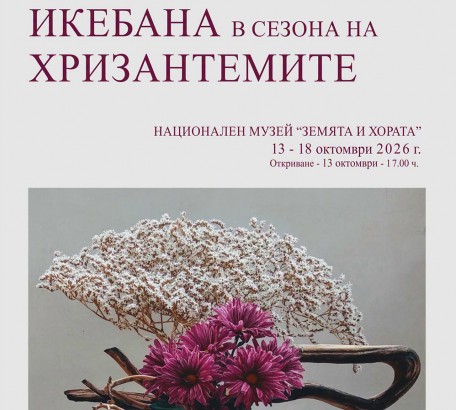 13.10.2026 - 18.10.2026
Exhibition "Ikebana in the Chrysanthemum Season"
13-18 October, from10:00 to 18:00 o'clock
Entrance with museum tickets
Entrance with museum tickets
Exhibitions
04.08.2026 - 21.10.2026
FRANCISCO GOYA - DREAMS OF A KEEN MIND
The Spaniard FRANCISCO GOYA (1746–1828) was one of the most prominent and influential creative figures in world culture. He produced over 1,000 paintings, as well as the graphic series titled Los Caprichos, Los Desastres de la Guerra, Tauromaquia, and Los Disparates.
His stylistic and philosophical spectrum had a strong influence on the subsequent dynamic development of art, defining him as the last of the Old Masters and one of the earliest of Modernism. His extensive output—paintings, graphics and drawings—served as a leading aesthetic principle for many artistic trends of the 19th and 20th centuries, including Impressionism, Expressionism and Surrealism.
The twenty-one prints from the National Gallery collection follow Goya’s development from his earliest etchings, influenced by Diego Velázquez’s style, to his peak achievements as a social interpreter, remarkable for his sharpness, and a chronicler of dour events and complex human characters. The high artistic level of his four graphic series has left a deep imprint on the history of art.
The National Gallery houses seven works from Los Caprichos (The Caprices) series, 1799. Satirising the institutional pillars of power, the church, the Inquisition, the parasitism of the feudal nobility, and the decay of the moral values of social classes, was the reason for the series to be banned from exhibiting.
Los Desastres de la Guerra (The Disasters of War) series, which Goya began ca. 1810, and returned to ca. 1820, was not published by the artist during his lifetime. One of the works is titled ‘Prisoner. The Custody Is as Barbarous as the Crime’. It is considered unique, as it is rarely found in other museum and private collections around the world.
La Tauromaquia (The Art of Bullfighting) series, probably created between 1815 and 1816, reflected the artist’s interest in bullfighting. These works combine the flagrant cruelty of the corrida and his admiration for the skill and exciting action of the games. Of the thirty-three prints in the series, the National Gallery owns five.
While still working on La Tauromaquia, the artist in all probability launched into another series titled Los Disparates (The Follies), the meaning in his time being along the lines of stupidity or madness. The fantastic compositions are encrypted allegories whose impressive depth fascinated artists such as Baudelaire, Hugo, and Delacroix. The National Gallery’s collection houses four of those; two of them—‘Little Bulls’ Folly’ and ‘A Way of Flying’—are emblematic of the artist’s genius.
The National Gallery also owns the etching ‘Blind Singer’, emotionally described by Nikolay Raynov, in his ‘History of the Plastic Arts’ (1939), as ‘first’ among the ‘curious and significant’ graphic works of Goya.
The exhibition also includes a work by the Spanish surrealist artist, Salvador Dali (1904–1989), dedicated to Goya and his Caprichos.
His stylistic and philosophical spectrum had a strong influence on the subsequent dynamic development of art, defining him as the last of the Old Masters and one of the earliest of Modernism. His extensive output—paintings, graphics and drawings—served as a leading aesthetic principle for many artistic trends of the 19th and 20th centuries, including Impressionism, Expressionism and Surrealism.
The twenty-one prints from the National Gallery collection follow Goya’s development from his earliest etchings, influenced by Diego Velázquez’s style, to his peak achievements as a social interpreter, remarkable for his sharpness, and a chronicler of dour events and complex human characters. The high artistic level of his four graphic series has left a deep imprint on the history of art.
The National Gallery houses seven works from Los Caprichos (The Caprices) series, 1799. Satirising the institutional pillars of power, the church, the Inquisition, the parasitism of the feudal nobility, and the decay of the moral values of social classes, was the reason for the series to be banned from exhibiting.
Los Desastres de la Guerra (The Disasters of War) series, which Goya began ca. 1810, and returned to ca. 1820, was not published by the artist during his lifetime. One of the works is titled ‘Prisoner. The Custody Is as Barbarous as the Crime’. It is considered unique, as it is rarely found in other museum and private collections around the world.
La Tauromaquia (The Art of Bullfighting) series, probably created between 1815 and 1816, reflected the artist’s interest in bullfighting. These works combine the flagrant cruelty of the corrida and his admiration for the skill and exciting action of the games. Of the thirty-three prints in the series, the National Gallery owns five.
While still working on La Tauromaquia, the artist in all probability launched into another series titled Los Disparates (The Follies), the meaning in his time being along the lines of stupidity or madness. The fantastic compositions are encrypted allegories whose impressive depth fascinated artists such as Baudelaire, Hugo, and Delacroix. The National Gallery’s collection houses four of those; two of them—‘Little Bulls’ Folly’ and ‘A Way of Flying’—are emblematic of the artist’s genius.
The National Gallery also owns the etching ‘Blind Singer’, emotionally described by Nikolay Raynov, in his ‘History of the Plastic Arts’ (1939), as ‘first’ among the ‘curious and significant’ graphic works of Goya.
The exhibition also includes a work by the Spanish surrealist artist, Salvador Dali (1904–1989), dedicated to Goya and his Caprichos.
Exhibitions
23.09.2026 - 18.11.2026
Piano Extravaganza Festival 2026
Within this year’s edition, Piano Extravaganza Festival will present four piano recitals and two chamber music concerts. We hope that our extraordinary artists and the variety of the repertoire for those 6 events would satisfy even the most sophisticated connoisseur. We would be delighted to welcome you at the wonderful venues of the Central Military Club and the “Bulgaria” Chamber Hall in Sofia!
Tickets at EVENTIM.
Tickets at EVENTIM.
Festivals
16.06.2026 - 16.06.2027
Temporary Exhibition New Acquisitions
from 10:00 to 18:00 o'clock
Entrance with museum tickets
Entrance with museum tickets
Exhibitions
12.02.2026 - 31.12.2026
Temporary exhibition "Copper - Ancient and Modern"
from 10:00 to 18:00 o'clock
Entrance with museum tickets.
Entrance with museum tickets.
Exhibitions
11.04.2025 - 31.12.2026
Temporary exhibition "Minerals and Colorful Creatures. Drawings by Nature"
The Minerals of Bulgaria exposition has been expanded with a new theme: Unique mineral finds from Bulgaria, a project financed by the Ministry of culture. In 6 display cases, minerals with the most beautiful crystals, rare colors and shapes are exhibited, selected for tens of years by hundreds of geologists and collectors from all over Bulgaria.
from 10:00 to 18:00 o'clock
Entrance with museum tickets
from 10:00 to 18:00 o'clock
Entrance with museum tickets
Exhibitions
01.04.2026 - 31.12.2026
Temporary exhibition "Natural Art from Chalcedony"
from 10:00 to 18:00 o'clock
Entrance with museum tickets.
Entrance with museum tickets.
Exhibitions
01.01.2023 - 31.12.2026
Temporary exhibition "Smart Minerals for Smartphones"
from 10:00 to 18:00 o'clock
Entrance with museum tickets.
Entrance with museum tickets.
Exhibitions
10.12.2025 - 30.01.2027
Zahari Zograph Immersive Exhibition
The National Gallery presents one of the most iconic figures in the history of Bulgarian art – Zahari Zograph. This first immersive exhibition introduces a new way of experiencing the masterpieces of the the museum’s collection. Harnessing new technologies, the 20-minute project, created by Senzor Studio, brings his religious and secular masterpieces to life, revealing essential elements of his creative process.
The initiative promotes Bulgarian Revival аrt, a period characterized by economic, social, and cultural growth, closely tied to the pursuit of ecclesiastical and national independence. The period traces its origins to the mid-18th century, when Paisius of Hilendar wrote Istoriya Slavyanobulgarskaya (History of the Slavs and Bulgarians) in 1762—which profoundly shaped the spiritual awakening of the population and contributed significantly to the development of national consciousness…
The exhibition features a selection of icons, drawings, copies, letters, documents, and secular portraits from the artist’s early period. It also showcases a substantive collection of murals, ranging from his earliest works—created in 1838 for the Chapel of St John the Baptist at the Church of the Holy Virgin—Annunciation in Asenovgrad—to what is considered as his “final masterpiece,” the murals adorning the narthex of the Great Lavra Monastery on Mount Athos, completed between 1851 and 1852.
Zahari Zograph emerged as a defining figure of Bulgarian Revival art. His relentlessly inquisitive artistic spirit was ahead of its era, and his extensive body of work reflects the vitality of the approaching modern age, the artistry of traditional imagery, the strength of line, and the emotive power of color.
The project is realised with the financial support of the National Culture Fund of Bulgaria under the Creation programme 2024.
Media partners: BTA / Bulgarian News Agency and SOF Connect.
The initiative promotes Bulgarian Revival аrt, a period characterized by economic, social, and cultural growth, closely tied to the pursuit of ecclesiastical and national independence. The period traces its origins to the mid-18th century, when Paisius of Hilendar wrote Istoriya Slavyanobulgarskaya (History of the Slavs and Bulgarians) in 1762—which profoundly shaped the spiritual awakening of the population and contributed significantly to the development of national consciousness…
The exhibition features a selection of icons, drawings, copies, letters, documents, and secular portraits from the artist’s early period. It also showcases a substantive collection of murals, ranging from his earliest works—created in 1838 for the Chapel of St John the Baptist at the Church of the Holy Virgin—Annunciation in Asenovgrad—to what is considered as his “final masterpiece,” the murals adorning the narthex of the Great Lavra Monastery on Mount Athos, completed between 1851 and 1852.
Zahari Zograph emerged as a defining figure of Bulgarian Revival art. His relentlessly inquisitive artistic spirit was ahead of its era, and his extensive body of work reflects the vitality of the approaching modern age, the artistry of traditional imagery, the strength of line, and the emotive power of color.
The project is realised with the financial support of the National Culture Fund of Bulgaria under the Creation programme 2024.
Media partners: BTA / Bulgarian News Agency and SOF Connect.
Exhibitions
 14.10.2026 - 30.10.2026
Andrey Yanev. Blue Mind – States of Watercolour
opening: 14 October, Wednesday, 6:00 p.m.
The term Blue Mind describes that particular state of hushed attentiveness experienced in the presence of water. Among Andrey Yanev’s watercolours, it hardly needs explanation.
Water, horizon, light and the transparency of colour draw the viewer into a different sense of time – a time of spreading and receding, of quiet inward movement.
The exhibition Blue Mind – States of Watercolour turns towards a natural realm within the artist’s visual world, one in which the sensibility of someone born by the sea quietly surfaces. In Yanev’s watercolours, the sea becomes a space in which seeing gradually turns into contemplation.
It is no coincidence, then, that the exhibition opens with works from the Portals series – works through which the noise of the city seems to subside and the narratives of everyday life to recede.
With this subtle shift in perception, the ‘blue mind’ begins to unfold through the slower rhythm of the main gallery, where the pauses are filled with music.
There, Andrey Yanev’s voice fills the space much as pigment spreads across the watercolours he has created over the past three decades – dissolving, leaving a trace, at times almost disappearing.
In the most recent works, created in 2026, this thread continues, while the artist’s language seems freer still. He seeks to capture the elusive – through Reflections, perhaps Between Two Cypresses, by looking Somewhere Beyond, or entering into Conversations with Infinity – while Blue Mind – States of Watercolour creates a space for stillness at the very heart of the city’s swirling autumn life.
+++
Curator: Elisaveta Stantcheva
Exhibition design: Petar Mitev
The term Blue Mind describes that particular state of hushed attentiveness experienced in the presence of water. Among Andrey Yanev’s watercolours, it hardly needs explanation.
Water, horizon, light and the transparency of colour draw the viewer into a different sense of time – a time of spreading and receding, of quiet inward movement.
The exhibition Blue Mind – States of Watercolour turns towards a natural realm within the artist’s visual world, one in which the sensibility of someone born by the sea quietly surfaces. In Yanev’s watercolours, the sea becomes a space in which seeing gradually turns into contemplation.
It is no coincidence, then, that the exhibition opens with works from the Portals series – works through which the noise of the city seems to subside and the narratives of everyday life to recede.
With this subtle shift in perception, the ‘blue mind’ begins to unfold through the slower rhythm of the main gallery, where the pauses are filled with music.
There, Andrey Yanev’s voice fills the space much as pigment spreads across the watercolours he has created over the past three decades – dissolving, leaving a trace, at times almost disappearing.
In the most recent works, created in 2026, this thread continues, while the artist’s language seems freer still. He seeks to capture the elusive – through Reflections, perhaps Between Two Cypresses, by looking Somewhere Beyond, or entering into Conversations with Infinity – while Blue Mind – States of Watercolour creates a space for stillness at the very heart of the city’s swirling autumn life.
+++
Curator: Elisaveta Stantcheva
Exhibition design: Petar Mitev
Exhibitions
18.09.2026 - 22.11.2026
DECHKO UZUNOV/IVAN PENKOV – DIRECTIONS
Memory Programme
DECHKO UZUNOV/IVAN PENKOV – DIRECTIONS
Opening: September 18, 6:00 p.m.
The exhibition Dechko Uzunov/Ivan Penkov: Directions is part of the Memory Programme at the Dechko Uzunov Art Gallery, a branch of the Sofia City Art Gallery, which aims to contribute to raising awareness of the life and work of Dechko Uzunov by presenting research-based exhibitions that reveal different aspects of his oeuvre through artists who were part of his journey. This exhibition showcases the different paths taken by two fellow townsmen and friends during the interwar period.
In 1919, Ivan Penkov and Dechko Uzunov enrolled at the State School of Drawing; that same year, Uzunov painted a portrait of his friend that poked fun at his fascination with folk art. Three years later, the two organised a joint exhibition in Sofia to fund their studies at the Munich Art Academy. The young artists’ exhibition was noticed by Joseph Herbst, who wrote:
“Now, on the occasion of their departure abroad, the two artists had exhibited most of their works, from which their strong talents could be seen quite well. Dechko Uzunov promises to develop most in portrait painting. [...] Ivan Penkov is primarily a decorator with a strong sense of composition and a keen sensitivity to line” (J.H., Razvigor, April 1, 1922, no. 60, p. 4).
In an ironic twist of fate, the older of the two, Penkov, would go on to graduate from the Academy of Art under Prof. Uzunov. In 1939, with Uzonov’s active support, Ivan Penkov won the competition for a permanent teaching position in decorative art.
The selected works invite us to seek similarities amidst the differences between these two constantly experimenting artists during the period when Bulgarian visual arts were coming of age.
Presented in this exhibition are pieces from the collections of the Sofia City Art Gallery, the Dechko Uzunov Art Gallery, the Kazanlak Art Gallery, the Central State Archives, and private collections.
The exhibition also features the film Ivan Penkov: The Crossed-Out Classic (Bulgarian National Television, 2006), by screenwriter: Oskar Kristanov; cinematographer: Yaroslav Yachev; directors: Oskar Kristanov and Kosta Bikov; sound engineer: Petar Yosifov; music arrangement: Georgi (Johnny) Penkov. Duration: 48 min.
DECHKO UZUNOV/IVAN PENKOV – DIRECTIONS
Opening: September 18, 6:00 p.m.
The exhibition Dechko Uzunov/Ivan Penkov: Directions is part of the Memory Programme at the Dechko Uzunov Art Gallery, a branch of the Sofia City Art Gallery, which aims to contribute to raising awareness of the life and work of Dechko Uzunov by presenting research-based exhibitions that reveal different aspects of his oeuvre through artists who were part of his journey. This exhibition showcases the different paths taken by two fellow townsmen and friends during the interwar period.
In 1919, Ivan Penkov and Dechko Uzunov enrolled at the State School of Drawing; that same year, Uzunov painted a portrait of his friend that poked fun at his fascination with folk art. Three years later, the two organised a joint exhibition in Sofia to fund their studies at the Munich Art Academy. The young artists’ exhibition was noticed by Joseph Herbst, who wrote:
“Now, on the occasion of their departure abroad, the two artists had exhibited most of their works, from which their strong talents could be seen quite well. Dechko Uzunov promises to develop most in portrait painting. [...] Ivan Penkov is primarily a decorator with a strong sense of composition and a keen sensitivity to line” (J.H., Razvigor, April 1, 1922, no. 60, p. 4).
In an ironic twist of fate, the older of the two, Penkov, would go on to graduate from the Academy of Art under Prof. Uzunov. In 1939, with Uzonov’s active support, Ivan Penkov won the competition for a permanent teaching position in decorative art.
The selected works invite us to seek similarities amidst the differences between these two constantly experimenting artists during the period when Bulgarian visual arts were coming of age.
Presented in this exhibition are pieces from the collections of the Sofia City Art Gallery, the Dechko Uzunov Art Gallery, the Kazanlak Art Gallery, the Central State Archives, and private collections.
The exhibition also features the film Ivan Penkov: The Crossed-Out Classic (Bulgarian National Television, 2006), by screenwriter: Oskar Kristanov; cinematographer: Yaroslav Yachev; directors: Oskar Kristanov and Kosta Bikov; sound engineer: Petar Yosifov; music arrangement: Georgi (Johnny) Penkov. Duration: 48 min.
Exhibitions
13.10.2026 - 18.10.2026
Exhibition "Ikebana in the Chrysanthemum Season"
13-18 October, from10:00 to 18:00 o'clock
Entrance with museum tickets
Entrance with museum tickets
Exhibitions
04.08.2026 - 21.10.2026
FRANCISCO GOYA - DREAMS OF A KEEN MIND
The Spaniard FRANCISCO GOYA (1746–1828) was one of the most prominent and influential creative figures in world culture. He produced over 1,000 paintings, as well as the graphic series titled Los Caprichos, Los Desastres de la Guerra, Tauromaquia, and Los Disparates.
His stylistic and philosophical spectrum had a strong influence on the subsequent dynamic development of art, defining him as the last of the Old Masters and one of the earliest of Modernism. His extensive output—paintings, graphics and drawings—served as a leading aesthetic principle for many artistic trends of the 19th and 20th centuries, including Impressionism, Expressionism and Surrealism.
The twenty-one prints from the National Gallery collection follow Goya’s development from his earliest etchings, influenced by Diego Velázquez’s style, to his peak achievements as a social interpreter, remarkable for his sharpness, and a chronicler of dour events and complex human characters. The high artistic level of his four graphic series has left a deep imprint on the history of art.
The National Gallery houses seven works from Los Caprichos (The Caprices) series, 1799. Satirising the institutional pillars of power, the church, the Inquisition, the parasitism of the feudal nobility, and the decay of the moral values of social classes, was the reason for the series to be banned from exhibiting.
Los Desastres de la Guerra (The Disasters of War) series, which Goya began ca. 1810, and returned to ca. 1820, was not published by the artist during his lifetime. One of the works is titled ‘Prisoner. The Custody Is as Barbarous as the Crime’. It is considered unique, as it is rarely found in other museum and private collections around the world.
La Tauromaquia (The Art of Bullfighting) series, probably created between 1815 and 1816, reflected the artist’s interest in bullfighting. These works combine the flagrant cruelty of the corrida and his admiration for the skill and exciting action of the games. Of the thirty-three prints in the series, the National Gallery owns five.
While still working on La Tauromaquia, the artist in all probability launched into another series titled Los Disparates (The Follies), the meaning in his time being along the lines of stupidity or madness. The fantastic compositions are encrypted allegories whose impressive depth fascinated artists such as Baudelaire, Hugo, and Delacroix. The National Gallery’s collection houses four of those; two of them—‘Little Bulls’ Folly’ and ‘A Way of Flying’—are emblematic of the artist’s genius.
The National Gallery also owns the etching ‘Blind Singer’, emotionally described by Nikolay Raynov, in his ‘History of the Plastic Arts’ (1939), as ‘first’ among the ‘curious and significant’ graphic works of Goya.
The exhibition also includes a work by the Spanish surrealist artist, Salvador Dali (1904–1989), dedicated to Goya and his Caprichos.
His stylistic and philosophical spectrum had a strong influence on the subsequent dynamic development of art, defining him as the last of the Old Masters and one of the earliest of Modernism. His extensive output—paintings, graphics and drawings—served as a leading aesthetic principle for many artistic trends of the 19th and 20th centuries, including Impressionism, Expressionism and Surrealism.
The twenty-one prints from the National Gallery collection follow Goya’s development from his earliest etchings, influenced by Diego Velázquez’s style, to his peak achievements as a social interpreter, remarkable for his sharpness, and a chronicler of dour events and complex human characters. The high artistic level of his four graphic series has left a deep imprint on the history of art.
The National Gallery houses seven works from Los Caprichos (The Caprices) series, 1799. Satirising the institutional pillars of power, the church, the Inquisition, the parasitism of the feudal nobility, and the decay of the moral values of social classes, was the reason for the series to be banned from exhibiting.
Los Desastres de la Guerra (The Disasters of War) series, which Goya began ca. 1810, and returned to ca. 1820, was not published by the artist during his lifetime. One of the works is titled ‘Prisoner. The Custody Is as Barbarous as the Crime’. It is considered unique, as it is rarely found in other museum and private collections around the world.
La Tauromaquia (The Art of Bullfighting) series, probably created between 1815 and 1816, reflected the artist’s interest in bullfighting. These works combine the flagrant cruelty of the corrida and his admiration for the skill and exciting action of the games. Of the thirty-three prints in the series, the National Gallery owns five.
While still working on La Tauromaquia, the artist in all probability launched into another series titled Los Disparates (The Follies), the meaning in his time being along the lines of stupidity or madness. The fantastic compositions are encrypted allegories whose impressive depth fascinated artists such as Baudelaire, Hugo, and Delacroix. The National Gallery’s collection houses four of those; two of them—‘Little Bulls’ Folly’ and ‘A Way of Flying’—are emblematic of the artist’s genius.
The National Gallery also owns the etching ‘Blind Singer’, emotionally described by Nikolay Raynov, in his ‘History of the Plastic Arts’ (1939), as ‘first’ among the ‘curious and significant’ graphic works of Goya.
The exhibition also includes a work by the Spanish surrealist artist, Salvador Dali (1904–1989), dedicated to Goya and his Caprichos.
Exhibitions
23.09.2026 - 18.11.2026
Piano Extravaganza Festival 2026
Within this year’s edition, Piano Extravaganza Festival will present four piano recitals and two chamber music concerts. We hope that our extraordinary artists and the variety of the repertoire for those 6 events would satisfy even the most sophisticated connoisseur. We would be delighted to welcome you at the wonderful venues of the Central Military Club and the “Bulgaria” Chamber Hall in Sofia!
Tickets at EVENTIM.
Tickets at EVENTIM.
Festivals
16.06.2026 - 16.06.2027
Temporary Exhibition New Acquisitions
from 10:00 to 18:00 o'clock
Entrance with museum tickets
Entrance with museum tickets
Exhibitions
12.02.2026 - 31.12.2026
Temporary exhibition "Copper - Ancient and Modern"
from 10:00 to 18:00 o'clock
Entrance with museum tickets.
Entrance with museum tickets.
Exhibitions
11.04.2025 - 31.12.2026
Temporary exhibition "Minerals and Colorful Creatures. Drawings by Nature"
The Minerals of Bulgaria exposition has been expanded with a new theme: Unique mineral finds from Bulgaria, a project financed by the Ministry of culture. In 6 display cases, minerals with the most beautiful crystals, rare colors and shapes are exhibited, selected for tens of years by hundreds of geologists and collectors from all over Bulgaria.
from 10:00 to 18:00 o'clock
Entrance with museum tickets
from 10:00 to 18:00 o'clock
Entrance with museum tickets
Exhibitions
01.04.2026 - 31.12.2026
Temporary exhibition "Natural Art from Chalcedony"
from 10:00 to 18:00 o'clock
Entrance with museum tickets.
Entrance with museum tickets.
Exhibitions
01.01.2023 - 31.12.2026
Temporary exhibition "Smart Minerals for Smartphones"
from 10:00 to 18:00 o'clock
Entrance with museum tickets.
Entrance with museum tickets.
Exhibitions
10.12.2025 - 30.01.2027
Zahari Zograph Immersive Exhibition
The National Gallery presents one of the most iconic figures in the history of Bulgarian art – Zahari Zograph. This first immersive exhibition introduces a new way of experiencing the masterpieces of the the museum’s collection. Harnessing new technologies, the 20-minute project, created by Senzor Studio, brings his religious and secular masterpieces to life, revealing essential elements of his creative process.
The initiative promotes Bulgarian Revival аrt, a period characterized by economic, social, and cultural growth, closely tied to the pursuit of ecclesiastical and national independence. The period traces its origins to the mid-18th century, when Paisius of Hilendar wrote Istoriya Slavyanobulgarskaya (History of the Slavs and Bulgarians) in 1762—which profoundly shaped the spiritual awakening of the population and contributed significantly to the development of national consciousness…
The exhibition features a selection of icons, drawings, copies, letters, documents, and secular portraits from the artist’s early period. It also showcases a substantive collection of murals, ranging from his earliest works—created in 1838 for the Chapel of St John the Baptist at the Church of the Holy Virgin—Annunciation in Asenovgrad—to what is considered as his “final masterpiece,” the murals adorning the narthex of the Great Lavra Monastery on Mount Athos, completed between 1851 and 1852.
Zahari Zograph emerged as a defining figure of Bulgarian Revival art. His relentlessly inquisitive artistic spirit was ahead of its era, and his extensive body of work reflects the vitality of the approaching modern age, the artistry of traditional imagery, the strength of line, and the emotive power of color.
The project is realised with the financial support of the National Culture Fund of Bulgaria under the Creation programme 2024.
Media partners: BTA / Bulgarian News Agency and SOF Connect.
The initiative promotes Bulgarian Revival аrt, a period characterized by economic, social, and cultural growth, closely tied to the pursuit of ecclesiastical and national independence. The period traces its origins to the mid-18th century, when Paisius of Hilendar wrote Istoriya Slavyanobulgarskaya (History of the Slavs and Bulgarians) in 1762—which profoundly shaped the spiritual awakening of the population and contributed significantly to the development of national consciousness…
The exhibition features a selection of icons, drawings, copies, letters, documents, and secular portraits from the artist’s early period. It also showcases a substantive collection of murals, ranging from his earliest works—created in 1838 for the Chapel of St John the Baptist at the Church of the Holy Virgin—Annunciation in Asenovgrad—to what is considered as his “final masterpiece,” the murals adorning the narthex of the Great Lavra Monastery on Mount Athos, completed between 1851 and 1852.
Zahari Zograph emerged as a defining figure of Bulgarian Revival art. His relentlessly inquisitive artistic spirit was ahead of its era, and his extensive body of work reflects the vitality of the approaching modern age, the artistry of traditional imagery, the strength of line, and the emotive power of color.
The project is realised with the financial support of the National Culture Fund of Bulgaria under the Creation programme 2024.
Media partners: BTA / Bulgarian News Agency and SOF Connect.
Exhibitions
14.10.2026 - 30.10.2026
Andrey Yanev. Blue Mind – States of Watercolour
opening: 14 October, Wednesday, 6:00 p.m.
The term Blue Mind describes that particular state of hushed attentiveness experienced in the presence of water. Among Andrey Yanev’s watercolours, it hardly needs explanation.
Water, horizon, light and the transparency of colour draw the viewer into a different sense of time – a time of spreading and receding, of quiet inward movement.
The exhibition Blue Mind – States of Watercolour turns towards a natural realm within the artist’s visual world, one in which the sensibility of someone born by the sea quietly surfaces. In Yanev’s watercolours, the sea becomes a space in which seeing gradually turns into contemplation.
It is no coincidence, then, that the exhibition opens with works from the Portals series – works through which the noise of the city seems to subside and the narratives of everyday life to recede.
With this subtle shift in perception, the ‘blue mind’ begins to unfold through the slower rhythm of the main gallery, where the pauses are filled with music.
There, Andrey Yanev’s voice fills the space much as pigment spreads across the watercolours he has created over the past three decades – dissolving, leaving a trace, at times almost disappearing.
In the most recent works, created in 2026, this thread continues, while the artist’s language seems freer still. He seeks to capture the elusive – through Reflections, perhaps Between Two Cypresses, by looking Somewhere Beyond, or entering into Conversations with Infinity – while Blue Mind – States of Watercolour creates a space for stillness at the very heart of the city’s swirling autumn life.
+++
Curator: Elisaveta Stantcheva
Exhibition design: Petar Mitev
The term Blue Mind describes that particular state of hushed attentiveness experienced in the presence of water. Among Andrey Yanev’s watercolours, it hardly needs explanation.
Water, horizon, light and the transparency of colour draw the viewer into a different sense of time – a time of spreading and receding, of quiet inward movement.
The exhibition Blue Mind – States of Watercolour turns towards a natural realm within the artist’s visual world, one in which the sensibility of someone born by the sea quietly surfaces. In Yanev’s watercolours, the sea becomes a space in which seeing gradually turns into contemplation.
It is no coincidence, then, that the exhibition opens with works from the Portals series – works through which the noise of the city seems to subside and the narratives of everyday life to recede.
With this subtle shift in perception, the ‘blue mind’ begins to unfold through the slower rhythm of the main gallery, where the pauses are filled with music.
There, Andrey Yanev’s voice fills the space much as pigment spreads across the watercolours he has created over the past three decades – dissolving, leaving a trace, at times almost disappearing.
In the most recent works, created in 2026, this thread continues, while the artist’s language seems freer still. He seeks to capture the elusive – through Reflections, perhaps Between Two Cypresses, by looking Somewhere Beyond, or entering into Conversations with Infinity – while Blue Mind – States of Watercolour creates a space for stillness at the very heart of the city’s swirling autumn life.
+++
Curator: Elisaveta Stantcheva
Exhibition design: Petar Mitev
Exhibitions
18.09.2026 - 22.11.2026
DECHKO UZUNOV/IVAN PENKOV – DIRECTIONS
Memory Programme
DECHKO UZUNOV/IVAN PENKOV – DIRECTIONS
Opening: September 18, 6:00 p.m.
The exhibition Dechko Uzunov/Ivan Penkov: Directions is part of the Memory Programme at the Dechko Uzunov Art Gallery, a branch of the Sofia City Art Gallery, which aims to contribute to raising awareness of the life and work of Dechko Uzunov by presenting research-based exhibitions that reveal different aspects of his oeuvre through artists who were part of his journey. This exhibition showcases the different paths taken by two fellow townsmen and friends during the interwar period.
In 1919, Ivan Penkov and Dechko Uzunov enrolled at the State School of Drawing; that same year, Uzunov painted a portrait of his friend that poked fun at his fascination with folk art. Three years later, the two organised a joint exhibition in Sofia to fund their studies at the Munich Art Academy. The young artists’ exhibition was noticed by Joseph Herbst, who wrote:
“Now, on the occasion of their departure abroad, the two artists had exhibited most of their works, from which their strong talents could be seen quite well. Dechko Uzunov promises to develop most in portrait painting. [...] Ivan Penkov is primarily a decorator with a strong sense of composition and a keen sensitivity to line” (J.H., Razvigor, April 1, 1922, no. 60, p. 4).
In an ironic twist of fate, the older of the two, Penkov, would go on to graduate from the Academy of Art under Prof. Uzunov. In 1939, with Uzonov’s active support, Ivan Penkov won the competition for a permanent teaching position in decorative art.
The selected works invite us to seek similarities amidst the differences between these two constantly experimenting artists during the period when Bulgarian visual arts were coming of age.
Presented in this exhibition are pieces from the collections of the Sofia City Art Gallery, the Dechko Uzunov Art Gallery, the Kazanlak Art Gallery, the Central State Archives, and private collections.
The exhibition also features the film Ivan Penkov: The Crossed-Out Classic (Bulgarian National Television, 2006), by screenwriter: Oskar Kristanov; cinematographer: Yaroslav Yachev; directors: Oskar Kristanov and Kosta Bikov; sound engineer: Petar Yosifov; music arrangement: Georgi (Johnny) Penkov. Duration: 48 min.
DECHKO UZUNOV/IVAN PENKOV – DIRECTIONS
Opening: September 18, 6:00 p.m.
The exhibition Dechko Uzunov/Ivan Penkov: Directions is part of the Memory Programme at the Dechko Uzunov Art Gallery, a branch of the Sofia City Art Gallery, which aims to contribute to raising awareness of the life and work of Dechko Uzunov by presenting research-based exhibitions that reveal different aspects of his oeuvre through artists who were part of his journey. This exhibition showcases the different paths taken by two fellow townsmen and friends during the interwar period.
In 1919, Ivan Penkov and Dechko Uzunov enrolled at the State School of Drawing; that same year, Uzunov painted a portrait of his friend that poked fun at his fascination with folk art. Three years later, the two organised a joint exhibition in Sofia to fund their studies at the Munich Art Academy. The young artists’ exhibition was noticed by Joseph Herbst, who wrote:
“Now, on the occasion of their departure abroad, the two artists had exhibited most of their works, from which their strong talents could be seen quite well. Dechko Uzunov promises to develop most in portrait painting. [...] Ivan Penkov is primarily a decorator with a strong sense of composition and a keen sensitivity to line” (J.H., Razvigor, April 1, 1922, no. 60, p. 4).
In an ironic twist of fate, the older of the two, Penkov, would go on to graduate from the Academy of Art under Prof. Uzunov. In 1939, with Uzonov’s active support, Ivan Penkov won the competition for a permanent teaching position in decorative art.
The selected works invite us to seek similarities amidst the differences between these two constantly experimenting artists during the period when Bulgarian visual arts were coming of age.
Presented in this exhibition are pieces from the collections of the Sofia City Art Gallery, the Dechko Uzunov Art Gallery, the Kazanlak Art Gallery, the Central State Archives, and private collections.
The exhibition also features the film Ivan Penkov: The Crossed-Out Classic (Bulgarian National Television, 2006), by screenwriter: Oskar Kristanov; cinematographer: Yaroslav Yachev; directors: Oskar Kristanov and Kosta Bikov; sound engineer: Petar Yosifov; music arrangement: Georgi (Johnny) Penkov. Duration: 48 min.
Exhibitions
13.10.2026 - 18.10.2026
Exhibition "Ikebana in the Chrysanthemum Season"
13-18 October, from10:00 to 18:00 o'clock
Entrance with museum tickets
Entrance with museum tickets
Exhibitions
04.08.2026 - 21.10.2026
FRANCISCO GOYA - DREAMS OF A KEEN MIND
The Spaniard FRANCISCO GOYA (1746–1828) was one of the most prominent and influential creative figures in world culture. He produced over 1,000 paintings, as well as the graphic series titled Los Caprichos, Los Desastres de la Guerra, Tauromaquia, and Los Disparates.
His stylistic and philosophical spectrum had a strong influence on the subsequent dynamic development of art, defining him as the last of the Old Masters and one of the earliest of Modernism. His extensive output—paintings, graphics and drawings—served as a leading aesthetic principle for many artistic trends of the 19th and 20th centuries, including Impressionism, Expressionism and Surrealism.
The twenty-one prints from the National Gallery collection follow Goya’s development from his earliest etchings, influenced by Diego Velázquez’s style, to his peak achievements as a social interpreter, remarkable for his sharpness, and a chronicler of dour events and complex human characters. The high artistic level of his four graphic series has left a deep imprint on the history of art.
The National Gallery houses seven works from Los Caprichos (The Caprices) series, 1799. Satirising the institutional pillars of power, the church, the Inquisition, the parasitism of the feudal nobility, and the decay of the moral values of social classes, was the reason for the series to be banned from exhibiting.
Los Desastres de la Guerra (The Disasters of War) series, which Goya began ca. 1810, and returned to ca. 1820, was not published by the artist during his lifetime. One of the works is titled ‘Prisoner. The Custody Is as Barbarous as the Crime’. It is considered unique, as it is rarely found in other museum and private collections around the world.
La Tauromaquia (The Art of Bullfighting) series, probably created between 1815 and 1816, reflected the artist’s interest in bullfighting. These works combine the flagrant cruelty of the corrida and his admiration for the skill and exciting action of the games. Of the thirty-three prints in the series, the National Gallery owns five.
While still working on La Tauromaquia, the artist in all probability launched into another series titled Los Disparates (The Follies), the meaning in his time being along the lines of stupidity or madness. The fantastic compositions are encrypted allegories whose impressive depth fascinated artists such as Baudelaire, Hugo, and Delacroix. The National Gallery’s collection houses four of those; two of them—‘Little Bulls’ Folly’ and ‘A Way of Flying’—are emblematic of the artist’s genius.
The National Gallery also owns the etching ‘Blind Singer’, emotionally described by Nikolay Raynov, in his ‘History of the Plastic Arts’ (1939), as ‘first’ among the ‘curious and significant’ graphic works of Goya.
The exhibition also includes a work by the Spanish surrealist artist, Salvador Dali (1904–1989), dedicated to Goya and his Caprichos.
His stylistic and philosophical spectrum had a strong influence on the subsequent dynamic development of art, defining him as the last of the Old Masters and one of the earliest of Modernism. His extensive output—paintings, graphics and drawings—served as a leading aesthetic principle for many artistic trends of the 19th and 20th centuries, including Impressionism, Expressionism and Surrealism.
The twenty-one prints from the National Gallery collection follow Goya’s development from his earliest etchings, influenced by Diego Velázquez’s style, to his peak achievements as a social interpreter, remarkable for his sharpness, and a chronicler of dour events and complex human characters. The high artistic level of his four graphic series has left a deep imprint on the history of art.
The National Gallery houses seven works from Los Caprichos (The Caprices) series, 1799. Satirising the institutional pillars of power, the church, the Inquisition, the parasitism of the feudal nobility, and the decay of the moral values of social classes, was the reason for the series to be banned from exhibiting.
Los Desastres de la Guerra (The Disasters of War) series, which Goya began ca. 1810, and returned to ca. 1820, was not published by the artist during his lifetime. One of the works is titled ‘Prisoner. The Custody Is as Barbarous as the Crime’. It is considered unique, as it is rarely found in other museum and private collections around the world.
La Tauromaquia (The Art of Bullfighting) series, probably created between 1815 and 1816, reflected the artist’s interest in bullfighting. These works combine the flagrant cruelty of the corrida and his admiration for the skill and exciting action of the games. Of the thirty-three prints in the series, the National Gallery owns five.
While still working on La Tauromaquia, the artist in all probability launched into another series titled Los Disparates (The Follies), the meaning in his time being along the lines of stupidity or madness. The fantastic compositions are encrypted allegories whose impressive depth fascinated artists such as Baudelaire, Hugo, and Delacroix. The National Gallery’s collection houses four of those; two of them—‘Little Bulls’ Folly’ and ‘A Way of Flying’—are emblematic of the artist’s genius.
The National Gallery also owns the etching ‘Blind Singer’, emotionally described by Nikolay Raynov, in his ‘History of the Plastic Arts’ (1939), as ‘first’ among the ‘curious and significant’ graphic works of Goya.
The exhibition also includes a work by the Spanish surrealist artist, Salvador Dali (1904–1989), dedicated to Goya and his Caprichos.
Exhibitions
23.09.2026 - 18.11.2026
Piano Extravaganza Festival 2026
Within this year’s edition, Piano Extravaganza Festival will present four piano recitals and two chamber music concerts. We hope that our extraordinary artists and the variety of the repertoire for those 6 events would satisfy even the most sophisticated connoisseur. We would be delighted to welcome you at the wonderful venues of the Central Military Club and the “Bulgaria” Chamber Hall in Sofia!
Tickets at EVENTIM.
Tickets at EVENTIM.
Festivals
16.06.2026 - 16.06.2027
Temporary Exhibition New Acquisitions
from 10:00 to 18:00 o'clock
Entrance with museum tickets
Entrance with museum tickets
Exhibitions
12.02.2026 - 31.12.2026
Temporary exhibition "Copper - Ancient and Modern"
from 10:00 to 18:00 o'clock
Entrance with museum tickets.
Entrance with museum tickets.
Exhibitions
11.04.2025 - 31.12.2026
Temporary exhibition "Minerals and Colorful Creatures. Drawings by Nature"
The Minerals of Bulgaria exposition has been expanded with a new theme: Unique mineral finds from Bulgaria, a project financed by the Ministry of culture. In 6 display cases, minerals with the most beautiful crystals, rare colors and shapes are exhibited, selected for tens of years by hundreds of geologists and collectors from all over Bulgaria.
from 10:00 to 18:00 o'clock
Entrance with museum tickets
from 10:00 to 18:00 o'clock
Entrance with museum tickets
Exhibitions
01.04.2026 - 31.12.2026
Temporary exhibition "Natural Art from Chalcedony"
from 10:00 to 18:00 o'clock
Entrance with museum tickets.
Entrance with museum tickets.
Exhibitions
01.01.2023 - 31.12.2026
Temporary exhibition "Smart Minerals for Smartphones"
from 10:00 to 18:00 o'clock
Entrance with museum tickets.
Entrance with museum tickets.
Exhibitions
10.12.2025 - 30.01.2027
Zahari Zograph Immersive Exhibition
The National Gallery presents one of the most iconic figures in the history of Bulgarian art – Zahari Zograph. This first immersive exhibition introduces a new way of experiencing the masterpieces of the the museum’s collection. Harnessing new technologies, the 20-minute project, created by Senzor Studio, brings his religious and secular masterpieces to life, revealing essential elements of his creative process.
The initiative promotes Bulgarian Revival аrt, a period characterized by economic, social, and cultural growth, closely tied to the pursuit of ecclesiastical and national independence. The period traces its origins to the mid-18th century, when Paisius of Hilendar wrote Istoriya Slavyanobulgarskaya (History of the Slavs and Bulgarians) in 1762—which profoundly shaped the spiritual awakening of the population and contributed significantly to the development of national consciousness…
The exhibition features a selection of icons, drawings, copies, letters, documents, and secular portraits from the artist’s early period. It also showcases a substantive collection of murals, ranging from his earliest works—created in 1838 for the Chapel of St John the Baptist at the Church of the Holy Virgin—Annunciation in Asenovgrad—to what is considered as his “final masterpiece,” the murals adorning the narthex of the Great Lavra Monastery on Mount Athos, completed between 1851 and 1852.
Zahari Zograph emerged as a defining figure of Bulgarian Revival art. His relentlessly inquisitive artistic spirit was ahead of its era, and his extensive body of work reflects the vitality of the approaching modern age, the artistry of traditional imagery, the strength of line, and the emotive power of color.
The project is realised with the financial support of the National Culture Fund of Bulgaria under the Creation programme 2024.
Media partners: BTA / Bulgarian News Agency and SOF Connect.
The initiative promotes Bulgarian Revival аrt, a period characterized by economic, social, and cultural growth, closely tied to the pursuit of ecclesiastical and national independence. The period traces its origins to the mid-18th century, when Paisius of Hilendar wrote Istoriya Slavyanobulgarskaya (History of the Slavs and Bulgarians) in 1762—which profoundly shaped the spiritual awakening of the population and contributed significantly to the development of national consciousness…
The exhibition features a selection of icons, drawings, copies, letters, documents, and secular portraits from the artist’s early period. It also showcases a substantive collection of murals, ranging from his earliest works—created in 1838 for the Chapel of St John the Baptist at the Church of the Holy Virgin—Annunciation in Asenovgrad—to what is considered as his “final masterpiece,” the murals adorning the narthex of the Great Lavra Monastery on Mount Athos, completed between 1851 and 1852.
Zahari Zograph emerged as a defining figure of Bulgarian Revival art. His relentlessly inquisitive artistic spirit was ahead of its era, and his extensive body of work reflects the vitality of the approaching modern age, the artistry of traditional imagery, the strength of line, and the emotive power of color.
The project is realised with the financial support of the National Culture Fund of Bulgaria under the Creation programme 2024.
Media partners: BTA / Bulgarian News Agency and SOF Connect.
Exhibitions
 15.10.2026
Onutė Gražinytė & Nayden Todorov
Conductor
Nayden Todorov
Solоist/s
Onutė Gražinytė
Ensemble
Sofia Philharmonic Orchestra
Program
Robert Schumann – Concerto for Piano and Orchestra, оp.54
Clara Schumann- Concerto for Piano and Orchestra
Nayden Todorov
Solоist/s
Onutė Gražinytė
Ensemble
Sofia Philharmonic Orchestra
Program
Robert Schumann – Concerto for Piano and Orchestra, оp.54
Clara Schumann- Concerto for Piano and Orchestra
Music and Dance Events
14.10.2026 - 30.10.2026
Andrey Yanev. Blue Mind – States of Watercolour
opening: 14 October, Wednesday, 6:00 p.m.
The term Blue Mind describes that particular state of hushed attentiveness experienced in the presence of water. Among Andrey Yanev’s watercolours, it hardly needs explanation.
Water, horizon, light and the transparency of colour draw the viewer into a different sense of time – a time of spreading and receding, of quiet inward movement.
The exhibition Blue Mind – States of Watercolour turns towards a natural realm within the artist’s visual world, one in which the sensibility of someone born by the sea quietly surfaces. In Yanev’s watercolours, the sea becomes a space in which seeing gradually turns into contemplation.
It is no coincidence, then, that the exhibition opens with works from the Portals series – works through which the noise of the city seems to subside and the narratives of everyday life to recede.
With this subtle shift in perception, the ‘blue mind’ begins to unfold through the slower rhythm of the main gallery, where the pauses are filled with music.
There, Andrey Yanev’s voice fills the space much as pigment spreads across the watercolours he has created over the past three decades – dissolving, leaving a trace, at times almost disappearing.
In the most recent works, created in 2026, this thread continues, while the artist’s language seems freer still. He seeks to capture the elusive – through Reflections, perhaps Between Two Cypresses, by looking Somewhere Beyond, or entering into Conversations with Infinity – while Blue Mind – States of Watercolour creates a space for stillness at the very heart of the city’s swirling autumn life.
+++
Curator: Elisaveta Stantcheva
Exhibition design: Petar Mitev
The term Blue Mind describes that particular state of hushed attentiveness experienced in the presence of water. Among Andrey Yanev’s watercolours, it hardly needs explanation.
Water, horizon, light and the transparency of colour draw the viewer into a different sense of time – a time of spreading and receding, of quiet inward movement.
The exhibition Blue Mind – States of Watercolour turns towards a natural realm within the artist’s visual world, one in which the sensibility of someone born by the sea quietly surfaces. In Yanev’s watercolours, the sea becomes a space in which seeing gradually turns into contemplation.
It is no coincidence, then, that the exhibition opens with works from the Portals series – works through which the noise of the city seems to subside and the narratives of everyday life to recede.
With this subtle shift in perception, the ‘blue mind’ begins to unfold through the slower rhythm of the main gallery, where the pauses are filled with music.
There, Andrey Yanev’s voice fills the space much as pigment spreads across the watercolours he has created over the past three decades – dissolving, leaving a trace, at times almost disappearing.
In the most recent works, created in 2026, this thread continues, while the artist’s language seems freer still. He seeks to capture the elusive – through Reflections, perhaps Between Two Cypresses, by looking Somewhere Beyond, or entering into Conversations with Infinity – while Blue Mind – States of Watercolour creates a space for stillness at the very heart of the city’s swirling autumn life.
+++
Curator: Elisaveta Stantcheva
Exhibition design: Petar Mitev
Exhibitions
18.09.2026 - 22.11.2026
DECHKO UZUNOV/IVAN PENKOV – DIRECTIONS
Memory Programme
DECHKO UZUNOV/IVAN PENKOV – DIRECTIONS
Opening: September 18, 6:00 p.m.
The exhibition Dechko Uzunov/Ivan Penkov: Directions is part of the Memory Programme at the Dechko Uzunov Art Gallery, a branch of the Sofia City Art Gallery, which aims to contribute to raising awareness of the life and work of Dechko Uzunov by presenting research-based exhibitions that reveal different aspects of his oeuvre through artists who were part of his journey. This exhibition showcases the different paths taken by two fellow townsmen and friends during the interwar period.
In 1919, Ivan Penkov and Dechko Uzunov enrolled at the State School of Drawing; that same year, Uzunov painted a portrait of his friend that poked fun at his fascination with folk art. Three years later, the two organised a joint exhibition in Sofia to fund their studies at the Munich Art Academy. The young artists’ exhibition was noticed by Joseph Herbst, who wrote:
“Now, on the occasion of their departure abroad, the two artists had exhibited most of their works, from which their strong talents could be seen quite well. Dechko Uzunov promises to develop most in portrait painting. [...] Ivan Penkov is primarily a decorator with a strong sense of composition and a keen sensitivity to line” (J.H., Razvigor, April 1, 1922, no. 60, p. 4).
In an ironic twist of fate, the older of the two, Penkov, would go on to graduate from the Academy of Art under Prof. Uzunov. In 1939, with Uzonov’s active support, Ivan Penkov won the competition for a permanent teaching position in decorative art.
The selected works invite us to seek similarities amidst the differences between these two constantly experimenting artists during the period when Bulgarian visual arts were coming of age.
Presented in this exhibition are pieces from the collections of the Sofia City Art Gallery, the Dechko Uzunov Art Gallery, the Kazanlak Art Gallery, the Central State Archives, and private collections.
The exhibition also features the film Ivan Penkov: The Crossed-Out Classic (Bulgarian National Television, 2006), by screenwriter: Oskar Kristanov; cinematographer: Yaroslav Yachev; directors: Oskar Kristanov and Kosta Bikov; sound engineer: Petar Yosifov; music arrangement: Georgi (Johnny) Penkov. Duration: 48 min.
DECHKO UZUNOV/IVAN PENKOV – DIRECTIONS
Opening: September 18, 6:00 p.m.
The exhibition Dechko Uzunov/Ivan Penkov: Directions is part of the Memory Programme at the Dechko Uzunov Art Gallery, a branch of the Sofia City Art Gallery, which aims to contribute to raising awareness of the life and work of Dechko Uzunov by presenting research-based exhibitions that reveal different aspects of his oeuvre through artists who were part of his journey. This exhibition showcases the different paths taken by two fellow townsmen and friends during the interwar period.
In 1919, Ivan Penkov and Dechko Uzunov enrolled at the State School of Drawing; that same year, Uzunov painted a portrait of his friend that poked fun at his fascination with folk art. Three years later, the two organised a joint exhibition in Sofia to fund their studies at the Munich Art Academy. The young artists’ exhibition was noticed by Joseph Herbst, who wrote:
“Now, on the occasion of their departure abroad, the two artists had exhibited most of their works, from which their strong talents could be seen quite well. Dechko Uzunov promises to develop most in portrait painting. [...] Ivan Penkov is primarily a decorator with a strong sense of composition and a keen sensitivity to line” (J.H., Razvigor, April 1, 1922, no. 60, p. 4).
In an ironic twist of fate, the older of the two, Penkov, would go on to graduate from the Academy of Art under Prof. Uzunov. In 1939, with Uzonov’s active support, Ivan Penkov won the competition for a permanent teaching position in decorative art.
The selected works invite us to seek similarities amidst the differences between these two constantly experimenting artists during the period when Bulgarian visual arts were coming of age.
Presented in this exhibition are pieces from the collections of the Sofia City Art Gallery, the Dechko Uzunov Art Gallery, the Kazanlak Art Gallery, the Central State Archives, and private collections.
The exhibition also features the film Ivan Penkov: The Crossed-Out Classic (Bulgarian National Television, 2006), by screenwriter: Oskar Kristanov; cinematographer: Yaroslav Yachev; directors: Oskar Kristanov and Kosta Bikov; sound engineer: Petar Yosifov; music arrangement: Georgi (Johnny) Penkov. Duration: 48 min.
Exhibitions
13.10.2026 - 18.10.2026
Exhibition "Ikebana in the Chrysanthemum Season"
13-18 October, from10:00 to 18:00 o'clock
Entrance with museum tickets
Entrance with museum tickets
Exhibitions
04.08.2026 - 21.10.2026
FRANCISCO GOYA - DREAMS OF A KEEN MIND
The Spaniard FRANCISCO GOYA (1746–1828) was one of the most prominent and influential creative figures in world culture. He produced over 1,000 paintings, as well as the graphic series titled Los Caprichos, Los Desastres de la Guerra, Tauromaquia, and Los Disparates.
His stylistic and philosophical spectrum had a strong influence on the subsequent dynamic development of art, defining him as the last of the Old Masters and one of the earliest of Modernism. His extensive output—paintings, graphics and drawings—served as a leading aesthetic principle for many artistic trends of the 19th and 20th centuries, including Impressionism, Expressionism and Surrealism.
The twenty-one prints from the National Gallery collection follow Goya’s development from his earliest etchings, influenced by Diego Velázquez’s style, to his peak achievements as a social interpreter, remarkable for his sharpness, and a chronicler of dour events and complex human characters. The high artistic level of his four graphic series has left a deep imprint on the history of art.
The National Gallery houses seven works from Los Caprichos (The Caprices) series, 1799. Satirising the institutional pillars of power, the church, the Inquisition, the parasitism of the feudal nobility, and the decay of the moral values of social classes, was the reason for the series to be banned from exhibiting.
Los Desastres de la Guerra (The Disasters of War) series, which Goya began ca. 1810, and returned to ca. 1820, was not published by the artist during his lifetime. One of the works is titled ‘Prisoner. The Custody Is as Barbarous as the Crime’. It is considered unique, as it is rarely found in other museum and private collections around the world.
La Tauromaquia (The Art of Bullfighting) series, probably created between 1815 and 1816, reflected the artist’s interest in bullfighting. These works combine the flagrant cruelty of the corrida and his admiration for the skill and exciting action of the games. Of the thirty-three prints in the series, the National Gallery owns five.
While still working on La Tauromaquia, the artist in all probability launched into another series titled Los Disparates (The Follies), the meaning in his time being along the lines of stupidity or madness. The fantastic compositions are encrypted allegories whose impressive depth fascinated artists such as Baudelaire, Hugo, and Delacroix. The National Gallery’s collection houses four of those; two of them—‘Little Bulls’ Folly’ and ‘A Way of Flying’—are emblematic of the artist’s genius.
The National Gallery also owns the etching ‘Blind Singer’, emotionally described by Nikolay Raynov, in his ‘History of the Plastic Arts’ (1939), as ‘first’ among the ‘curious and significant’ graphic works of Goya.
The exhibition also includes a work by the Spanish surrealist artist, Salvador Dali (1904–1989), dedicated to Goya and his Caprichos.
His stylistic and philosophical spectrum had a strong influence on the subsequent dynamic development of art, defining him as the last of the Old Masters and one of the earliest of Modernism. His extensive output—paintings, graphics and drawings—served as a leading aesthetic principle for many artistic trends of the 19th and 20th centuries, including Impressionism, Expressionism and Surrealism.
The twenty-one prints from the National Gallery collection follow Goya’s development from his earliest etchings, influenced by Diego Velázquez’s style, to his peak achievements as a social interpreter, remarkable for his sharpness, and a chronicler of dour events and complex human characters. The high artistic level of his four graphic series has left a deep imprint on the history of art.
The National Gallery houses seven works from Los Caprichos (The Caprices) series, 1799. Satirising the institutional pillars of power, the church, the Inquisition, the parasitism of the feudal nobility, and the decay of the moral values of social classes, was the reason for the series to be banned from exhibiting.
Los Desastres de la Guerra (The Disasters of War) series, which Goya began ca. 1810, and returned to ca. 1820, was not published by the artist during his lifetime. One of the works is titled ‘Prisoner. The Custody Is as Barbarous as the Crime’. It is considered unique, as it is rarely found in other museum and private collections around the world.
La Tauromaquia (The Art of Bullfighting) series, probably created between 1815 and 1816, reflected the artist’s interest in bullfighting. These works combine the flagrant cruelty of the corrida and his admiration for the skill and exciting action of the games. Of the thirty-three prints in the series, the National Gallery owns five.
While still working on La Tauromaquia, the artist in all probability launched into another series titled Los Disparates (The Follies), the meaning in his time being along the lines of stupidity or madness. The fantastic compositions are encrypted allegories whose impressive depth fascinated artists such as Baudelaire, Hugo, and Delacroix. The National Gallery’s collection houses four of those; two of them—‘Little Bulls’ Folly’ and ‘A Way of Flying’—are emblematic of the artist’s genius.
The National Gallery also owns the etching ‘Blind Singer’, emotionally described by Nikolay Raynov, in his ‘History of the Plastic Arts’ (1939), as ‘first’ among the ‘curious and significant’ graphic works of Goya.
The exhibition also includes a work by the Spanish surrealist artist, Salvador Dali (1904–1989), dedicated to Goya and his Caprichos.
Exhibitions
23.09.2026 - 18.11.2026
Piano Extravaganza Festival 2026
Within this year’s edition, Piano Extravaganza Festival will present four piano recitals and two chamber music concerts. We hope that our extraordinary artists and the variety of the repertoire for those 6 events would satisfy even the most sophisticated connoisseur. We would be delighted to welcome you at the wonderful venues of the Central Military Club and the “Bulgaria” Chamber Hall in Sofia!
Tickets at EVENTIM.
Tickets at EVENTIM.
Festivals
16.06.2026 - 16.06.2027
Temporary Exhibition New Acquisitions
from 10:00 to 18:00 o'clock
Entrance with museum tickets
Entrance with museum tickets
Exhibitions
12.02.2026 - 31.12.2026
Temporary exhibition "Copper - Ancient and Modern"
from 10:00 to 18:00 o'clock
Entrance with museum tickets.
Entrance with museum tickets.
Exhibitions
11.04.2025 - 31.12.2026
Temporary exhibition "Minerals and Colorful Creatures. Drawings by Nature"
The Minerals of Bulgaria exposition has been expanded with a new theme: Unique mineral finds from Bulgaria, a project financed by the Ministry of culture. In 6 display cases, minerals with the most beautiful crystals, rare colors and shapes are exhibited, selected for tens of years by hundreds of geologists and collectors from all over Bulgaria.
from 10:00 to 18:00 o'clock
Entrance with museum tickets
from 10:00 to 18:00 o'clock
Entrance with museum tickets
Exhibitions
01.04.2026 - 31.12.2026
Temporary exhibition "Natural Art from Chalcedony"
from 10:00 to 18:00 o'clock
Entrance with museum tickets.
Entrance with museum tickets.
Exhibitions
01.01.2023 - 31.12.2026
Temporary exhibition "Smart Minerals for Smartphones"
from 10:00 to 18:00 o'clock
Entrance with museum tickets.
Entrance with museum tickets.
Exhibitions
10.12.2025 - 30.01.2027
Zahari Zograph Immersive Exhibition
The National Gallery presents one of the most iconic figures in the history of Bulgarian art – Zahari Zograph. This first immersive exhibition introduces a new way of experiencing the masterpieces of the the museum’s collection. Harnessing new technologies, the 20-minute project, created by Senzor Studio, brings his religious and secular masterpieces to life, revealing essential elements of his creative process.
The initiative promotes Bulgarian Revival аrt, a period characterized by economic, social, and cultural growth, closely tied to the pursuit of ecclesiastical and national independence. The period traces its origins to the mid-18th century, when Paisius of Hilendar wrote Istoriya Slavyanobulgarskaya (History of the Slavs and Bulgarians) in 1762—which profoundly shaped the spiritual awakening of the population and contributed significantly to the development of national consciousness…
The exhibition features a selection of icons, drawings, copies, letters, documents, and secular portraits from the artist’s early period. It also showcases a substantive collection of murals, ranging from his earliest works—created in 1838 for the Chapel of St John the Baptist at the Church of the Holy Virgin—Annunciation in Asenovgrad—to what is considered as his “final masterpiece,” the murals adorning the narthex of the Great Lavra Monastery on Mount Athos, completed between 1851 and 1852.
Zahari Zograph emerged as a defining figure of Bulgarian Revival art. His relentlessly inquisitive artistic spirit was ahead of its era, and his extensive body of work reflects the vitality of the approaching modern age, the artistry of traditional imagery, the strength of line, and the emotive power of color.
The project is realised with the financial support of the National Culture Fund of Bulgaria under the Creation programme 2024.
Media partners: BTA / Bulgarian News Agency and SOF Connect.
The initiative promotes Bulgarian Revival аrt, a period characterized by economic, social, and cultural growth, closely tied to the pursuit of ecclesiastical and national independence. The period traces its origins to the mid-18th century, when Paisius of Hilendar wrote Istoriya Slavyanobulgarskaya (History of the Slavs and Bulgarians) in 1762—which profoundly shaped the spiritual awakening of the population and contributed significantly to the development of national consciousness…
The exhibition features a selection of icons, drawings, copies, letters, documents, and secular portraits from the artist’s early period. It also showcases a substantive collection of murals, ranging from his earliest works—created in 1838 for the Chapel of St John the Baptist at the Church of the Holy Virgin—Annunciation in Asenovgrad—to what is considered as his “final masterpiece,” the murals adorning the narthex of the Great Lavra Monastery on Mount Athos, completed between 1851 and 1852.
Zahari Zograph emerged as a defining figure of Bulgarian Revival art. His relentlessly inquisitive artistic spirit was ahead of its era, and his extensive body of work reflects the vitality of the approaching modern age, the artistry of traditional imagery, the strength of line, and the emotive power of color.
The project is realised with the financial support of the National Culture Fund of Bulgaria under the Creation programme 2024.
Media partners: BTA / Bulgarian News Agency and SOF Connect.
Exhibitions
 17.10.2026
"20 Under 20", Class of 2026
"20 Under 20" is a ranking that recognizes, connects and promotes the most active and inspiring young people in Bulgaria under 20 years old.
Business Events
14.10.2026 - 30.10.2026
Andrey Yanev. Blue Mind – States of Watercolour
opening: 14 October, Wednesday, 6:00 p.m.
The term Blue Mind describes that particular state of hushed attentiveness experienced in the presence of water. Among Andrey Yanev’s watercolours, it hardly needs explanation.
Water, horizon, light and the transparency of colour draw the viewer into a different sense of time – a time of spreading and receding, of quiet inward movement.
The exhibition Blue Mind – States of Watercolour turns towards a natural realm within the artist’s visual world, one in which the sensibility of someone born by the sea quietly surfaces. In Yanev’s watercolours, the sea becomes a space in which seeing gradually turns into contemplation.
It is no coincidence, then, that the exhibition opens with works from the Portals series – works through which the noise of the city seems to subside and the narratives of everyday life to recede.
With this subtle shift in perception, the ‘blue mind’ begins to unfold through the slower rhythm of the main gallery, where the pauses are filled with music.
There, Andrey Yanev’s voice fills the space much as pigment spreads across the watercolours he has created over the past three decades – dissolving, leaving a trace, at times almost disappearing.
In the most recent works, created in 2026, this thread continues, while the artist’s language seems freer still. He seeks to capture the elusive – through Reflections, perhaps Between Two Cypresses, by looking Somewhere Beyond, or entering into Conversations with Infinity – while Blue Mind – States of Watercolour creates a space for stillness at the very heart of the city’s swirling autumn life.
+++
Curator: Elisaveta Stantcheva
Exhibition design: Petar Mitev
The term Blue Mind describes that particular state of hushed attentiveness experienced in the presence of water. Among Andrey Yanev’s watercolours, it hardly needs explanation.
Water, horizon, light and the transparency of colour draw the viewer into a different sense of time – a time of spreading and receding, of quiet inward movement.
The exhibition Blue Mind – States of Watercolour turns towards a natural realm within the artist’s visual world, one in which the sensibility of someone born by the sea quietly surfaces. In Yanev’s watercolours, the sea becomes a space in which seeing gradually turns into contemplation.
It is no coincidence, then, that the exhibition opens with works from the Portals series – works through which the noise of the city seems to subside and the narratives of everyday life to recede.
With this subtle shift in perception, the ‘blue mind’ begins to unfold through the slower rhythm of the main gallery, where the pauses are filled with music.
There, Andrey Yanev’s voice fills the space much as pigment spreads across the watercolours he has created over the past three decades – dissolving, leaving a trace, at times almost disappearing.
In the most recent works, created in 2026, this thread continues, while the artist’s language seems freer still. He seeks to capture the elusive – through Reflections, perhaps Between Two Cypresses, by looking Somewhere Beyond, or entering into Conversations with Infinity – while Blue Mind – States of Watercolour creates a space for stillness at the very heart of the city’s swirling autumn life.
+++
Curator: Elisaveta Stantcheva
Exhibition design: Petar Mitev
Exhibitions
18.09.2026 - 22.11.2026
DECHKO UZUNOV/IVAN PENKOV – DIRECTIONS
Memory Programme
DECHKO UZUNOV/IVAN PENKOV – DIRECTIONS
Opening: September 18, 6:00 p.m.
The exhibition Dechko Uzunov/Ivan Penkov: Directions is part of the Memory Programme at the Dechko Uzunov Art Gallery, a branch of the Sofia City Art Gallery, which aims to contribute to raising awareness of the life and work of Dechko Uzunov by presenting research-based exhibitions that reveal different aspects of his oeuvre through artists who were part of his journey. This exhibition showcases the different paths taken by two fellow townsmen and friends during the interwar period.
In 1919, Ivan Penkov and Dechko Uzunov enrolled at the State School of Drawing; that same year, Uzunov painted a portrait of his friend that poked fun at his fascination with folk art. Three years later, the two organised a joint exhibition in Sofia to fund their studies at the Munich Art Academy. The young artists’ exhibition was noticed by Joseph Herbst, who wrote:
“Now, on the occasion of their departure abroad, the two artists had exhibited most of their works, from which their strong talents could be seen quite well. Dechko Uzunov promises to develop most in portrait painting. [...] Ivan Penkov is primarily a decorator with a strong sense of composition and a keen sensitivity to line” (J.H., Razvigor, April 1, 1922, no. 60, p. 4).
In an ironic twist of fate, the older of the two, Penkov, would go on to graduate from the Academy of Art under Prof. Uzunov. In 1939, with Uzonov’s active support, Ivan Penkov won the competition for a permanent teaching position in decorative art.
The selected works invite us to seek similarities amidst the differences between these two constantly experimenting artists during the period when Bulgarian visual arts were coming of age.
Presented in this exhibition are pieces from the collections of the Sofia City Art Gallery, the Dechko Uzunov Art Gallery, the Kazanlak Art Gallery, the Central State Archives, and private collections.
The exhibition also features the film Ivan Penkov: The Crossed-Out Classic (Bulgarian National Television, 2006), by screenwriter: Oskar Kristanov; cinematographer: Yaroslav Yachev; directors: Oskar Kristanov and Kosta Bikov; sound engineer: Petar Yosifov; music arrangement: Georgi (Johnny) Penkov. Duration: 48 min.
DECHKO UZUNOV/IVAN PENKOV – DIRECTIONS
Opening: September 18, 6:00 p.m.
The exhibition Dechko Uzunov/Ivan Penkov: Directions is part of the Memory Programme at the Dechko Uzunov Art Gallery, a branch of the Sofia City Art Gallery, which aims to contribute to raising awareness of the life and work of Dechko Uzunov by presenting research-based exhibitions that reveal different aspects of his oeuvre through artists who were part of his journey. This exhibition showcases the different paths taken by two fellow townsmen and friends during the interwar period.
In 1919, Ivan Penkov and Dechko Uzunov enrolled at the State School of Drawing; that same year, Uzunov painted a portrait of his friend that poked fun at his fascination with folk art. Three years later, the two organised a joint exhibition in Sofia to fund their studies at the Munich Art Academy. The young artists’ exhibition was noticed by Joseph Herbst, who wrote:
“Now, on the occasion of their departure abroad, the two artists had exhibited most of their works, from which their strong talents could be seen quite well. Dechko Uzunov promises to develop most in portrait painting. [...] Ivan Penkov is primarily a decorator with a strong sense of composition and a keen sensitivity to line” (J.H., Razvigor, April 1, 1922, no. 60, p. 4).
In an ironic twist of fate, the older of the two, Penkov, would go on to graduate from the Academy of Art under Prof. Uzunov. In 1939, with Uzonov’s active support, Ivan Penkov won the competition for a permanent teaching position in decorative art.
The selected works invite us to seek similarities amidst the differences between these two constantly experimenting artists during the period when Bulgarian visual arts were coming of age.
Presented in this exhibition are pieces from the collections of the Sofia City Art Gallery, the Dechko Uzunov Art Gallery, the Kazanlak Art Gallery, the Central State Archives, and private collections.
The exhibition also features the film Ivan Penkov: The Crossed-Out Classic (Bulgarian National Television, 2006), by screenwriter: Oskar Kristanov; cinematographer: Yaroslav Yachev; directors: Oskar Kristanov and Kosta Bikov; sound engineer: Petar Yosifov; music arrangement: Georgi (Johnny) Penkov. Duration: 48 min.
Exhibitions
13.10.2026 - 18.10.2026
Exhibition "Ikebana in the Chrysanthemum Season"
13-18 October, from10:00 to 18:00 o'clock
Entrance with museum tickets
Entrance with museum tickets
Exhibitions
04.08.2026 - 21.10.2026
FRANCISCO GOYA - DREAMS OF A KEEN MIND
The Spaniard FRANCISCO GOYA (1746–1828) was one of the most prominent and influential creative figures in world culture. He produced over 1,000 paintings, as well as the graphic series titled Los Caprichos, Los Desastres de la Guerra, Tauromaquia, and Los Disparates.
His stylistic and philosophical spectrum had a strong influence on the subsequent dynamic development of art, defining him as the last of the Old Masters and one of the earliest of Modernism. His extensive output—paintings, graphics and drawings—served as a leading aesthetic principle for many artistic trends of the 19th and 20th centuries, including Impressionism, Expressionism and Surrealism.
The twenty-one prints from the National Gallery collection follow Goya’s development from his earliest etchings, influenced by Diego Velázquez’s style, to his peak achievements as a social interpreter, remarkable for his sharpness, and a chronicler of dour events and complex human characters. The high artistic level of his four graphic series has left a deep imprint on the history of art.
The National Gallery houses seven works from Los Caprichos (The Caprices) series, 1799. Satirising the institutional pillars of power, the church, the Inquisition, the parasitism of the feudal nobility, and the decay of the moral values of social classes, was the reason for the series to be banned from exhibiting.
Los Desastres de la Guerra (The Disasters of War) series, which Goya began ca. 1810, and returned to ca. 1820, was not published by the artist during his lifetime. One of the works is titled ‘Prisoner. The Custody Is as Barbarous as the Crime’. It is considered unique, as it is rarely found in other museum and private collections around the world.
La Tauromaquia (The Art of Bullfighting) series, probably created between 1815 and 1816, reflected the artist’s interest in bullfighting. These works combine the flagrant cruelty of the corrida and his admiration for the skill and exciting action of the games. Of the thirty-three prints in the series, the National Gallery owns five.
While still working on La Tauromaquia, the artist in all probability launched into another series titled Los Disparates (The Follies), the meaning in his time being along the lines of stupidity or madness. The fantastic compositions are encrypted allegories whose impressive depth fascinated artists such as Baudelaire, Hugo, and Delacroix. The National Gallery’s collection houses four of those; two of them—‘Little Bulls’ Folly’ and ‘A Way of Flying’—are emblematic of the artist’s genius.
The National Gallery also owns the etching ‘Blind Singer’, emotionally described by Nikolay Raynov, in his ‘History of the Plastic Arts’ (1939), as ‘first’ among the ‘curious and significant’ graphic works of Goya.
The exhibition also includes a work by the Spanish surrealist artist, Salvador Dali (1904–1989), dedicated to Goya and his Caprichos.
His stylistic and philosophical spectrum had a strong influence on the subsequent dynamic development of art, defining him as the last of the Old Masters and one of the earliest of Modernism. His extensive output—paintings, graphics and drawings—served as a leading aesthetic principle for many artistic trends of the 19th and 20th centuries, including Impressionism, Expressionism and Surrealism.
The twenty-one prints from the National Gallery collection follow Goya’s development from his earliest etchings, influenced by Diego Velázquez’s style, to his peak achievements as a social interpreter, remarkable for his sharpness, and a chronicler of dour events and complex human characters. The high artistic level of his four graphic series has left a deep imprint on the history of art.
The National Gallery houses seven works from Los Caprichos (The Caprices) series, 1799. Satirising the institutional pillars of power, the church, the Inquisition, the parasitism of the feudal nobility, and the decay of the moral values of social classes, was the reason for the series to be banned from exhibiting.
Los Desastres de la Guerra (The Disasters of War) series, which Goya began ca. 1810, and returned to ca. 1820, was not published by the artist during his lifetime. One of the works is titled ‘Prisoner. The Custody Is as Barbarous as the Crime’. It is considered unique, as it is rarely found in other museum and private collections around the world.
La Tauromaquia (The Art of Bullfighting) series, probably created between 1815 and 1816, reflected the artist’s interest in bullfighting. These works combine the flagrant cruelty of the corrida and his admiration for the skill and exciting action of the games. Of the thirty-three prints in the series, the National Gallery owns five.
While still working on La Tauromaquia, the artist in all probability launched into another series titled Los Disparates (The Follies), the meaning in his time being along the lines of stupidity or madness. The fantastic compositions are encrypted allegories whose impressive depth fascinated artists such as Baudelaire, Hugo, and Delacroix. The National Gallery’s collection houses four of those; two of them—‘Little Bulls’ Folly’ and ‘A Way of Flying’—are emblematic of the artist’s genius.
The National Gallery also owns the etching ‘Blind Singer’, emotionally described by Nikolay Raynov, in his ‘History of the Plastic Arts’ (1939), as ‘first’ among the ‘curious and significant’ graphic works of Goya.
The exhibition also includes a work by the Spanish surrealist artist, Salvador Dali (1904–1989), dedicated to Goya and his Caprichos.
Exhibitions
23.09.2026 - 18.11.2026
Piano Extravaganza Festival 2026
Within this year’s edition, Piano Extravaganza Festival will present four piano recitals and two chamber music concerts. We hope that our extraordinary artists and the variety of the repertoire for those 6 events would satisfy even the most sophisticated connoisseur. We would be delighted to welcome you at the wonderful venues of the Central Military Club and the “Bulgaria” Chamber Hall in Sofia!
Tickets at EVENTIM.
Tickets at EVENTIM.
Festivals
16.06.2026 - 16.06.2027
Temporary Exhibition New Acquisitions
from 10:00 to 18:00 o'clock
Entrance with museum tickets
Entrance with museum tickets
Exhibitions
12.02.2026 - 31.12.2026
Temporary exhibition "Copper - Ancient and Modern"
from 10:00 to 18:00 o'clock
Entrance with museum tickets.
Entrance with museum tickets.
Exhibitions
11.04.2025 - 31.12.2026
Temporary exhibition "Minerals and Colorful Creatures. Drawings by Nature"
The Minerals of Bulgaria exposition has been expanded with a new theme: Unique mineral finds from Bulgaria, a project financed by the Ministry of culture. In 6 display cases, minerals with the most beautiful crystals, rare colors and shapes are exhibited, selected for tens of years by hundreds of geologists and collectors from all over Bulgaria.
from 10:00 to 18:00 o'clock
Entrance with museum tickets
from 10:00 to 18:00 o'clock
Entrance with museum tickets
Exhibitions
01.04.2026 - 31.12.2026
Temporary exhibition "Natural Art from Chalcedony"
from 10:00 to 18:00 o'clock
Entrance with museum tickets.
Entrance with museum tickets.
Exhibitions
01.01.2023 - 31.12.2026
Temporary exhibition "Smart Minerals for Smartphones"
from 10:00 to 18:00 o'clock
Entrance with museum tickets.
Entrance with museum tickets.
Exhibitions
10.12.2025 - 30.01.2027
Zahari Zograph Immersive Exhibition
The National Gallery presents one of the most iconic figures in the history of Bulgarian art – Zahari Zograph. This first immersive exhibition introduces a new way of experiencing the masterpieces of the the museum’s collection. Harnessing new technologies, the 20-minute project, created by Senzor Studio, brings his religious and secular masterpieces to life, revealing essential elements of his creative process.
The initiative promotes Bulgarian Revival аrt, a period characterized by economic, social, and cultural growth, closely tied to the pursuit of ecclesiastical and national independence. The period traces its origins to the mid-18th century, when Paisius of Hilendar wrote Istoriya Slavyanobulgarskaya (History of the Slavs and Bulgarians) in 1762—which profoundly shaped the spiritual awakening of the population and contributed significantly to the development of national consciousness…
The exhibition features a selection of icons, drawings, copies, letters, documents, and secular portraits from the artist’s early period. It also showcases a substantive collection of murals, ranging from his earliest works—created in 1838 for the Chapel of St John the Baptist at the Church of the Holy Virgin—Annunciation in Asenovgrad—to what is considered as his “final masterpiece,” the murals adorning the narthex of the Great Lavra Monastery on Mount Athos, completed between 1851 and 1852.
Zahari Zograph emerged as a defining figure of Bulgarian Revival art. His relentlessly inquisitive artistic spirit was ahead of its era, and his extensive body of work reflects the vitality of the approaching modern age, the artistry of traditional imagery, the strength of line, and the emotive power of color.
The project is realised with the financial support of the National Culture Fund of Bulgaria under the Creation programme 2024.
Media partners: BTA / Bulgarian News Agency and SOF Connect.
The initiative promotes Bulgarian Revival аrt, a period characterized by economic, social, and cultural growth, closely tied to the pursuit of ecclesiastical and national independence. The period traces its origins to the mid-18th century, when Paisius of Hilendar wrote Istoriya Slavyanobulgarskaya (History of the Slavs and Bulgarians) in 1762—which profoundly shaped the spiritual awakening of the population and contributed significantly to the development of national consciousness…
The exhibition features a selection of icons, drawings, copies, letters, documents, and secular portraits from the artist’s early period. It also showcases a substantive collection of murals, ranging from his earliest works—created in 1838 for the Chapel of St John the Baptist at the Church of the Holy Virgin—Annunciation in Asenovgrad—to what is considered as his “final masterpiece,” the murals adorning the narthex of the Great Lavra Monastery on Mount Athos, completed between 1851 and 1852.
Zahari Zograph emerged as a defining figure of Bulgarian Revival art. His relentlessly inquisitive artistic spirit was ahead of its era, and his extensive body of work reflects the vitality of the approaching modern age, the artistry of traditional imagery, the strength of line, and the emotive power of color.
The project is realised with the financial support of the National Culture Fund of Bulgaria under the Creation programme 2024.
Media partners: BTA / Bulgarian News Agency and SOF Connect.
Exhibitions
 17.10.2026
THE HERMIT OF RILA
Musical Poem by Father Kiril Popov
THE HERMIT OF RILA / Duration 2:00
Main Hall
Children under 6 are not admitted to adult performances!
Performed in Bulgarian, with English subtitles.
THE HERMIT OF RILA / Duration 2:00
Main Hall
Children under 6 are not admitted to adult performances!
Performed in Bulgarian, with English subtitles.
Music and Dance Events
14.10.2026 - 30.10.2026
Andrey Yanev. Blue Mind – States of Watercolour
opening: 14 October, Wednesday, 6:00 p.m.
The term Blue Mind describes that particular state of hushed attentiveness experienced in the presence of water. Among Andrey Yanev’s watercolours, it hardly needs explanation.
Water, horizon, light and the transparency of colour draw the viewer into a different sense of time – a time of spreading and receding, of quiet inward movement.
The exhibition Blue Mind – States of Watercolour turns towards a natural realm within the artist’s visual world, one in which the sensibility of someone born by the sea quietly surfaces. In Yanev’s watercolours, the sea becomes a space in which seeing gradually turns into contemplation.
It is no coincidence, then, that the exhibition opens with works from the Portals series – works through which the noise of the city seems to subside and the narratives of everyday life to recede.
With this subtle shift in perception, the ‘blue mind’ begins to unfold through the slower rhythm of the main gallery, where the pauses are filled with music.
There, Andrey Yanev’s voice fills the space much as pigment spreads across the watercolours he has created over the past three decades – dissolving, leaving a trace, at times almost disappearing.
In the most recent works, created in 2026, this thread continues, while the artist’s language seems freer still. He seeks to capture the elusive – through Reflections, perhaps Between Two Cypresses, by looking Somewhere Beyond, or entering into Conversations with Infinity – while Blue Mind – States of Watercolour creates a space for stillness at the very heart of the city’s swirling autumn life.
+++
Curator: Elisaveta Stantcheva
Exhibition design: Petar Mitev
The term Blue Mind describes that particular state of hushed attentiveness experienced in the presence of water. Among Andrey Yanev’s watercolours, it hardly needs explanation.
Water, horizon, light and the transparency of colour draw the viewer into a different sense of time – a time of spreading and receding, of quiet inward movement.
The exhibition Blue Mind – States of Watercolour turns towards a natural realm within the artist’s visual world, one in which the sensibility of someone born by the sea quietly surfaces. In Yanev’s watercolours, the sea becomes a space in which seeing gradually turns into contemplation.
It is no coincidence, then, that the exhibition opens with works from the Portals series – works through which the noise of the city seems to subside and the narratives of everyday life to recede.
With this subtle shift in perception, the ‘blue mind’ begins to unfold through the slower rhythm of the main gallery, where the pauses are filled with music.
There, Andrey Yanev’s voice fills the space much as pigment spreads across the watercolours he has created over the past three decades – dissolving, leaving a trace, at times almost disappearing.
In the most recent works, created in 2026, this thread continues, while the artist’s language seems freer still. He seeks to capture the elusive – through Reflections, perhaps Between Two Cypresses, by looking Somewhere Beyond, or entering into Conversations with Infinity – while Blue Mind – States of Watercolour creates a space for stillness at the very heart of the city’s swirling autumn life.
+++
Curator: Elisaveta Stantcheva
Exhibition design: Petar Mitev
Exhibitions
18.09.2026 - 22.11.2026
DECHKO UZUNOV/IVAN PENKOV – DIRECTIONS
Memory Programme
DECHKO UZUNOV/IVAN PENKOV – DIRECTIONS
Opening: September 18, 6:00 p.m.
The exhibition Dechko Uzunov/Ivan Penkov: Directions is part of the Memory Programme at the Dechko Uzunov Art Gallery, a branch of the Sofia City Art Gallery, which aims to contribute to raising awareness of the life and work of Dechko Uzunov by presenting research-based exhibitions that reveal different aspects of his oeuvre through artists who were part of his journey. This exhibition showcases the different paths taken by two fellow townsmen and friends during the interwar period.
In 1919, Ivan Penkov and Dechko Uzunov enrolled at the State School of Drawing; that same year, Uzunov painted a portrait of his friend that poked fun at his fascination with folk art. Three years later, the two organised a joint exhibition in Sofia to fund their studies at the Munich Art Academy. The young artists’ exhibition was noticed by Joseph Herbst, who wrote:
“Now, on the occasion of their departure abroad, the two artists had exhibited most of their works, from which their strong talents could be seen quite well. Dechko Uzunov promises to develop most in portrait painting. [...] Ivan Penkov is primarily a decorator with a strong sense of composition and a keen sensitivity to line” (J.H., Razvigor, April 1, 1922, no. 60, p. 4).
In an ironic twist of fate, the older of the two, Penkov, would go on to graduate from the Academy of Art under Prof. Uzunov. In 1939, with Uzonov’s active support, Ivan Penkov won the competition for a permanent teaching position in decorative art.
The selected works invite us to seek similarities amidst the differences between these two constantly experimenting artists during the period when Bulgarian visual arts were coming of age.
Presented in this exhibition are pieces from the collections of the Sofia City Art Gallery, the Dechko Uzunov Art Gallery, the Kazanlak Art Gallery, the Central State Archives, and private collections.
The exhibition also features the film Ivan Penkov: The Crossed-Out Classic (Bulgarian National Television, 2006), by screenwriter: Oskar Kristanov; cinematographer: Yaroslav Yachev; directors: Oskar Kristanov and Kosta Bikov; sound engineer: Petar Yosifov; music arrangement: Georgi (Johnny) Penkov. Duration: 48 min.
DECHKO UZUNOV/IVAN PENKOV – DIRECTIONS
Opening: September 18, 6:00 p.m.
The exhibition Dechko Uzunov/Ivan Penkov: Directions is part of the Memory Programme at the Dechko Uzunov Art Gallery, a branch of the Sofia City Art Gallery, which aims to contribute to raising awareness of the life and work of Dechko Uzunov by presenting research-based exhibitions that reveal different aspects of his oeuvre through artists who were part of his journey. This exhibition showcases the different paths taken by two fellow townsmen and friends during the interwar period.
In 1919, Ivan Penkov and Dechko Uzunov enrolled at the State School of Drawing; that same year, Uzunov painted a portrait of his friend that poked fun at his fascination with folk art. Three years later, the two organised a joint exhibition in Sofia to fund their studies at the Munich Art Academy. The young artists’ exhibition was noticed by Joseph Herbst, who wrote:
“Now, on the occasion of their departure abroad, the two artists had exhibited most of their works, from which their strong talents could be seen quite well. Dechko Uzunov promises to develop most in portrait painting. [...] Ivan Penkov is primarily a decorator with a strong sense of composition and a keen sensitivity to line” (J.H., Razvigor, April 1, 1922, no. 60, p. 4).
In an ironic twist of fate, the older of the two, Penkov, would go on to graduate from the Academy of Art under Prof. Uzunov. In 1939, with Uzonov’s active support, Ivan Penkov won the competition for a permanent teaching position in decorative art.
The selected works invite us to seek similarities amidst the differences between these two constantly experimenting artists during the period when Bulgarian visual arts were coming of age.
Presented in this exhibition are pieces from the collections of the Sofia City Art Gallery, the Dechko Uzunov Art Gallery, the Kazanlak Art Gallery, the Central State Archives, and private collections.
The exhibition also features the film Ivan Penkov: The Crossed-Out Classic (Bulgarian National Television, 2006), by screenwriter: Oskar Kristanov; cinematographer: Yaroslav Yachev; directors: Oskar Kristanov and Kosta Bikov; sound engineer: Petar Yosifov; music arrangement: Georgi (Johnny) Penkov. Duration: 48 min.
Exhibitions
13.10.2026 - 18.10.2026
Exhibition "Ikebana in the Chrysanthemum Season"
13-18 October, from10:00 to 18:00 o'clock
Entrance with museum tickets
Entrance with museum tickets
Exhibitions
04.08.2026 - 21.10.2026
FRANCISCO GOYA - DREAMS OF A KEEN MIND
The Spaniard FRANCISCO GOYA (1746–1828) was one of the most prominent and influential creative figures in world culture. He produced over 1,000 paintings, as well as the graphic series titled Los Caprichos, Los Desastres de la Guerra, Tauromaquia, and Los Disparates.
His stylistic and philosophical spectrum had a strong influence on the subsequent dynamic development of art, defining him as the last of the Old Masters and one of the earliest of Modernism. His extensive output—paintings, graphics and drawings—served as a leading aesthetic principle for many artistic trends of the 19th and 20th centuries, including Impressionism, Expressionism and Surrealism.
The twenty-one prints from the National Gallery collection follow Goya’s development from his earliest etchings, influenced by Diego Velázquez’s style, to his peak achievements as a social interpreter, remarkable for his sharpness, and a chronicler of dour events and complex human characters. The high artistic level of his four graphic series has left a deep imprint on the history of art.
The National Gallery houses seven works from Los Caprichos (The Caprices) series, 1799. Satirising the institutional pillars of power, the church, the Inquisition, the parasitism of the feudal nobility, and the decay of the moral values of social classes, was the reason for the series to be banned from exhibiting.
Los Desastres de la Guerra (The Disasters of War) series, which Goya began ca. 1810, and returned to ca. 1820, was not published by the artist during his lifetime. One of the works is titled ‘Prisoner. The Custody Is as Barbarous as the Crime’. It is considered unique, as it is rarely found in other museum and private collections around the world.
La Tauromaquia (The Art of Bullfighting) series, probably created between 1815 and 1816, reflected the artist’s interest in bullfighting. These works combine the flagrant cruelty of the corrida and his admiration for the skill and exciting action of the games. Of the thirty-three prints in the series, the National Gallery owns five.
While still working on La Tauromaquia, the artist in all probability launched into another series titled Los Disparates (The Follies), the meaning in his time being along the lines of stupidity or madness. The fantastic compositions are encrypted allegories whose impressive depth fascinated artists such as Baudelaire, Hugo, and Delacroix. The National Gallery’s collection houses four of those; two of them—‘Little Bulls’ Folly’ and ‘A Way of Flying’—are emblematic of the artist’s genius.
The National Gallery also owns the etching ‘Blind Singer’, emotionally described by Nikolay Raynov, in his ‘History of the Plastic Arts’ (1939), as ‘first’ among the ‘curious and significant’ graphic works of Goya.
The exhibition also includes a work by the Spanish surrealist artist, Salvador Dali (1904–1989), dedicated to Goya and his Caprichos.
His stylistic and philosophical spectrum had a strong influence on the subsequent dynamic development of art, defining him as the last of the Old Masters and one of the earliest of Modernism. His extensive output—paintings, graphics and drawings—served as a leading aesthetic principle for many artistic trends of the 19th and 20th centuries, including Impressionism, Expressionism and Surrealism.
The twenty-one prints from the National Gallery collection follow Goya’s development from his earliest etchings, influenced by Diego Velázquez’s style, to his peak achievements as a social interpreter, remarkable for his sharpness, and a chronicler of dour events and complex human characters. The high artistic level of his four graphic series has left a deep imprint on the history of art.
The National Gallery houses seven works from Los Caprichos (The Caprices) series, 1799. Satirising the institutional pillars of power, the church, the Inquisition, the parasitism of the feudal nobility, and the decay of the moral values of social classes, was the reason for the series to be banned from exhibiting.
Los Desastres de la Guerra (The Disasters of War) series, which Goya began ca. 1810, and returned to ca. 1820, was not published by the artist during his lifetime. One of the works is titled ‘Prisoner. The Custody Is as Barbarous as the Crime’. It is considered unique, as it is rarely found in other museum and private collections around the world.
La Tauromaquia (The Art of Bullfighting) series, probably created between 1815 and 1816, reflected the artist’s interest in bullfighting. These works combine the flagrant cruelty of the corrida and his admiration for the skill and exciting action of the games. Of the thirty-three prints in the series, the National Gallery owns five.
While still working on La Tauromaquia, the artist in all probability launched into another series titled Los Disparates (The Follies), the meaning in his time being along the lines of stupidity or madness. The fantastic compositions are encrypted allegories whose impressive depth fascinated artists such as Baudelaire, Hugo, and Delacroix. The National Gallery’s collection houses four of those; two of them—‘Little Bulls’ Folly’ and ‘A Way of Flying’—are emblematic of the artist’s genius.
The National Gallery also owns the etching ‘Blind Singer’, emotionally described by Nikolay Raynov, in his ‘History of the Plastic Arts’ (1939), as ‘first’ among the ‘curious and significant’ graphic works of Goya.
The exhibition also includes a work by the Spanish surrealist artist, Salvador Dali (1904–1989), dedicated to Goya and his Caprichos.
Exhibitions
23.09.2026 - 18.11.2026
Piano Extravaganza Festival 2026
Within this year’s edition, Piano Extravaganza Festival will present four piano recitals and two chamber music concerts. We hope that our extraordinary artists and the variety of the repertoire for those 6 events would satisfy even the most sophisticated connoisseur. We would be delighted to welcome you at the wonderful venues of the Central Military Club and the “Bulgaria” Chamber Hall in Sofia!
Tickets at EVENTIM.
Tickets at EVENTIM.
Festivals
16.06.2026 - 16.06.2027
Temporary Exhibition New Acquisitions
from 10:00 to 18:00 o'clock
Entrance with museum tickets
Entrance with museum tickets
Exhibitions
12.02.2026 - 31.12.2026
Temporary exhibition "Copper - Ancient and Modern"
from 10:00 to 18:00 o'clock
Entrance with museum tickets.
Entrance with museum tickets.
Exhibitions
11.04.2025 - 31.12.2026
Temporary exhibition "Minerals and Colorful Creatures. Drawings by Nature"
The Minerals of Bulgaria exposition has been expanded with a new theme: Unique mineral finds from Bulgaria, a project financed by the Ministry of culture. In 6 display cases, minerals with the most beautiful crystals, rare colors and shapes are exhibited, selected for tens of years by hundreds of geologists and collectors from all over Bulgaria.
from 10:00 to 18:00 o'clock
Entrance with museum tickets
from 10:00 to 18:00 o'clock
Entrance with museum tickets
Exhibitions
01.04.2026 - 31.12.2026
Temporary exhibition "Natural Art from Chalcedony"
from 10:00 to 18:00 o'clock
Entrance with museum tickets.
Entrance with museum tickets.
Exhibitions
01.01.2023 - 31.12.2026
Temporary exhibition "Smart Minerals for Smartphones"
from 10:00 to 18:00 o'clock
Entrance with museum tickets.
Entrance with museum tickets.
Exhibitions
10.12.2025 - 30.01.2027
Zahari Zograph Immersive Exhibition
The National Gallery presents one of the most iconic figures in the history of Bulgarian art – Zahari Zograph. This first immersive exhibition introduces a new way of experiencing the masterpieces of the the museum’s collection. Harnessing new technologies, the 20-minute project, created by Senzor Studio, brings his religious and secular masterpieces to life, revealing essential elements of his creative process.
The initiative promotes Bulgarian Revival аrt, a period characterized by economic, social, and cultural growth, closely tied to the pursuit of ecclesiastical and national independence. The period traces its origins to the mid-18th century, when Paisius of Hilendar wrote Istoriya Slavyanobulgarskaya (History of the Slavs and Bulgarians) in 1762—which profoundly shaped the spiritual awakening of the population and contributed significantly to the development of national consciousness…
The exhibition features a selection of icons, drawings, copies, letters, documents, and secular portraits from the artist’s early period. It also showcases a substantive collection of murals, ranging from his earliest works—created in 1838 for the Chapel of St John the Baptist at the Church of the Holy Virgin—Annunciation in Asenovgrad—to what is considered as his “final masterpiece,” the murals adorning the narthex of the Great Lavra Monastery on Mount Athos, completed between 1851 and 1852.
Zahari Zograph emerged as a defining figure of Bulgarian Revival art. His relentlessly inquisitive artistic spirit was ahead of its era, and his extensive body of work reflects the vitality of the approaching modern age, the artistry of traditional imagery, the strength of line, and the emotive power of color.
The project is realised with the financial support of the National Culture Fund of Bulgaria under the Creation programme 2024.
Media partners: BTA / Bulgarian News Agency and SOF Connect.
The initiative promotes Bulgarian Revival аrt, a period characterized by economic, social, and cultural growth, closely tied to the pursuit of ecclesiastical and national independence. The period traces its origins to the mid-18th century, when Paisius of Hilendar wrote Istoriya Slavyanobulgarskaya (History of the Slavs and Bulgarians) in 1762—which profoundly shaped the spiritual awakening of the population and contributed significantly to the development of national consciousness…
The exhibition features a selection of icons, drawings, copies, letters, documents, and secular portraits from the artist’s early period. It also showcases a substantive collection of murals, ranging from his earliest works—created in 1838 for the Chapel of St John the Baptist at the Church of the Holy Virgin—Annunciation in Asenovgrad—to what is considered as his “final masterpiece,” the murals adorning the narthex of the Great Lavra Monastery on Mount Athos, completed between 1851 and 1852.
Zahari Zograph emerged as a defining figure of Bulgarian Revival art. His relentlessly inquisitive artistic spirit was ahead of its era, and his extensive body of work reflects the vitality of the approaching modern age, the artistry of traditional imagery, the strength of line, and the emotive power of color.
The project is realised with the financial support of the National Culture Fund of Bulgaria under the Creation programme 2024.
Media partners: BTA / Bulgarian News Agency and SOF Connect.
Exhibitions

 18.10.2026
Bryn Terfel & Nayden Todorov
Conductor
Nayden Todorov
Solоist/s
Sir Bryn Terfel
Ensemble
Sofia Philharmonic Orchestra
About this event
Overtures and Opera Arias
Nayden Todorov
Solоist/s
Sir Bryn Terfel
Ensemble
Sofia Philharmonic Orchestra
About this event
Overtures and Opera Arias
Music and Dance Events
14.10.2026 - 30.10.2026
Andrey Yanev. Blue Mind – States of Watercolour
opening: 14 October, Wednesday, 6:00 p.m.
The term Blue Mind describes that particular state of hushed attentiveness experienced in the presence of water. Among Andrey Yanev’s watercolours, it hardly needs explanation.
Water, horizon, light and the transparency of colour draw the viewer into a different sense of time – a time of spreading and receding, of quiet inward movement.
The exhibition Blue Mind – States of Watercolour turns towards a natural realm within the artist’s visual world, one in which the sensibility of someone born by the sea quietly surfaces. In Yanev’s watercolours, the sea becomes a space in which seeing gradually turns into contemplation.
It is no coincidence, then, that the exhibition opens with works from the Portals series – works through which the noise of the city seems to subside and the narratives of everyday life to recede.
With this subtle shift in perception, the ‘blue mind’ begins to unfold through the slower rhythm of the main gallery, where the pauses are filled with music.
There, Andrey Yanev’s voice fills the space much as pigment spreads across the watercolours he has created over the past three decades – dissolving, leaving a trace, at times almost disappearing.
In the most recent works, created in 2026, this thread continues, while the artist’s language seems freer still. He seeks to capture the elusive – through Reflections, perhaps Between Two Cypresses, by looking Somewhere Beyond, or entering into Conversations with Infinity – while Blue Mind – States of Watercolour creates a space for stillness at the very heart of the city’s swirling autumn life.
+++
Curator: Elisaveta Stantcheva
Exhibition design: Petar Mitev
The term Blue Mind describes that particular state of hushed attentiveness experienced in the presence of water. Among Andrey Yanev’s watercolours, it hardly needs explanation.
Water, horizon, light and the transparency of colour draw the viewer into a different sense of time – a time of spreading and receding, of quiet inward movement.
The exhibition Blue Mind – States of Watercolour turns towards a natural realm within the artist’s visual world, one in which the sensibility of someone born by the sea quietly surfaces. In Yanev’s watercolours, the sea becomes a space in which seeing gradually turns into contemplation.
It is no coincidence, then, that the exhibition opens with works from the Portals series – works through which the noise of the city seems to subside and the narratives of everyday life to recede.
With this subtle shift in perception, the ‘blue mind’ begins to unfold through the slower rhythm of the main gallery, where the pauses are filled with music.
There, Andrey Yanev’s voice fills the space much as pigment spreads across the watercolours he has created over the past three decades – dissolving, leaving a trace, at times almost disappearing.
In the most recent works, created in 2026, this thread continues, while the artist’s language seems freer still. He seeks to capture the elusive – through Reflections, perhaps Between Two Cypresses, by looking Somewhere Beyond, or entering into Conversations with Infinity – while Blue Mind – States of Watercolour creates a space for stillness at the very heart of the city’s swirling autumn life.
+++
Curator: Elisaveta Stantcheva
Exhibition design: Petar Mitev
Exhibitions
18.09.2026 - 22.11.2026
DECHKO UZUNOV/IVAN PENKOV – DIRECTIONS
Memory Programme
DECHKO UZUNOV/IVAN PENKOV – DIRECTIONS
Opening: September 18, 6:00 p.m.
The exhibition Dechko Uzunov/Ivan Penkov: Directions is part of the Memory Programme at the Dechko Uzunov Art Gallery, a branch of the Sofia City Art Gallery, which aims to contribute to raising awareness of the life and work of Dechko Uzunov by presenting research-based exhibitions that reveal different aspects of his oeuvre through artists who were part of his journey. This exhibition showcases the different paths taken by two fellow townsmen and friends during the interwar period.
In 1919, Ivan Penkov and Dechko Uzunov enrolled at the State School of Drawing; that same year, Uzunov painted a portrait of his friend that poked fun at his fascination with folk art. Three years later, the two organised a joint exhibition in Sofia to fund their studies at the Munich Art Academy. The young artists’ exhibition was noticed by Joseph Herbst, who wrote:
“Now, on the occasion of their departure abroad, the two artists had exhibited most of their works, from which their strong talents could be seen quite well. Dechko Uzunov promises to develop most in portrait painting. [...] Ivan Penkov is primarily a decorator with a strong sense of composition and a keen sensitivity to line” (J.H., Razvigor, April 1, 1922, no. 60, p. 4).
In an ironic twist of fate, the older of the two, Penkov, would go on to graduate from the Academy of Art under Prof. Uzunov. In 1939, with Uzonov’s active support, Ivan Penkov won the competition for a permanent teaching position in decorative art.
The selected works invite us to seek similarities amidst the differences between these two constantly experimenting artists during the period when Bulgarian visual arts were coming of age.
Presented in this exhibition are pieces from the collections of the Sofia City Art Gallery, the Dechko Uzunov Art Gallery, the Kazanlak Art Gallery, the Central State Archives, and private collections.
The exhibition also features the film Ivan Penkov: The Crossed-Out Classic (Bulgarian National Television, 2006), by screenwriter: Oskar Kristanov; cinematographer: Yaroslav Yachev; directors: Oskar Kristanov and Kosta Bikov; sound engineer: Petar Yosifov; music arrangement: Georgi (Johnny) Penkov. Duration: 48 min.
DECHKO UZUNOV/IVAN PENKOV – DIRECTIONS
Opening: September 18, 6:00 p.m.
The exhibition Dechko Uzunov/Ivan Penkov: Directions is part of the Memory Programme at the Dechko Uzunov Art Gallery, a branch of the Sofia City Art Gallery, which aims to contribute to raising awareness of the life and work of Dechko Uzunov by presenting research-based exhibitions that reveal different aspects of his oeuvre through artists who were part of his journey. This exhibition showcases the different paths taken by two fellow townsmen and friends during the interwar period.
In 1919, Ivan Penkov and Dechko Uzunov enrolled at the State School of Drawing; that same year, Uzunov painted a portrait of his friend that poked fun at his fascination with folk art. Three years later, the two organised a joint exhibition in Sofia to fund their studies at the Munich Art Academy. The young artists’ exhibition was noticed by Joseph Herbst, who wrote:
“Now, on the occasion of their departure abroad, the two artists had exhibited most of their works, from which their strong talents could be seen quite well. Dechko Uzunov promises to develop most in portrait painting. [...] Ivan Penkov is primarily a decorator with a strong sense of composition and a keen sensitivity to line” (J.H., Razvigor, April 1, 1922, no. 60, p. 4).
In an ironic twist of fate, the older of the two, Penkov, would go on to graduate from the Academy of Art under Prof. Uzunov. In 1939, with Uzonov’s active support, Ivan Penkov won the competition for a permanent teaching position in decorative art.
The selected works invite us to seek similarities amidst the differences between these two constantly experimenting artists during the period when Bulgarian visual arts were coming of age.
Presented in this exhibition are pieces from the collections of the Sofia City Art Gallery, the Dechko Uzunov Art Gallery, the Kazanlak Art Gallery, the Central State Archives, and private collections.
The exhibition also features the film Ivan Penkov: The Crossed-Out Classic (Bulgarian National Television, 2006), by screenwriter: Oskar Kristanov; cinematographer: Yaroslav Yachev; directors: Oskar Kristanov and Kosta Bikov; sound engineer: Petar Yosifov; music arrangement: Georgi (Johnny) Penkov. Duration: 48 min.
Exhibitions
04.08.2026 - 21.10.2026
FRANCISCO GOYA - DREAMS OF A KEEN MIND
The Spaniard FRANCISCO GOYA (1746–1828) was one of the most prominent and influential creative figures in world culture. He produced over 1,000 paintings, as well as the graphic series titled Los Caprichos, Los Desastres de la Guerra, Tauromaquia, and Los Disparates.
His stylistic and philosophical spectrum had a strong influence on the subsequent dynamic development of art, defining him as the last of the Old Masters and one of the earliest of Modernism. His extensive output—paintings, graphics and drawings—served as a leading aesthetic principle for many artistic trends of the 19th and 20th centuries, including Impressionism, Expressionism and Surrealism.
The twenty-one prints from the National Gallery collection follow Goya’s development from his earliest etchings, influenced by Diego Velázquez’s style, to his peak achievements as a social interpreter, remarkable for his sharpness, and a chronicler of dour events and complex human characters. The high artistic level of his four graphic series has left a deep imprint on the history of art.
The National Gallery houses seven works from Los Caprichos (The Caprices) series, 1799. Satirising the institutional pillars of power, the church, the Inquisition, the parasitism of the feudal nobility, and the decay of the moral values of social classes, was the reason for the series to be banned from exhibiting.
Los Desastres de la Guerra (The Disasters of War) series, which Goya began ca. 1810, and returned to ca. 1820, was not published by the artist during his lifetime. One of the works is titled ‘Prisoner. The Custody Is as Barbarous as the Crime’. It is considered unique, as it is rarely found in other museum and private collections around the world.
La Tauromaquia (The Art of Bullfighting) series, probably created between 1815 and 1816, reflected the artist’s interest in bullfighting. These works combine the flagrant cruelty of the corrida and his admiration for the skill and exciting action of the games. Of the thirty-three prints in the series, the National Gallery owns five.
While still working on La Tauromaquia, the artist in all probability launched into another series titled Los Disparates (The Follies), the meaning in his time being along the lines of stupidity or madness. The fantastic compositions are encrypted allegories whose impressive depth fascinated artists such as Baudelaire, Hugo, and Delacroix. The National Gallery’s collection houses four of those; two of them—‘Little Bulls’ Folly’ and ‘A Way of Flying’—are emblematic of the artist’s genius.
The National Gallery also owns the etching ‘Blind Singer’, emotionally described by Nikolay Raynov, in his ‘History of the Plastic Arts’ (1939), as ‘first’ among the ‘curious and significant’ graphic works of Goya.
The exhibition also includes a work by the Spanish surrealist artist, Salvador Dali (1904–1989), dedicated to Goya and his Caprichos.
His stylistic and philosophical spectrum had a strong influence on the subsequent dynamic development of art, defining him as the last of the Old Masters and one of the earliest of Modernism. His extensive output—paintings, graphics and drawings—served as a leading aesthetic principle for many artistic trends of the 19th and 20th centuries, including Impressionism, Expressionism and Surrealism.
The twenty-one prints from the National Gallery collection follow Goya’s development from his earliest etchings, influenced by Diego Velázquez’s style, to his peak achievements as a social interpreter, remarkable for his sharpness, and a chronicler of dour events and complex human characters. The high artistic level of his four graphic series has left a deep imprint on the history of art.
The National Gallery houses seven works from Los Caprichos (The Caprices) series, 1799. Satirising the institutional pillars of power, the church, the Inquisition, the parasitism of the feudal nobility, and the decay of the moral values of social classes, was the reason for the series to be banned from exhibiting.
Los Desastres de la Guerra (The Disasters of War) series, which Goya began ca. 1810, and returned to ca. 1820, was not published by the artist during his lifetime. One of the works is titled ‘Prisoner. The Custody Is as Barbarous as the Crime’. It is considered unique, as it is rarely found in other museum and private collections around the world.
La Tauromaquia (The Art of Bullfighting) series, probably created between 1815 and 1816, reflected the artist’s interest in bullfighting. These works combine the flagrant cruelty of the corrida and his admiration for the skill and exciting action of the games. Of the thirty-three prints in the series, the National Gallery owns five.
While still working on La Tauromaquia, the artist in all probability launched into another series titled Los Disparates (The Follies), the meaning in his time being along the lines of stupidity or madness. The fantastic compositions are encrypted allegories whose impressive depth fascinated artists such as Baudelaire, Hugo, and Delacroix. The National Gallery’s collection houses four of those; two of them—‘Little Bulls’ Folly’ and ‘A Way of Flying’—are emblematic of the artist’s genius.
The National Gallery also owns the etching ‘Blind Singer’, emotionally described by Nikolay Raynov, in his ‘History of the Plastic Arts’ (1939), as ‘first’ among the ‘curious and significant’ graphic works of Goya.
The exhibition also includes a work by the Spanish surrealist artist, Salvador Dali (1904–1989), dedicated to Goya and his Caprichos.
Exhibitions
23.09.2026 - 18.11.2026
Piano Extravaganza Festival 2026
Within this year’s edition, Piano Extravaganza Festival will present four piano recitals and two chamber music concerts. We hope that our extraordinary artists and the variety of the repertoire for those 6 events would satisfy even the most sophisticated connoisseur. We would be delighted to welcome you at the wonderful venues of the Central Military Club and the “Bulgaria” Chamber Hall in Sofia!
Tickets at EVENTIM.
Tickets at EVENTIM.
Festivals
16.06.2026 - 16.06.2027
Temporary Exhibition New Acquisitions
from 10:00 to 18:00 o'clock
Entrance with museum tickets
Entrance with museum tickets
Exhibitions
12.02.2026 - 31.12.2026
Temporary exhibition "Copper - Ancient and Modern"
from 10:00 to 18:00 o'clock
Entrance with museum tickets.
Entrance with museum tickets.
Exhibitions
11.04.2025 - 31.12.2026
Temporary exhibition "Minerals and Colorful Creatures. Drawings by Nature"
The Minerals of Bulgaria exposition has been expanded with a new theme: Unique mineral finds from Bulgaria, a project financed by the Ministry of culture. In 6 display cases, minerals with the most beautiful crystals, rare colors and shapes are exhibited, selected for tens of years by hundreds of geologists and collectors from all over Bulgaria.
from 10:00 to 18:00 o'clock
Entrance with museum tickets
from 10:00 to 18:00 o'clock
Entrance with museum tickets
Exhibitions
01.04.2026 - 31.12.2026
Temporary exhibition "Natural Art from Chalcedony"
from 10:00 to 18:00 o'clock
Entrance with museum tickets.
Entrance with museum tickets.
Exhibitions
01.01.2023 - 31.12.2026
Temporary exhibition "Smart Minerals for Smartphones"
from 10:00 to 18:00 o'clock
Entrance with museum tickets.
Entrance with museum tickets.
Exhibitions
10.12.2025 - 30.01.2027
Zahari Zograph Immersive Exhibition
The National Gallery presents one of the most iconic figures in the history of Bulgarian art – Zahari Zograph. This first immersive exhibition introduces a new way of experiencing the masterpieces of the the museum’s collection. Harnessing new technologies, the 20-minute project, created by Senzor Studio, brings his religious and secular masterpieces to life, revealing essential elements of his creative process.
The initiative promotes Bulgarian Revival аrt, a period characterized by economic, social, and cultural growth, closely tied to the pursuit of ecclesiastical and national independence. The period traces its origins to the mid-18th century, when Paisius of Hilendar wrote Istoriya Slavyanobulgarskaya (History of the Slavs and Bulgarians) in 1762—which profoundly shaped the spiritual awakening of the population and contributed significantly to the development of national consciousness…
The exhibition features a selection of icons, drawings, copies, letters, documents, and secular portraits from the artist’s early period. It also showcases a substantive collection of murals, ranging from his earliest works—created in 1838 for the Chapel of St John the Baptist at the Church of the Holy Virgin—Annunciation in Asenovgrad—to what is considered as his “final masterpiece,” the murals adorning the narthex of the Great Lavra Monastery on Mount Athos, completed between 1851 and 1852.
Zahari Zograph emerged as a defining figure of Bulgarian Revival art. His relentlessly inquisitive artistic spirit was ahead of its era, and his extensive body of work reflects the vitality of the approaching modern age, the artistry of traditional imagery, the strength of line, and the emotive power of color.
The project is realised with the financial support of the National Culture Fund of Bulgaria under the Creation programme 2024.
Media partners: BTA / Bulgarian News Agency and SOF Connect.
The initiative promotes Bulgarian Revival аrt, a period characterized by economic, social, and cultural growth, closely tied to the pursuit of ecclesiastical and national independence. The period traces its origins to the mid-18th century, when Paisius of Hilendar wrote Istoriya Slavyanobulgarskaya (History of the Slavs and Bulgarians) in 1762—which profoundly shaped the spiritual awakening of the population and contributed significantly to the development of national consciousness…
The exhibition features a selection of icons, drawings, copies, letters, documents, and secular portraits from the artist’s early period. It also showcases a substantive collection of murals, ranging from his earliest works—created in 1838 for the Chapel of St John the Baptist at the Church of the Holy Virgin—Annunciation in Asenovgrad—to what is considered as his “final masterpiece,” the murals adorning the narthex of the Great Lavra Monastery on Mount Athos, completed between 1851 and 1852.
Zahari Zograph emerged as a defining figure of Bulgarian Revival art. His relentlessly inquisitive artistic spirit was ahead of its era, and his extensive body of work reflects the vitality of the approaching modern age, the artistry of traditional imagery, the strength of line, and the emotive power of color.
The project is realised with the financial support of the National Culture Fund of Bulgaria under the Creation programme 2024.
Media partners: BTA / Bulgarian News Agency and SOF Connect.
Exhibitions
 19.10.2026
Piano Extravaganza Festival 2026 - Piano recital of Jimmy Brière (Canada)
Works of Schubert, Liszt, Debussy, Corigliano, Brière.
Festivals
14.10.2026 - 30.10.2026
Andrey Yanev. Blue Mind – States of Watercolour
opening: 14 October, Wednesday, 6:00 p.m.
The term Blue Mind describes that particular state of hushed attentiveness experienced in the presence of water. Among Andrey Yanev’s watercolours, it hardly needs explanation.
Water, horizon, light and the transparency of colour draw the viewer into a different sense of time – a time of spreading and receding, of quiet inward movement.
The exhibition Blue Mind – States of Watercolour turns towards a natural realm within the artist’s visual world, one in which the sensibility of someone born by the sea quietly surfaces. In Yanev’s watercolours, the sea becomes a space in which seeing gradually turns into contemplation.
It is no coincidence, then, that the exhibition opens with works from the Portals series – works through which the noise of the city seems to subside and the narratives of everyday life to recede.
With this subtle shift in perception, the ‘blue mind’ begins to unfold through the slower rhythm of the main gallery, where the pauses are filled with music.
There, Andrey Yanev’s voice fills the space much as pigment spreads across the watercolours he has created over the past three decades – dissolving, leaving a trace, at times almost disappearing.
In the most recent works, created in 2026, this thread continues, while the artist’s language seems freer still. He seeks to capture the elusive – through Reflections, perhaps Between Two Cypresses, by looking Somewhere Beyond, or entering into Conversations with Infinity – while Blue Mind – States of Watercolour creates a space for stillness at the very heart of the city’s swirling autumn life.
+++
Curator: Elisaveta Stantcheva
Exhibition design: Petar Mitev
The term Blue Mind describes that particular state of hushed attentiveness experienced in the presence of water. Among Andrey Yanev’s watercolours, it hardly needs explanation.
Water, horizon, light and the transparency of colour draw the viewer into a different sense of time – a time of spreading and receding, of quiet inward movement.
The exhibition Blue Mind – States of Watercolour turns towards a natural realm within the artist’s visual world, one in which the sensibility of someone born by the sea quietly surfaces. In Yanev’s watercolours, the sea becomes a space in which seeing gradually turns into contemplation.
It is no coincidence, then, that the exhibition opens with works from the Portals series – works through which the noise of the city seems to subside and the narratives of everyday life to recede.
With this subtle shift in perception, the ‘blue mind’ begins to unfold through the slower rhythm of the main gallery, where the pauses are filled with music.
There, Andrey Yanev’s voice fills the space much as pigment spreads across the watercolours he has created over the past three decades – dissolving, leaving a trace, at times almost disappearing.
In the most recent works, created in 2026, this thread continues, while the artist’s language seems freer still. He seeks to capture the elusive – through Reflections, perhaps Between Two Cypresses, by looking Somewhere Beyond, or entering into Conversations with Infinity – while Blue Mind – States of Watercolour creates a space for stillness at the very heart of the city’s swirling autumn life.
+++
Curator: Elisaveta Stantcheva
Exhibition design: Petar Mitev
Exhibitions
18.09.2026 - 22.11.2026
DECHKO UZUNOV/IVAN PENKOV – DIRECTIONS
Memory Programme
DECHKO UZUNOV/IVAN PENKOV – DIRECTIONS
Opening: September 18, 6:00 p.m.
The exhibition Dechko Uzunov/Ivan Penkov: Directions is part of the Memory Programme at the Dechko Uzunov Art Gallery, a branch of the Sofia City Art Gallery, which aims to contribute to raising awareness of the life and work of Dechko Uzunov by presenting research-based exhibitions that reveal different aspects of his oeuvre through artists who were part of his journey. This exhibition showcases the different paths taken by two fellow townsmen and friends during the interwar period.
In 1919, Ivan Penkov and Dechko Uzunov enrolled at the State School of Drawing; that same year, Uzunov painted a portrait of his friend that poked fun at his fascination with folk art. Three years later, the two organised a joint exhibition in Sofia to fund their studies at the Munich Art Academy. The young artists’ exhibition was noticed by Joseph Herbst, who wrote:
“Now, on the occasion of their departure abroad, the two artists had exhibited most of their works, from which their strong talents could be seen quite well. Dechko Uzunov promises to develop most in portrait painting. [...] Ivan Penkov is primarily a decorator with a strong sense of composition and a keen sensitivity to line” (J.H., Razvigor, April 1, 1922, no. 60, p. 4).
In an ironic twist of fate, the older of the two, Penkov, would go on to graduate from the Academy of Art under Prof. Uzunov. In 1939, with Uzonov’s active support, Ivan Penkov won the competition for a permanent teaching position in decorative art.
The selected works invite us to seek similarities amidst the differences between these two constantly experimenting artists during the period when Bulgarian visual arts were coming of age.
Presented in this exhibition are pieces from the collections of the Sofia City Art Gallery, the Dechko Uzunov Art Gallery, the Kazanlak Art Gallery, the Central State Archives, and private collections.
The exhibition also features the film Ivan Penkov: The Crossed-Out Classic (Bulgarian National Television, 2006), by screenwriter: Oskar Kristanov; cinematographer: Yaroslav Yachev; directors: Oskar Kristanov and Kosta Bikov; sound engineer: Petar Yosifov; music arrangement: Georgi (Johnny) Penkov. Duration: 48 min.
DECHKO UZUNOV/IVAN PENKOV – DIRECTIONS
Opening: September 18, 6:00 p.m.
The exhibition Dechko Uzunov/Ivan Penkov: Directions is part of the Memory Programme at the Dechko Uzunov Art Gallery, a branch of the Sofia City Art Gallery, which aims to contribute to raising awareness of the life and work of Dechko Uzunov by presenting research-based exhibitions that reveal different aspects of his oeuvre through artists who were part of his journey. This exhibition showcases the different paths taken by two fellow townsmen and friends during the interwar period.
In 1919, Ivan Penkov and Dechko Uzunov enrolled at the State School of Drawing; that same year, Uzunov painted a portrait of his friend that poked fun at his fascination with folk art. Three years later, the two organised a joint exhibition in Sofia to fund their studies at the Munich Art Academy. The young artists’ exhibition was noticed by Joseph Herbst, who wrote:
“Now, on the occasion of their departure abroad, the two artists had exhibited most of their works, from which their strong talents could be seen quite well. Dechko Uzunov promises to develop most in portrait painting. [...] Ivan Penkov is primarily a decorator with a strong sense of composition and a keen sensitivity to line” (J.H., Razvigor, April 1, 1922, no. 60, p. 4).
In an ironic twist of fate, the older of the two, Penkov, would go on to graduate from the Academy of Art under Prof. Uzunov. In 1939, with Uzonov’s active support, Ivan Penkov won the competition for a permanent teaching position in decorative art.
The selected works invite us to seek similarities amidst the differences between these two constantly experimenting artists during the period when Bulgarian visual arts were coming of age.
Presented in this exhibition are pieces from the collections of the Sofia City Art Gallery, the Dechko Uzunov Art Gallery, the Kazanlak Art Gallery, the Central State Archives, and private collections.
The exhibition also features the film Ivan Penkov: The Crossed-Out Classic (Bulgarian National Television, 2006), by screenwriter: Oskar Kristanov; cinematographer: Yaroslav Yachev; directors: Oskar Kristanov and Kosta Bikov; sound engineer: Petar Yosifov; music arrangement: Georgi (Johnny) Penkov. Duration: 48 min.
Exhibitions
04.08.2026 - 21.10.2026
FRANCISCO GOYA - DREAMS OF A KEEN MIND
The Spaniard FRANCISCO GOYA (1746–1828) was one of the most prominent and influential creative figures in world culture. He produced over 1,000 paintings, as well as the graphic series titled Los Caprichos, Los Desastres de la Guerra, Tauromaquia, and Los Disparates.
His stylistic and philosophical spectrum had a strong influence on the subsequent dynamic development of art, defining him as the last of the Old Masters and one of the earliest of Modernism. His extensive output—paintings, graphics and drawings—served as a leading aesthetic principle for many artistic trends of the 19th and 20th centuries, including Impressionism, Expressionism and Surrealism.
The twenty-one prints from the National Gallery collection follow Goya’s development from his earliest etchings, influenced by Diego Velázquez’s style, to his peak achievements as a social interpreter, remarkable for his sharpness, and a chronicler of dour events and complex human characters. The high artistic level of his four graphic series has left a deep imprint on the history of art.
The National Gallery houses seven works from Los Caprichos (The Caprices) series, 1799. Satirising the institutional pillars of power, the church, the Inquisition, the parasitism of the feudal nobility, and the decay of the moral values of social classes, was the reason for the series to be banned from exhibiting.
Los Desastres de la Guerra (The Disasters of War) series, which Goya began ca. 1810, and returned to ca. 1820, was not published by the artist during his lifetime. One of the works is titled ‘Prisoner. The Custody Is as Barbarous as the Crime’. It is considered unique, as it is rarely found in other museum and private collections around the world.
La Tauromaquia (The Art of Bullfighting) series, probably created between 1815 and 1816, reflected the artist’s interest in bullfighting. These works combine the flagrant cruelty of the corrida and his admiration for the skill and exciting action of the games. Of the thirty-three prints in the series, the National Gallery owns five.
While still working on La Tauromaquia, the artist in all probability launched into another series titled Los Disparates (The Follies), the meaning in his time being along the lines of stupidity or madness. The fantastic compositions are encrypted allegories whose impressive depth fascinated artists such as Baudelaire, Hugo, and Delacroix. The National Gallery’s collection houses four of those; two of them—‘Little Bulls’ Folly’ and ‘A Way of Flying’—are emblematic of the artist’s genius.
The National Gallery also owns the etching ‘Blind Singer’, emotionally described by Nikolay Raynov, in his ‘History of the Plastic Arts’ (1939), as ‘first’ among the ‘curious and significant’ graphic works of Goya.
The exhibition also includes a work by the Spanish surrealist artist, Salvador Dali (1904–1989), dedicated to Goya and his Caprichos.
His stylistic and philosophical spectrum had a strong influence on the subsequent dynamic development of art, defining him as the last of the Old Masters and one of the earliest of Modernism. His extensive output—paintings, graphics and drawings—served as a leading aesthetic principle for many artistic trends of the 19th and 20th centuries, including Impressionism, Expressionism and Surrealism.
The twenty-one prints from the National Gallery collection follow Goya’s development from his earliest etchings, influenced by Diego Velázquez’s style, to his peak achievements as a social interpreter, remarkable for his sharpness, and a chronicler of dour events and complex human characters. The high artistic level of his four graphic series has left a deep imprint on the history of art.
The National Gallery houses seven works from Los Caprichos (The Caprices) series, 1799. Satirising the institutional pillars of power, the church, the Inquisition, the parasitism of the feudal nobility, and the decay of the moral values of social classes, was the reason for the series to be banned from exhibiting.
Los Desastres de la Guerra (The Disasters of War) series, which Goya began ca. 1810, and returned to ca. 1820, was not published by the artist during his lifetime. One of the works is titled ‘Prisoner. The Custody Is as Barbarous as the Crime’. It is considered unique, as it is rarely found in other museum and private collections around the world.
La Tauromaquia (The Art of Bullfighting) series, probably created between 1815 and 1816, reflected the artist’s interest in bullfighting. These works combine the flagrant cruelty of the corrida and his admiration for the skill and exciting action of the games. Of the thirty-three prints in the series, the National Gallery owns five.
While still working on La Tauromaquia, the artist in all probability launched into another series titled Los Disparates (The Follies), the meaning in his time being along the lines of stupidity or madness. The fantastic compositions are encrypted allegories whose impressive depth fascinated artists such as Baudelaire, Hugo, and Delacroix. The National Gallery’s collection houses four of those; two of them—‘Little Bulls’ Folly’ and ‘A Way of Flying’—are emblematic of the artist’s genius.
The National Gallery also owns the etching ‘Blind Singer’, emotionally described by Nikolay Raynov, in his ‘History of the Plastic Arts’ (1939), as ‘first’ among the ‘curious and significant’ graphic works of Goya.
The exhibition also includes a work by the Spanish surrealist artist, Salvador Dali (1904–1989), dedicated to Goya and his Caprichos.
Exhibitions
23.09.2026 - 18.11.2026
Piano Extravaganza Festival 2026
Within this year’s edition, Piano Extravaganza Festival will present four piano recitals and two chamber music concerts. We hope that our extraordinary artists and the variety of the repertoire for those 6 events would satisfy even the most sophisticated connoisseur. We would be delighted to welcome you at the wonderful venues of the Central Military Club and the “Bulgaria” Chamber Hall in Sofia!
Tickets at EVENTIM.
Tickets at EVENTIM.
Festivals
 20.10.2026
Real Estate Business Forum
Annual business forum on the real estate market in Bulgaria, with main topics such as: new construction, urban environment, investments and modernization of the sector.
Business Events
16.06.2026 - 16.06.2027
Temporary Exhibition New Acquisitions
from 10:00 to 18:00 o'clock
Entrance with museum tickets
Entrance with museum tickets
Exhibitions
12.02.2026 - 31.12.2026
Temporary exhibition "Copper - Ancient and Modern"
from 10:00 to 18:00 o'clock
Entrance with museum tickets.
Entrance with museum tickets.
Exhibitions
11.04.2025 - 31.12.2026
Temporary exhibition "Minerals and Colorful Creatures. Drawings by Nature"
The Minerals of Bulgaria exposition has been expanded with a new theme: Unique mineral finds from Bulgaria, a project financed by the Ministry of culture. In 6 display cases, minerals with the most beautiful crystals, rare colors and shapes are exhibited, selected for tens of years by hundreds of geologists and collectors from all over Bulgaria.
from 10:00 to 18:00 o'clock
Entrance with museum tickets
from 10:00 to 18:00 o'clock
Entrance with museum tickets
Exhibitions
01.04.2026 - 31.12.2026
Temporary exhibition "Natural Art from Chalcedony"
from 10:00 to 18:00 o'clock
Entrance with museum tickets.
Entrance with museum tickets.
Exhibitions
01.01.2023 - 31.12.2026
Temporary exhibition "Smart Minerals for Smartphones"
from 10:00 to 18:00 o'clock
Entrance with museum tickets.
Entrance with museum tickets.
Exhibitions
10.12.2025 - 30.01.2027
Zahari Zograph Immersive Exhibition
The National Gallery presents one of the most iconic figures in the history of Bulgarian art – Zahari Zograph. This first immersive exhibition introduces a new way of experiencing the masterpieces of the the museum’s collection. Harnessing new technologies, the 20-minute project, created by Senzor Studio, brings his religious and secular masterpieces to life, revealing essential elements of his creative process.
The initiative promotes Bulgarian Revival аrt, a period characterized by economic, social, and cultural growth, closely tied to the pursuit of ecclesiastical and national independence. The period traces its origins to the mid-18th century, when Paisius of Hilendar wrote Istoriya Slavyanobulgarskaya (History of the Slavs and Bulgarians) in 1762—which profoundly shaped the spiritual awakening of the population and contributed significantly to the development of national consciousness…
The exhibition features a selection of icons, drawings, copies, letters, documents, and secular portraits from the artist’s early period. It also showcases a substantive collection of murals, ranging from his earliest works—created in 1838 for the Chapel of St John the Baptist at the Church of the Holy Virgin—Annunciation in Asenovgrad—to what is considered as his “final masterpiece,” the murals adorning the narthex of the Great Lavra Monastery on Mount Athos, completed between 1851 and 1852.
Zahari Zograph emerged as a defining figure of Bulgarian Revival art. His relentlessly inquisitive artistic spirit was ahead of its era, and his extensive body of work reflects the vitality of the approaching modern age, the artistry of traditional imagery, the strength of line, and the emotive power of color.
The project is realised with the financial support of the National Culture Fund of Bulgaria under the Creation programme 2024.
Media partners: BTA / Bulgarian News Agency and SOF Connect.
The initiative promotes Bulgarian Revival аrt, a period characterized by economic, social, and cultural growth, closely tied to the pursuit of ecclesiastical and national independence. The period traces its origins to the mid-18th century, when Paisius of Hilendar wrote Istoriya Slavyanobulgarskaya (History of the Slavs and Bulgarians) in 1762—which profoundly shaped the spiritual awakening of the population and contributed significantly to the development of national consciousness…
The exhibition features a selection of icons, drawings, copies, letters, documents, and secular portraits from the artist’s early period. It also showcases a substantive collection of murals, ranging from his earliest works—created in 1838 for the Chapel of St John the Baptist at the Church of the Holy Virgin—Annunciation in Asenovgrad—to what is considered as his “final masterpiece,” the murals adorning the narthex of the Great Lavra Monastery on Mount Athos, completed between 1851 and 1852.
Zahari Zograph emerged as a defining figure of Bulgarian Revival art. His relentlessly inquisitive artistic spirit was ahead of its era, and his extensive body of work reflects the vitality of the approaching modern age, the artistry of traditional imagery, the strength of line, and the emotive power of color.
The project is realised with the financial support of the National Culture Fund of Bulgaria under the Creation programme 2024.
Media partners: BTA / Bulgarian News Agency and SOF Connect.
Exhibitions
 20.10.2026
Romantic Choral Pictures
Conductor
Miroslav Popsavov
Solоist/s
Ensemble
National Philharmonic Choir
About this event
Works by FELIX MENDELSSOHN–BARTHOLDY, JOHANNES BRAHMS, FRANZ SCHUBERT, GIUSEPPE VERDI, GABRIEL FAURÉ
Miroslav Popsavov
Solоist/s
Ensemble
National Philharmonic Choir
About this event
Works by FELIX MENDELSSOHN–BARTHOLDY, JOHANNES BRAHMS, FRANZ SCHUBERT, GIUSEPPE VERDI, GABRIEL FAURÉ
Music and Dance Events
14.10.2026 - 30.10.2026
Andrey Yanev. Blue Mind – States of Watercolour
opening: 14 October, Wednesday, 6:00 p.m.
The term Blue Mind describes that particular state of hushed attentiveness experienced in the presence of water. Among Andrey Yanev’s watercolours, it hardly needs explanation.
Water, horizon, light and the transparency of colour draw the viewer into a different sense of time – a time of spreading and receding, of quiet inward movement.
The exhibition Blue Mind – States of Watercolour turns towards a natural realm within the artist’s visual world, one in which the sensibility of someone born by the sea quietly surfaces. In Yanev’s watercolours, the sea becomes a space in which seeing gradually turns into contemplation.
It is no coincidence, then, that the exhibition opens with works from the Portals series – works through which the noise of the city seems to subside and the narratives of everyday life to recede.
With this subtle shift in perception, the ‘blue mind’ begins to unfold through the slower rhythm of the main gallery, where the pauses are filled with music.
There, Andrey Yanev’s voice fills the space much as pigment spreads across the watercolours he has created over the past three decades – dissolving, leaving a trace, at times almost disappearing.
In the most recent works, created in 2026, this thread continues, while the artist’s language seems freer still. He seeks to capture the elusive – through Reflections, perhaps Between Two Cypresses, by looking Somewhere Beyond, or entering into Conversations with Infinity – while Blue Mind – States of Watercolour creates a space for stillness at the very heart of the city’s swirling autumn life.
+++
Curator: Elisaveta Stantcheva
Exhibition design: Petar Mitev
The term Blue Mind describes that particular state of hushed attentiveness experienced in the presence of water. Among Andrey Yanev’s watercolours, it hardly needs explanation.
Water, horizon, light and the transparency of colour draw the viewer into a different sense of time – a time of spreading and receding, of quiet inward movement.
The exhibition Blue Mind – States of Watercolour turns towards a natural realm within the artist’s visual world, one in which the sensibility of someone born by the sea quietly surfaces. In Yanev’s watercolours, the sea becomes a space in which seeing gradually turns into contemplation.
It is no coincidence, then, that the exhibition opens with works from the Portals series – works through which the noise of the city seems to subside and the narratives of everyday life to recede.
With this subtle shift in perception, the ‘blue mind’ begins to unfold through the slower rhythm of the main gallery, where the pauses are filled with music.
There, Andrey Yanev’s voice fills the space much as pigment spreads across the watercolours he has created over the past three decades – dissolving, leaving a trace, at times almost disappearing.
In the most recent works, created in 2026, this thread continues, while the artist’s language seems freer still. He seeks to capture the elusive – through Reflections, perhaps Between Two Cypresses, by looking Somewhere Beyond, or entering into Conversations with Infinity – while Blue Mind – States of Watercolour creates a space for stillness at the very heart of the city’s swirling autumn life.
+++
Curator: Elisaveta Stantcheva
Exhibition design: Petar Mitev
Exhibitions
18.09.2026 - 22.11.2026
DECHKO UZUNOV/IVAN PENKOV – DIRECTIONS
Memory Programme
DECHKO UZUNOV/IVAN PENKOV – DIRECTIONS
Opening: September 18, 6:00 p.m.
The exhibition Dechko Uzunov/Ivan Penkov: Directions is part of the Memory Programme at the Dechko Uzunov Art Gallery, a branch of the Sofia City Art Gallery, which aims to contribute to raising awareness of the life and work of Dechko Uzunov by presenting research-based exhibitions that reveal different aspects of his oeuvre through artists who were part of his journey. This exhibition showcases the different paths taken by two fellow townsmen and friends during the interwar period.
In 1919, Ivan Penkov and Dechko Uzunov enrolled at the State School of Drawing; that same year, Uzunov painted a portrait of his friend that poked fun at his fascination with folk art. Three years later, the two organised a joint exhibition in Sofia to fund their studies at the Munich Art Academy. The young artists’ exhibition was noticed by Joseph Herbst, who wrote:
“Now, on the occasion of their departure abroad, the two artists had exhibited most of their works, from which their strong talents could be seen quite well. Dechko Uzunov promises to develop most in portrait painting. [...] Ivan Penkov is primarily a decorator with a strong sense of composition and a keen sensitivity to line” (J.H., Razvigor, April 1, 1922, no. 60, p. 4).
In an ironic twist of fate, the older of the two, Penkov, would go on to graduate from the Academy of Art under Prof. Uzunov. In 1939, with Uzonov’s active support, Ivan Penkov won the competition for a permanent teaching position in decorative art.
The selected works invite us to seek similarities amidst the differences between these two constantly experimenting artists during the period when Bulgarian visual arts were coming of age.
Presented in this exhibition are pieces from the collections of the Sofia City Art Gallery, the Dechko Uzunov Art Gallery, the Kazanlak Art Gallery, the Central State Archives, and private collections.
The exhibition also features the film Ivan Penkov: The Crossed-Out Classic (Bulgarian National Television, 2006), by screenwriter: Oskar Kristanov; cinematographer: Yaroslav Yachev; directors: Oskar Kristanov and Kosta Bikov; sound engineer: Petar Yosifov; music arrangement: Georgi (Johnny) Penkov. Duration: 48 min.
DECHKO UZUNOV/IVAN PENKOV – DIRECTIONS
Opening: September 18, 6:00 p.m.
The exhibition Dechko Uzunov/Ivan Penkov: Directions is part of the Memory Programme at the Dechko Uzunov Art Gallery, a branch of the Sofia City Art Gallery, which aims to contribute to raising awareness of the life and work of Dechko Uzunov by presenting research-based exhibitions that reveal different aspects of his oeuvre through artists who were part of his journey. This exhibition showcases the different paths taken by two fellow townsmen and friends during the interwar period.
In 1919, Ivan Penkov and Dechko Uzunov enrolled at the State School of Drawing; that same year, Uzunov painted a portrait of his friend that poked fun at his fascination with folk art. Three years later, the two organised a joint exhibition in Sofia to fund their studies at the Munich Art Academy. The young artists’ exhibition was noticed by Joseph Herbst, who wrote:
“Now, on the occasion of their departure abroad, the two artists had exhibited most of their works, from which their strong talents could be seen quite well. Dechko Uzunov promises to develop most in portrait painting. [...] Ivan Penkov is primarily a decorator with a strong sense of composition and a keen sensitivity to line” (J.H., Razvigor, April 1, 1922, no. 60, p. 4).
In an ironic twist of fate, the older of the two, Penkov, would go on to graduate from the Academy of Art under Prof. Uzunov. In 1939, with Uzonov’s active support, Ivan Penkov won the competition for a permanent teaching position in decorative art.
The selected works invite us to seek similarities amidst the differences between these two constantly experimenting artists during the period when Bulgarian visual arts were coming of age.
Presented in this exhibition are pieces from the collections of the Sofia City Art Gallery, the Dechko Uzunov Art Gallery, the Kazanlak Art Gallery, the Central State Archives, and private collections.
The exhibition also features the film Ivan Penkov: The Crossed-Out Classic (Bulgarian National Television, 2006), by screenwriter: Oskar Kristanov; cinematographer: Yaroslav Yachev; directors: Oskar Kristanov and Kosta Bikov; sound engineer: Petar Yosifov; music arrangement: Georgi (Johnny) Penkov. Duration: 48 min.
Exhibitions
04.08.2026 - 21.10.2026
FRANCISCO GOYA - DREAMS OF A KEEN MIND
The Spaniard FRANCISCO GOYA (1746–1828) was one of the most prominent and influential creative figures in world culture. He produced over 1,000 paintings, as well as the graphic series titled Los Caprichos, Los Desastres de la Guerra, Tauromaquia, and Los Disparates.
His stylistic and philosophical spectrum had a strong influence on the subsequent dynamic development of art, defining him as the last of the Old Masters and one of the earliest of Modernism. His extensive output—paintings, graphics and drawings—served as a leading aesthetic principle for many artistic trends of the 19th and 20th centuries, including Impressionism, Expressionism and Surrealism.
The twenty-one prints from the National Gallery collection follow Goya’s development from his earliest etchings, influenced by Diego Velázquez’s style, to his peak achievements as a social interpreter, remarkable for his sharpness, and a chronicler of dour events and complex human characters. The high artistic level of his four graphic series has left a deep imprint on the history of art.
The National Gallery houses seven works from Los Caprichos (The Caprices) series, 1799. Satirising the institutional pillars of power, the church, the Inquisition, the parasitism of the feudal nobility, and the decay of the moral values of social classes, was the reason for the series to be banned from exhibiting.
Los Desastres de la Guerra (The Disasters of War) series, which Goya began ca. 1810, and returned to ca. 1820, was not published by the artist during his lifetime. One of the works is titled ‘Prisoner. The Custody Is as Barbarous as the Crime’. It is considered unique, as it is rarely found in other museum and private collections around the world.
La Tauromaquia (The Art of Bullfighting) series, probably created between 1815 and 1816, reflected the artist’s interest in bullfighting. These works combine the flagrant cruelty of the corrida and his admiration for the skill and exciting action of the games. Of the thirty-three prints in the series, the National Gallery owns five.
While still working on La Tauromaquia, the artist in all probability launched into another series titled Los Disparates (The Follies), the meaning in his time being along the lines of stupidity or madness. The fantastic compositions are encrypted allegories whose impressive depth fascinated artists such as Baudelaire, Hugo, and Delacroix. The National Gallery’s collection houses four of those; two of them—‘Little Bulls’ Folly’ and ‘A Way of Flying’—are emblematic of the artist’s genius.
The National Gallery also owns the etching ‘Blind Singer’, emotionally described by Nikolay Raynov, in his ‘History of the Plastic Arts’ (1939), as ‘first’ among the ‘curious and significant’ graphic works of Goya.
The exhibition also includes a work by the Spanish surrealist artist, Salvador Dali (1904–1989), dedicated to Goya and his Caprichos.
His stylistic and philosophical spectrum had a strong influence on the subsequent dynamic development of art, defining him as the last of the Old Masters and one of the earliest of Modernism. His extensive output—paintings, graphics and drawings—served as a leading aesthetic principle for many artistic trends of the 19th and 20th centuries, including Impressionism, Expressionism and Surrealism.
The twenty-one prints from the National Gallery collection follow Goya’s development from his earliest etchings, influenced by Diego Velázquez’s style, to his peak achievements as a social interpreter, remarkable for his sharpness, and a chronicler of dour events and complex human characters. The high artistic level of his four graphic series has left a deep imprint on the history of art.
The National Gallery houses seven works from Los Caprichos (The Caprices) series, 1799. Satirising the institutional pillars of power, the church, the Inquisition, the parasitism of the feudal nobility, and the decay of the moral values of social classes, was the reason for the series to be banned from exhibiting.
Los Desastres de la Guerra (The Disasters of War) series, which Goya began ca. 1810, and returned to ca. 1820, was not published by the artist during his lifetime. One of the works is titled ‘Prisoner. The Custody Is as Barbarous as the Crime’. It is considered unique, as it is rarely found in other museum and private collections around the world.
La Tauromaquia (The Art of Bullfighting) series, probably created between 1815 and 1816, reflected the artist’s interest in bullfighting. These works combine the flagrant cruelty of the corrida and his admiration for the skill and exciting action of the games. Of the thirty-three prints in the series, the National Gallery owns five.
While still working on La Tauromaquia, the artist in all probability launched into another series titled Los Disparates (The Follies), the meaning in his time being along the lines of stupidity or madness. The fantastic compositions are encrypted allegories whose impressive depth fascinated artists such as Baudelaire, Hugo, and Delacroix. The National Gallery’s collection houses four of those; two of them—‘Little Bulls’ Folly’ and ‘A Way of Flying’—are emblematic of the artist’s genius.
The National Gallery also owns the etching ‘Blind Singer’, emotionally described by Nikolay Raynov, in his ‘History of the Plastic Arts’ (1939), as ‘first’ among the ‘curious and significant’ graphic works of Goya.
The exhibition also includes a work by the Spanish surrealist artist, Salvador Dali (1904–1989), dedicated to Goya and his Caprichos.
Exhibitions
23.09.2026 - 18.11.2026
Piano Extravaganza Festival 2026
Within this year’s edition, Piano Extravaganza Festival will present four piano recitals and two chamber music concerts. We hope that our extraordinary artists and the variety of the repertoire for those 6 events would satisfy even the most sophisticated connoisseur. We would be delighted to welcome you at the wonderful venues of the Central Military Club and the “Bulgaria” Chamber Hall in Sofia!
Tickets at EVENTIM.
Tickets at EVENTIM.
Festivals
16.06.2026 - 16.06.2027
Temporary Exhibition New Acquisitions
from 10:00 to 18:00 o'clock
Entrance with museum tickets
Entrance with museum tickets
Exhibitions
12.02.2026 - 31.12.2026
Temporary exhibition "Copper - Ancient and Modern"
from 10:00 to 18:00 o'clock
Entrance with museum tickets.
Entrance with museum tickets.
Exhibitions
11.04.2025 - 31.12.2026
Temporary exhibition "Minerals and Colorful Creatures. Drawings by Nature"
The Minerals of Bulgaria exposition has been expanded with a new theme: Unique mineral finds from Bulgaria, a project financed by the Ministry of culture. In 6 display cases, minerals with the most beautiful crystals, rare colors and shapes are exhibited, selected for tens of years by hundreds of geologists and collectors from all over Bulgaria.
from 10:00 to 18:00 o'clock
Entrance with museum tickets
from 10:00 to 18:00 o'clock
Entrance with museum tickets
Exhibitions
01.04.2026 - 31.12.2026
Temporary exhibition "Natural Art from Chalcedony"
from 10:00 to 18:00 o'clock
Entrance with museum tickets.
Entrance with museum tickets.
Exhibitions
01.01.2023 - 31.12.2026
Temporary exhibition "Smart Minerals for Smartphones"
from 10:00 to 18:00 o'clock
Entrance with museum tickets.
Entrance with museum tickets.
Exhibitions
10.12.2025 - 30.01.2027
Zahari Zograph Immersive Exhibition
The National Gallery presents one of the most iconic figures in the history of Bulgarian art – Zahari Zograph. This first immersive exhibition introduces a new way of experiencing the masterpieces of the the museum’s collection. Harnessing new technologies, the 20-minute project, created by Senzor Studio, brings his religious and secular masterpieces to life, revealing essential elements of his creative process.
The initiative promotes Bulgarian Revival аrt, a period characterized by economic, social, and cultural growth, closely tied to the pursuit of ecclesiastical and national independence. The period traces its origins to the mid-18th century, when Paisius of Hilendar wrote Istoriya Slavyanobulgarskaya (History of the Slavs and Bulgarians) in 1762—which profoundly shaped the spiritual awakening of the population and contributed significantly to the development of national consciousness…
The exhibition features a selection of icons, drawings, copies, letters, documents, and secular portraits from the artist’s early period. It also showcases a substantive collection of murals, ranging from his earliest works—created in 1838 for the Chapel of St John the Baptist at the Church of the Holy Virgin—Annunciation in Asenovgrad—to what is considered as his “final masterpiece,” the murals adorning the narthex of the Great Lavra Monastery on Mount Athos, completed between 1851 and 1852.
Zahari Zograph emerged as a defining figure of Bulgarian Revival art. His relentlessly inquisitive artistic spirit was ahead of its era, and his extensive body of work reflects the vitality of the approaching modern age, the artistry of traditional imagery, the strength of line, and the emotive power of color.
The project is realised with the financial support of the National Culture Fund of Bulgaria under the Creation programme 2024.
Media partners: BTA / Bulgarian News Agency and SOF Connect.
The initiative promotes Bulgarian Revival аrt, a period characterized by economic, social, and cultural growth, closely tied to the pursuit of ecclesiastical and national independence. The period traces its origins to the mid-18th century, when Paisius of Hilendar wrote Istoriya Slavyanobulgarskaya (History of the Slavs and Bulgarians) in 1762—which profoundly shaped the spiritual awakening of the population and contributed significantly to the development of national consciousness…
The exhibition features a selection of icons, drawings, copies, letters, documents, and secular portraits from the artist’s early period. It also showcases a substantive collection of murals, ranging from his earliest works—created in 1838 for the Chapel of St John the Baptist at the Church of the Holy Virgin—Annunciation in Asenovgrad—to what is considered as his “final masterpiece,” the murals adorning the narthex of the Great Lavra Monastery on Mount Athos, completed between 1851 and 1852.
Zahari Zograph emerged as a defining figure of Bulgarian Revival art. His relentlessly inquisitive artistic spirit was ahead of its era, and his extensive body of work reflects the vitality of the approaching modern age, the artistry of traditional imagery, the strength of line, and the emotive power of color.
The project is realised with the financial support of the National Culture Fund of Bulgaria under the Creation programme 2024.
Media partners: BTA / Bulgarian News Agency and SOF Connect.
Exhibitions
14.10.2026 - 30.10.2026
Andrey Yanev. Blue Mind – States of Watercolour
opening: 14 October, Wednesday, 6:00 p.m.
The term Blue Mind describes that particular state of hushed attentiveness experienced in the presence of water. Among Andrey Yanev’s watercolours, it hardly needs explanation.
Water, horizon, light and the transparency of colour draw the viewer into a different sense of time – a time of spreading and receding, of quiet inward movement.
The exhibition Blue Mind – States of Watercolour turns towards a natural realm within the artist’s visual world, one in which the sensibility of someone born by the sea quietly surfaces. In Yanev’s watercolours, the sea becomes a space in which seeing gradually turns into contemplation.
It is no coincidence, then, that the exhibition opens with works from the Portals series – works through which the noise of the city seems to subside and the narratives of everyday life to recede.
With this subtle shift in perception, the ‘blue mind’ begins to unfold through the slower rhythm of the main gallery, where the pauses are filled with music.
There, Andrey Yanev’s voice fills the space much as pigment spreads across the watercolours he has created over the past three decades – dissolving, leaving a trace, at times almost disappearing.
In the most recent works, created in 2026, this thread continues, while the artist’s language seems freer still. He seeks to capture the elusive – through Reflections, perhaps Between Two Cypresses, by looking Somewhere Beyond, or entering into Conversations with Infinity – while Blue Mind – States of Watercolour creates a space for stillness at the very heart of the city’s swirling autumn life.
+++
Curator: Elisaveta Stantcheva
Exhibition design: Petar Mitev
The term Blue Mind describes that particular state of hushed attentiveness experienced in the presence of water. Among Andrey Yanev’s watercolours, it hardly needs explanation.
Water, horizon, light and the transparency of colour draw the viewer into a different sense of time – a time of spreading and receding, of quiet inward movement.
The exhibition Blue Mind – States of Watercolour turns towards a natural realm within the artist’s visual world, one in which the sensibility of someone born by the sea quietly surfaces. In Yanev’s watercolours, the sea becomes a space in which seeing gradually turns into contemplation.
It is no coincidence, then, that the exhibition opens with works from the Portals series – works through which the noise of the city seems to subside and the narratives of everyday life to recede.
With this subtle shift in perception, the ‘blue mind’ begins to unfold through the slower rhythm of the main gallery, where the pauses are filled with music.
There, Andrey Yanev’s voice fills the space much as pigment spreads across the watercolours he has created over the past three decades – dissolving, leaving a trace, at times almost disappearing.
In the most recent works, created in 2026, this thread continues, while the artist’s language seems freer still. He seeks to capture the elusive – through Reflections, perhaps Between Two Cypresses, by looking Somewhere Beyond, or entering into Conversations with Infinity – while Blue Mind – States of Watercolour creates a space for stillness at the very heart of the city’s swirling autumn life.
+++
Curator: Elisaveta Stantcheva
Exhibition design: Petar Mitev
Exhibitions
 22.10.2026 - 26.10.2026
Asia Motor Show Sofia 2026
The largest exhibition of Asian automobiles in Sofia.
For the first time in Bulgaria, a specialized exhibition dedicated entirely to the Asian automotive industry will take place.
Asia Motor Show Sofia 2026 will be held from October 22 to 26 at Arena 8888 Sofia and will present the largest selection of Chinese, Japanese, and Korean car brands in the country.
The event will bring together leading brands such as BYD, Geely, Dongfeng, BAIC, GWM, KGM, Kia, Mazda, Subaru, MG, Leapmotor, Lynk & Co, Voyah, and many others that define the development of the automotive market and mobility technologies today.
Visitors will have the opportunity to see dozens of new models, electric and hybrid vehicles, as well as the latest solutions in the automotive industry.
One of the main attractions will be the test drive zone, where everyone will be able to try selected models in real conditions and feel the difference behind the wheel.
Asia Motor Show Sofia 2026 is not just an exhibition, it is an experience.
The program includes entertainment zones for all ages, an Asian food area, games, prizes, and activities for visitors throughout all event days.
The exhibition will take place across large-scale areas that ensure a comfortable visit and allow full exploration of all participants.
For the convenience of guests, free parking with over 800 spaces is provided.
Asia Motor Show Sofia 2026 – Don’t miss it.
Dates: October 22–26, 2026
Location: Arena 8888 Sofia
https://www.asiamotorshow.eu/
For the first time in Bulgaria, a specialized exhibition dedicated entirely to the Asian automotive industry will take place.
Asia Motor Show Sofia 2026 will be held from October 22 to 26 at Arena 8888 Sofia and will present the largest selection of Chinese, Japanese, and Korean car brands in the country.
The event will bring together leading brands such as BYD, Geely, Dongfeng, BAIC, GWM, KGM, Kia, Mazda, Subaru, MG, Leapmotor, Lynk & Co, Voyah, and many others that define the development of the automotive market and mobility technologies today.
Visitors will have the opportunity to see dozens of new models, electric and hybrid vehicles, as well as the latest solutions in the automotive industry.
One of the main attractions will be the test drive zone, where everyone will be able to try selected models in real conditions and feel the difference behind the wheel.
Asia Motor Show Sofia 2026 is not just an exhibition, it is an experience.
The program includes entertainment zones for all ages, an Asian food area, games, prizes, and activities for visitors throughout all event days.
The exhibition will take place across large-scale areas that ensure a comfortable visit and allow full exploration of all participants.
For the convenience of guests, free parking with over 800 spaces is provided.
Asia Motor Show Sofia 2026 – Don’t miss it.
Dates: October 22–26, 2026
Location: Arena 8888 Sofia
https://www.asiamotorshow.eu/
Business Events
18.09.2026 - 22.11.2026
DECHKO UZUNOV/IVAN PENKOV – DIRECTIONS
Memory Programme
DECHKO UZUNOV/IVAN PENKOV – DIRECTIONS
Opening: September 18, 6:00 p.m.
The exhibition Dechko Uzunov/Ivan Penkov: Directions is part of the Memory Programme at the Dechko Uzunov Art Gallery, a branch of the Sofia City Art Gallery, which aims to contribute to raising awareness of the life and work of Dechko Uzunov by presenting research-based exhibitions that reveal different aspects of his oeuvre through artists who were part of his journey. This exhibition showcases the different paths taken by two fellow townsmen and friends during the interwar period.
In 1919, Ivan Penkov and Dechko Uzunov enrolled at the State School of Drawing; that same year, Uzunov painted a portrait of his friend that poked fun at his fascination with folk art. Three years later, the two organised a joint exhibition in Sofia to fund their studies at the Munich Art Academy. The young artists’ exhibition was noticed by Joseph Herbst, who wrote:
“Now, on the occasion of their departure abroad, the two artists had exhibited most of their works, from which their strong talents could be seen quite well. Dechko Uzunov promises to develop most in portrait painting. [...] Ivan Penkov is primarily a decorator with a strong sense of composition and a keen sensitivity to line” (J.H., Razvigor, April 1, 1922, no. 60, p. 4).
In an ironic twist of fate, the older of the two, Penkov, would go on to graduate from the Academy of Art under Prof. Uzunov. In 1939, with Uzonov’s active support, Ivan Penkov won the competition for a permanent teaching position in decorative art.
The selected works invite us to seek similarities amidst the differences between these two constantly experimenting artists during the period when Bulgarian visual arts were coming of age.
Presented in this exhibition are pieces from the collections of the Sofia City Art Gallery, the Dechko Uzunov Art Gallery, the Kazanlak Art Gallery, the Central State Archives, and private collections.
The exhibition also features the film Ivan Penkov: The Crossed-Out Classic (Bulgarian National Television, 2006), by screenwriter: Oskar Kristanov; cinematographer: Yaroslav Yachev; directors: Oskar Kristanov and Kosta Bikov; sound engineer: Petar Yosifov; music arrangement: Georgi (Johnny) Penkov. Duration: 48 min.
DECHKO UZUNOV/IVAN PENKOV – DIRECTIONS
Opening: September 18, 6:00 p.m.
The exhibition Dechko Uzunov/Ivan Penkov: Directions is part of the Memory Programme at the Dechko Uzunov Art Gallery, a branch of the Sofia City Art Gallery, which aims to contribute to raising awareness of the life and work of Dechko Uzunov by presenting research-based exhibitions that reveal different aspects of his oeuvre through artists who were part of his journey. This exhibition showcases the different paths taken by two fellow townsmen and friends during the interwar period.
In 1919, Ivan Penkov and Dechko Uzunov enrolled at the State School of Drawing; that same year, Uzunov painted a portrait of his friend that poked fun at his fascination with folk art. Three years later, the two organised a joint exhibition in Sofia to fund their studies at the Munich Art Academy. The young artists’ exhibition was noticed by Joseph Herbst, who wrote:
“Now, on the occasion of their departure abroad, the two artists had exhibited most of their works, from which their strong talents could be seen quite well. Dechko Uzunov promises to develop most in portrait painting. [...] Ivan Penkov is primarily a decorator with a strong sense of composition and a keen sensitivity to line” (J.H., Razvigor, April 1, 1922, no. 60, p. 4).
In an ironic twist of fate, the older of the two, Penkov, would go on to graduate from the Academy of Art under Prof. Uzunov. In 1939, with Uzonov’s active support, Ivan Penkov won the competition for a permanent teaching position in decorative art.
The selected works invite us to seek similarities amidst the differences between these two constantly experimenting artists during the period when Bulgarian visual arts were coming of age.
Presented in this exhibition are pieces from the collections of the Sofia City Art Gallery, the Dechko Uzunov Art Gallery, the Kazanlak Art Gallery, the Central State Archives, and private collections.
The exhibition also features the film Ivan Penkov: The Crossed-Out Classic (Bulgarian National Television, 2006), by screenwriter: Oskar Kristanov; cinematographer: Yaroslav Yachev; directors: Oskar Kristanov and Kosta Bikov; sound engineer: Petar Yosifov; music arrangement: Georgi (Johnny) Penkov. Duration: 48 min.
Exhibitions
 22.10.2026
EVOLVE - Business Agility Bulgaria 2026
A conference aimed at showing how AI is changing the way organizations, teams, and leaders work, make decisions, and create value.
Business Events
23.09.2026 - 18.11.2026
Piano Extravaganza Festival 2026
Within this year’s edition, Piano Extravaganza Festival will present four piano recitals and two chamber music concerts. We hope that our extraordinary artists and the variety of the repertoire for those 6 events would satisfy even the most sophisticated connoisseur. We would be delighted to welcome you at the wonderful venues of the Central Military Club and the “Bulgaria” Chamber Hall in Sofia!
Tickets at EVENTIM.
Tickets at EVENTIM.
Festivals
16.06.2026 - 16.06.2027
Temporary Exhibition New Acquisitions
from 10:00 to 18:00 o'clock
Entrance with museum tickets
Entrance with museum tickets
Exhibitions
12.02.2026 - 31.12.2026
Temporary exhibition "Copper - Ancient and Modern"
from 10:00 to 18:00 o'clock
Entrance with museum tickets.
Entrance with museum tickets.
Exhibitions
11.04.2025 - 31.12.2026
Temporary exhibition "Minerals and Colorful Creatures. Drawings by Nature"
The Minerals of Bulgaria exposition has been expanded with a new theme: Unique mineral finds from Bulgaria, a project financed by the Ministry of culture. In 6 display cases, minerals with the most beautiful crystals, rare colors and shapes are exhibited, selected for tens of years by hundreds of geologists and collectors from all over Bulgaria.
from 10:00 to 18:00 o'clock
Entrance with museum tickets
from 10:00 to 18:00 o'clock
Entrance with museum tickets
Exhibitions
01.04.2026 - 31.12.2026
Temporary exhibition "Natural Art from Chalcedony"
from 10:00 to 18:00 o'clock
Entrance with museum tickets.
Entrance with museum tickets.
Exhibitions
01.01.2023 - 31.12.2026
Temporary exhibition "Smart Minerals for Smartphones"
from 10:00 to 18:00 o'clock
Entrance with museum tickets.
Entrance with museum tickets.
Exhibitions
10.12.2025 - 30.01.2027
Zahari Zograph Immersive Exhibition
The National Gallery presents one of the most iconic figures in the history of Bulgarian art – Zahari Zograph. This first immersive exhibition introduces a new way of experiencing the masterpieces of the the museum’s collection. Harnessing new technologies, the 20-minute project, created by Senzor Studio, brings his religious and secular masterpieces to life, revealing essential elements of his creative process.
The initiative promotes Bulgarian Revival аrt, a period characterized by economic, social, and cultural growth, closely tied to the pursuit of ecclesiastical and national independence. The period traces its origins to the mid-18th century, when Paisius of Hilendar wrote Istoriya Slavyanobulgarskaya (History of the Slavs and Bulgarians) in 1762—which profoundly shaped the spiritual awakening of the population and contributed significantly to the development of national consciousness…
The exhibition features a selection of icons, drawings, copies, letters, documents, and secular portraits from the artist’s early period. It also showcases a substantive collection of murals, ranging from his earliest works—created in 1838 for the Chapel of St John the Baptist at the Church of the Holy Virgin—Annunciation in Asenovgrad—to what is considered as his “final masterpiece,” the murals adorning the narthex of the Great Lavra Monastery on Mount Athos, completed between 1851 and 1852.
Zahari Zograph emerged as a defining figure of Bulgarian Revival art. His relentlessly inquisitive artistic spirit was ahead of its era, and his extensive body of work reflects the vitality of the approaching modern age, the artistry of traditional imagery, the strength of line, and the emotive power of color.
The project is realised with the financial support of the National Culture Fund of Bulgaria under the Creation programme 2024.
Media partners: BTA / Bulgarian News Agency and SOF Connect.
The initiative promotes Bulgarian Revival аrt, a period characterized by economic, social, and cultural growth, closely tied to the pursuit of ecclesiastical and national independence. The period traces its origins to the mid-18th century, when Paisius of Hilendar wrote Istoriya Slavyanobulgarskaya (History of the Slavs and Bulgarians) in 1762—which profoundly shaped the spiritual awakening of the population and contributed significantly to the development of national consciousness…
The exhibition features a selection of icons, drawings, copies, letters, documents, and secular portraits from the artist’s early period. It also showcases a substantive collection of murals, ranging from his earliest works—created in 1838 for the Chapel of St John the Baptist at the Church of the Holy Virgin—Annunciation in Asenovgrad—to what is considered as his “final masterpiece,” the murals adorning the narthex of the Great Lavra Monastery on Mount Athos, completed between 1851 and 1852.
Zahari Zograph emerged as a defining figure of Bulgarian Revival art. His relentlessly inquisitive artistic spirit was ahead of its era, and his extensive body of work reflects the vitality of the approaching modern age, the artistry of traditional imagery, the strength of line, and the emotive power of color.
The project is realised with the financial support of the National Culture Fund of Bulgaria under the Creation programme 2024.
Media partners: BTA / Bulgarian News Agency and SOF Connect.
Exhibitions
 22.10.2026
Delyana Lazarova Presents
Conductor
Delyana Lazarova
Solоist/s
Alexander Somov
Ensemble
Sofia Philharmonic Orchestra
Program
Antonín Dvořák – Concert for violoncello and orchestra in B Minor, opus 104
Sergei Rachmaninoff – Symphony No.3
Delyana Lazarova
Solоist/s
Alexander Somov
Ensemble
Sofia Philharmonic Orchestra
Program
Antonín Dvořák – Concert for violoncello and orchestra in B Minor, opus 104
Sergei Rachmaninoff – Symphony No.3
Music and Dance Events
14.10.2026 - 30.10.2026
Andrey Yanev. Blue Mind – States of Watercolour
opening: 14 October, Wednesday, 6:00 p.m.
The term Blue Mind describes that particular state of hushed attentiveness experienced in the presence of water. Among Andrey Yanev’s watercolours, it hardly needs explanation.
Water, horizon, light and the transparency of colour draw the viewer into a different sense of time – a time of spreading and receding, of quiet inward movement.
The exhibition Blue Mind – States of Watercolour turns towards a natural realm within the artist’s visual world, one in which the sensibility of someone born by the sea quietly surfaces. In Yanev’s watercolours, the sea becomes a space in which seeing gradually turns into contemplation.
It is no coincidence, then, that the exhibition opens with works from the Portals series – works through which the noise of the city seems to subside and the narratives of everyday life to recede.
With this subtle shift in perception, the ‘blue mind’ begins to unfold through the slower rhythm of the main gallery, where the pauses are filled with music.
There, Andrey Yanev’s voice fills the space much as pigment spreads across the watercolours he has created over the past three decades – dissolving, leaving a trace, at times almost disappearing.
In the most recent works, created in 2026, this thread continues, while the artist’s language seems freer still. He seeks to capture the elusive – through Reflections, perhaps Between Two Cypresses, by looking Somewhere Beyond, or entering into Conversations with Infinity – while Blue Mind – States of Watercolour creates a space for stillness at the very heart of the city’s swirling autumn life.
+++
Curator: Elisaveta Stantcheva
Exhibition design: Petar Mitev
The term Blue Mind describes that particular state of hushed attentiveness experienced in the presence of water. Among Andrey Yanev’s watercolours, it hardly needs explanation.
Water, horizon, light and the transparency of colour draw the viewer into a different sense of time – a time of spreading and receding, of quiet inward movement.
The exhibition Blue Mind – States of Watercolour turns towards a natural realm within the artist’s visual world, one in which the sensibility of someone born by the sea quietly surfaces. In Yanev’s watercolours, the sea becomes a space in which seeing gradually turns into contemplation.
It is no coincidence, then, that the exhibition opens with works from the Portals series – works through which the noise of the city seems to subside and the narratives of everyday life to recede.
With this subtle shift in perception, the ‘blue mind’ begins to unfold through the slower rhythm of the main gallery, where the pauses are filled with music.
There, Andrey Yanev’s voice fills the space much as pigment spreads across the watercolours he has created over the past three decades – dissolving, leaving a trace, at times almost disappearing.
In the most recent works, created in 2026, this thread continues, while the artist’s language seems freer still. He seeks to capture the elusive – through Reflections, perhaps Between Two Cypresses, by looking Somewhere Beyond, or entering into Conversations with Infinity – while Blue Mind – States of Watercolour creates a space for stillness at the very heart of the city’s swirling autumn life.
+++
Curator: Elisaveta Stantcheva
Exhibition design: Petar Mitev
Exhibitions
22.10.2026 - 26.10.2026
Asia Motor Show Sofia 2026
The largest exhibition of Asian automobiles in Sofia.
For the first time in Bulgaria, a specialized exhibition dedicated entirely to the Asian automotive industry will take place.
Asia Motor Show Sofia 2026 will be held from October 22 to 26 at Arena 8888 Sofia and will present the largest selection of Chinese, Japanese, and Korean car brands in the country.
The event will bring together leading brands such as BYD, Geely, Dongfeng, BAIC, GWM, KGM, Kia, Mazda, Subaru, MG, Leapmotor, Lynk & Co, Voyah, and many others that define the development of the automotive market and mobility technologies today.
Visitors will have the opportunity to see dozens of new models, electric and hybrid vehicles, as well as the latest solutions in the automotive industry.
One of the main attractions will be the test drive zone, where everyone will be able to try selected models in real conditions and feel the difference behind the wheel.
Asia Motor Show Sofia 2026 is not just an exhibition, it is an experience.
The program includes entertainment zones for all ages, an Asian food area, games, prizes, and activities for visitors throughout all event days.
The exhibition will take place across large-scale areas that ensure a comfortable visit and allow full exploration of all participants.
For the convenience of guests, free parking with over 800 spaces is provided.
Asia Motor Show Sofia 2026 – Don’t miss it.
Dates: October 22–26, 2026
Location: Arena 8888 Sofia
https://www.asiamotorshow.eu/
For the first time in Bulgaria, a specialized exhibition dedicated entirely to the Asian automotive industry will take place.
Asia Motor Show Sofia 2026 will be held from October 22 to 26 at Arena 8888 Sofia and will present the largest selection of Chinese, Japanese, and Korean car brands in the country.
The event will bring together leading brands such as BYD, Geely, Dongfeng, BAIC, GWM, KGM, Kia, Mazda, Subaru, MG, Leapmotor, Lynk & Co, Voyah, and many others that define the development of the automotive market and mobility technologies today.
Visitors will have the opportunity to see dozens of new models, electric and hybrid vehicles, as well as the latest solutions in the automotive industry.
One of the main attractions will be the test drive zone, where everyone will be able to try selected models in real conditions and feel the difference behind the wheel.
Asia Motor Show Sofia 2026 is not just an exhibition, it is an experience.
The program includes entertainment zones for all ages, an Asian food area, games, prizes, and activities for visitors throughout all event days.
The exhibition will take place across large-scale areas that ensure a comfortable visit and allow full exploration of all participants.
For the convenience of guests, free parking with over 800 spaces is provided.
Asia Motor Show Sofia 2026 – Don’t miss it.
Dates: October 22–26, 2026
Location: Arena 8888 Sofia
https://www.asiamotorshow.eu/
Business Events
 18.09.2026 - 22.11.2026
DECHKO UZUNOV/IVAN PENKOV – DIRECTIONS
Memory Programme
DECHKO UZUNOV/IVAN PENKOV – DIRECTIONS
Opening: September 18, 6:00 p.m.
The exhibition Dechko Uzunov/Ivan Penkov: Directions is part of the Memory Programme at the Dechko Uzunov Art Gallery, a branch of the Sofia City Art Gallery, which aims to contribute to raising awareness of the life and work of Dechko Uzunov by presenting research-based exhibitions that reveal different aspects of his oeuvre through artists who were part of his journey. This exhibition showcases the different paths taken by two fellow townsmen and friends during the interwar period.
In 1919, Ivan Penkov and Dechko Uzunov enrolled at the State School of Drawing; that same year, Uzunov painted a portrait of his friend that poked fun at his fascination with folk art. Three years later, the two organised a joint exhibition in Sofia to fund their studies at the Munich Art Academy. The young artists’ exhibition was noticed by Joseph Herbst, who wrote:
“Now, on the occasion of their departure abroad, the two artists had exhibited most of their works, from which their strong talents could be seen quite well. Dechko Uzunov promises to develop most in portrait painting. [...] Ivan Penkov is primarily a decorator with a strong sense of composition and a keen sensitivity to line” (J.H., Razvigor, April 1, 1922, no. 60, p. 4).
In an ironic twist of fate, the older of the two, Penkov, would go on to graduate from the Academy of Art under Prof. Uzunov. In 1939, with Uzonov’s active support, Ivan Penkov won the competition for a permanent teaching position in decorative art.
The selected works invite us to seek similarities amidst the differences between these two constantly experimenting artists during the period when Bulgarian visual arts were coming of age.
Presented in this exhibition are pieces from the collections of the Sofia City Art Gallery, the Dechko Uzunov Art Gallery, the Kazanlak Art Gallery, the Central State Archives, and private collections.
The exhibition also features the film Ivan Penkov: The Crossed-Out Classic (Bulgarian National Television, 2006), by screenwriter: Oskar Kristanov; cinematographer: Yaroslav Yachev; directors: Oskar Kristanov and Kosta Bikov; sound engineer: Petar Yosifov; music arrangement: Georgi (Johnny) Penkov. Duration: 48 min.
DECHKO UZUNOV/IVAN PENKOV – DIRECTIONS
Opening: September 18, 6:00 p.m.
The exhibition Dechko Uzunov/Ivan Penkov: Directions is part of the Memory Programme at the Dechko Uzunov Art Gallery, a branch of the Sofia City Art Gallery, which aims to contribute to raising awareness of the life and work of Dechko Uzunov by presenting research-based exhibitions that reveal different aspects of his oeuvre through artists who were part of his journey. This exhibition showcases the different paths taken by two fellow townsmen and friends during the interwar period.
In 1919, Ivan Penkov and Dechko Uzunov enrolled at the State School of Drawing; that same year, Uzunov painted a portrait of his friend that poked fun at his fascination with folk art. Three years later, the two organised a joint exhibition in Sofia to fund their studies at the Munich Art Academy. The young artists’ exhibition was noticed by Joseph Herbst, who wrote:
“Now, on the occasion of their departure abroad, the two artists had exhibited most of their works, from which their strong talents could be seen quite well. Dechko Uzunov promises to develop most in portrait painting. [...] Ivan Penkov is primarily a decorator with a strong sense of composition and a keen sensitivity to line” (J.H., Razvigor, April 1, 1922, no. 60, p. 4).
In an ironic twist of fate, the older of the two, Penkov, would go on to graduate from the Academy of Art under Prof. Uzunov. In 1939, with Uzonov’s active support, Ivan Penkov won the competition for a permanent teaching position in decorative art.
The selected works invite us to seek similarities amidst the differences between these two constantly experimenting artists during the period when Bulgarian visual arts were coming of age.
Presented in this exhibition are pieces from the collections of the Sofia City Art Gallery, the Dechko Uzunov Art Gallery, the Kazanlak Art Gallery, the Central State Archives, and private collections.
The exhibition also features the film Ivan Penkov: The Crossed-Out Classic (Bulgarian National Television, 2006), by screenwriter: Oskar Kristanov; cinematographer: Yaroslav Yachev; directors: Oskar Kristanov and Kosta Bikov; sound engineer: Petar Yosifov; music arrangement: Georgi (Johnny) Penkov. Duration: 48 min.
Exhibitions
23.09.2026 - 18.11.2026
Piano Extravaganza Festival 2026
Within this year’s edition, Piano Extravaganza Festival will present four piano recitals and two chamber music concerts. We hope that our extraordinary artists and the variety of the repertoire for those 6 events would satisfy even the most sophisticated connoisseur. We would be delighted to welcome you at the wonderful venues of the Central Military Club and the “Bulgaria” Chamber Hall in Sofia!
Tickets at EVENTIM.
Tickets at EVENTIM.
Festivals
16.06.2026 - 16.06.2027
Temporary Exhibition New Acquisitions
from 10:00 to 18:00 o'clock
Entrance with museum tickets
Entrance with museum tickets
Exhibitions
12.02.2026 - 31.12.2026
Temporary exhibition "Copper - Ancient and Modern"
from 10:00 to 18:00 o'clock
Entrance with museum tickets.
Entrance with museum tickets.
Exhibitions
11.04.2025 - 31.12.2026
Temporary exhibition "Minerals and Colorful Creatures. Drawings by Nature"
The Minerals of Bulgaria exposition has been expanded with a new theme: Unique mineral finds from Bulgaria, a project financed by the Ministry of culture. In 6 display cases, minerals with the most beautiful crystals, rare colors and shapes are exhibited, selected for tens of years by hundreds of geologists and collectors from all over Bulgaria.
from 10:00 to 18:00 o'clock
Entrance with museum tickets
from 10:00 to 18:00 o'clock
Entrance with museum tickets
Exhibitions
01.04.2026 - 31.12.2026
Temporary exhibition "Natural Art from Chalcedony"
from 10:00 to 18:00 o'clock
Entrance with museum tickets.
Entrance with museum tickets.
Exhibitions
01.01.2023 - 31.12.2026
Temporary exhibition "Smart Minerals for Smartphones"
from 10:00 to 18:00 o'clock
Entrance with museum tickets.
Entrance with museum tickets.
Exhibitions
10.12.2025 - 30.01.2027
Zahari Zograph Immersive Exhibition
The National Gallery presents one of the most iconic figures in the history of Bulgarian art – Zahari Zograph. This first immersive exhibition introduces a new way of experiencing the masterpieces of the the museum’s collection. Harnessing new technologies, the 20-minute project, created by Senzor Studio, brings his religious and secular masterpieces to life, revealing essential elements of his creative process.
The initiative promotes Bulgarian Revival аrt, a period characterized by economic, social, and cultural growth, closely tied to the pursuit of ecclesiastical and national independence. The period traces its origins to the mid-18th century, when Paisius of Hilendar wrote Istoriya Slavyanobulgarskaya (History of the Slavs and Bulgarians) in 1762—which profoundly shaped the spiritual awakening of the population and contributed significantly to the development of national consciousness…
The exhibition features a selection of icons, drawings, copies, letters, documents, and secular portraits from the artist’s early period. It also showcases a substantive collection of murals, ranging from his earliest works—created in 1838 for the Chapel of St John the Baptist at the Church of the Holy Virgin—Annunciation in Asenovgrad—to what is considered as his “final masterpiece,” the murals adorning the narthex of the Great Lavra Monastery on Mount Athos, completed between 1851 and 1852.
Zahari Zograph emerged as a defining figure of Bulgarian Revival art. His relentlessly inquisitive artistic spirit was ahead of its era, and his extensive body of work reflects the vitality of the approaching modern age, the artistry of traditional imagery, the strength of line, and the emotive power of color.
The project is realised with the financial support of the National Culture Fund of Bulgaria under the Creation programme 2024.
Media partners: BTA / Bulgarian News Agency and SOF Connect.
The initiative promotes Bulgarian Revival аrt, a period characterized by economic, social, and cultural growth, closely tied to the pursuit of ecclesiastical and national independence. The period traces its origins to the mid-18th century, when Paisius of Hilendar wrote Istoriya Slavyanobulgarskaya (History of the Slavs and Bulgarians) in 1762—which profoundly shaped the spiritual awakening of the population and contributed significantly to the development of national consciousness…
The exhibition features a selection of icons, drawings, copies, letters, documents, and secular portraits from the artist’s early period. It also showcases a substantive collection of murals, ranging from his earliest works—created in 1838 for the Chapel of St John the Baptist at the Church of the Holy Virgin—Annunciation in Asenovgrad—to what is considered as his “final masterpiece,” the murals adorning the narthex of the Great Lavra Monastery on Mount Athos, completed between 1851 and 1852.
Zahari Zograph emerged as a defining figure of Bulgarian Revival art. His relentlessly inquisitive artistic spirit was ahead of its era, and his extensive body of work reflects the vitality of the approaching modern age, the artistry of traditional imagery, the strength of line, and the emotive power of color.
The project is realised with the financial support of the National Culture Fund of Bulgaria under the Creation programme 2024.
Media partners: BTA / Bulgarian News Agency and SOF Connect.
Exhibitions
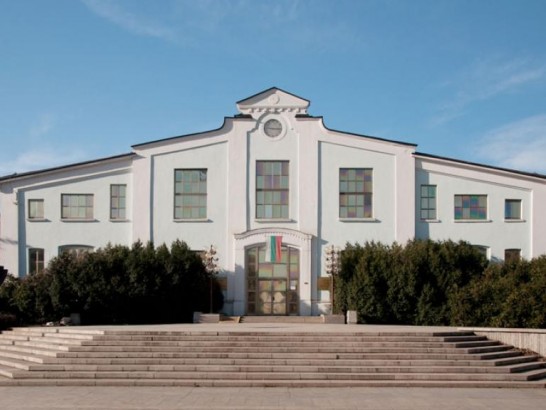 23.10.2026
Concert from the Arts for the Earth Festival
on 23 October from 18:00 o'clock
Free entrance
Free entrance
Music and Dance Events

 23.10.2026
Piano Extravaganza Festival 2026 - “Amadeus Piano Duo” – Valentina Fornari and Alberto Nosè (Italy)
Works of Schubert, Respighi, Ravel, Kapustin.
In partnership with the Italian Cultural Institute.
In partnership with the Italian Cultural Institute.
Festivals
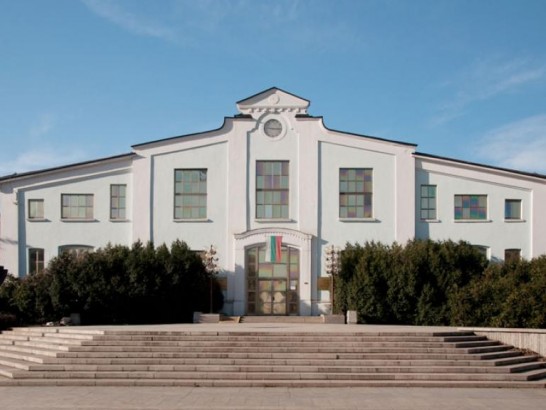 24.10.2026 - 25.10.2026
Albert Roussel Music Competition
On 24 and 25 October from 10:00 to 15:00 o'clock
Entrance with museum tickets
Entrance with museum tickets
Music and Dance Events
14.10.2026 - 30.10.2026
Andrey Yanev. Blue Mind – States of Watercolour
opening: 14 October, Wednesday, 6:00 p.m.
The term Blue Mind describes that particular state of hushed attentiveness experienced in the presence of water. Among Andrey Yanev’s watercolours, it hardly needs explanation.
Water, horizon, light and the transparency of colour draw the viewer into a different sense of time – a time of spreading and receding, of quiet inward movement.
The exhibition Blue Mind – States of Watercolour turns towards a natural realm within the artist’s visual world, one in which the sensibility of someone born by the sea quietly surfaces. In Yanev’s watercolours, the sea becomes a space in which seeing gradually turns into contemplation.
It is no coincidence, then, that the exhibition opens with works from the Portals series – works through which the noise of the city seems to subside and the narratives of everyday life to recede.
With this subtle shift in perception, the ‘blue mind’ begins to unfold through the slower rhythm of the main gallery, where the pauses are filled with music.
There, Andrey Yanev’s voice fills the space much as pigment spreads across the watercolours he has created over the past three decades – dissolving, leaving a trace, at times almost disappearing.
In the most recent works, created in 2026, this thread continues, while the artist’s language seems freer still. He seeks to capture the elusive – through Reflections, perhaps Between Two Cypresses, by looking Somewhere Beyond, or entering into Conversations with Infinity – while Blue Mind – States of Watercolour creates a space for stillness at the very heart of the city’s swirling autumn life.
+++
Curator: Elisaveta Stantcheva
Exhibition design: Petar Mitev
The term Blue Mind describes that particular state of hushed attentiveness experienced in the presence of water. Among Andrey Yanev’s watercolours, it hardly needs explanation.
Water, horizon, light and the transparency of colour draw the viewer into a different sense of time – a time of spreading and receding, of quiet inward movement.
The exhibition Blue Mind – States of Watercolour turns towards a natural realm within the artist’s visual world, one in which the sensibility of someone born by the sea quietly surfaces. In Yanev’s watercolours, the sea becomes a space in which seeing gradually turns into contemplation.
It is no coincidence, then, that the exhibition opens with works from the Portals series – works through which the noise of the city seems to subside and the narratives of everyday life to recede.
With this subtle shift in perception, the ‘blue mind’ begins to unfold through the slower rhythm of the main gallery, where the pauses are filled with music.
There, Andrey Yanev’s voice fills the space much as pigment spreads across the watercolours he has created over the past three decades – dissolving, leaving a trace, at times almost disappearing.
In the most recent works, created in 2026, this thread continues, while the artist’s language seems freer still. He seeks to capture the elusive – through Reflections, perhaps Between Two Cypresses, by looking Somewhere Beyond, or entering into Conversations with Infinity – while Blue Mind – States of Watercolour creates a space for stillness at the very heart of the city’s swirling autumn life.
+++
Curator: Elisaveta Stantcheva
Exhibition design: Petar Mitev
Exhibitions
22.10.2026 - 26.10.2026
Asia Motor Show Sofia 2026
The largest exhibition of Asian automobiles in Sofia.
For the first time in Bulgaria, a specialized exhibition dedicated entirely to the Asian automotive industry will take place.
Asia Motor Show Sofia 2026 will be held from October 22 to 26 at Arena 8888 Sofia and will present the largest selection of Chinese, Japanese, and Korean car brands in the country.
The event will bring together leading brands such as BYD, Geely, Dongfeng, BAIC, GWM, KGM, Kia, Mazda, Subaru, MG, Leapmotor, Lynk & Co, Voyah, and many others that define the development of the automotive market and mobility technologies today.
Visitors will have the opportunity to see dozens of new models, electric and hybrid vehicles, as well as the latest solutions in the automotive industry.
One of the main attractions will be the test drive zone, where everyone will be able to try selected models in real conditions and feel the difference behind the wheel.
Asia Motor Show Sofia 2026 is not just an exhibition, it is an experience.
The program includes entertainment zones for all ages, an Asian food area, games, prizes, and activities for visitors throughout all event days.
The exhibition will take place across large-scale areas that ensure a comfortable visit and allow full exploration of all participants.
For the convenience of guests, free parking with over 800 spaces is provided.
Asia Motor Show Sofia 2026 – Don’t miss it.
Dates: October 22–26, 2026
Location: Arena 8888 Sofia
https://www.asiamotorshow.eu/
For the first time in Bulgaria, a specialized exhibition dedicated entirely to the Asian automotive industry will take place.
Asia Motor Show Sofia 2026 will be held from October 22 to 26 at Arena 8888 Sofia and will present the largest selection of Chinese, Japanese, and Korean car brands in the country.
The event will bring together leading brands such as BYD, Geely, Dongfeng, BAIC, GWM, KGM, Kia, Mazda, Subaru, MG, Leapmotor, Lynk & Co, Voyah, and many others that define the development of the automotive market and mobility technologies today.
Visitors will have the opportunity to see dozens of new models, electric and hybrid vehicles, as well as the latest solutions in the automotive industry.
One of the main attractions will be the test drive zone, where everyone will be able to try selected models in real conditions and feel the difference behind the wheel.
Asia Motor Show Sofia 2026 is not just an exhibition, it is an experience.
The program includes entertainment zones for all ages, an Asian food area, games, prizes, and activities for visitors throughout all event days.
The exhibition will take place across large-scale areas that ensure a comfortable visit and allow full exploration of all participants.
For the convenience of guests, free parking with over 800 spaces is provided.
Asia Motor Show Sofia 2026 – Don’t miss it.
Dates: October 22–26, 2026
Location: Arena 8888 Sofia
https://www.asiamotorshow.eu/
Business Events
18.09.2026 - 22.11.2026
DECHKO UZUNOV/IVAN PENKOV – DIRECTIONS
Memory Programme
DECHKO UZUNOV/IVAN PENKOV – DIRECTIONS
Opening: September 18, 6:00 p.m.
The exhibition Dechko Uzunov/Ivan Penkov: Directions is part of the Memory Programme at the Dechko Uzunov Art Gallery, a branch of the Sofia City Art Gallery, which aims to contribute to raising awareness of the life and work of Dechko Uzunov by presenting research-based exhibitions that reveal different aspects of his oeuvre through artists who were part of his journey. This exhibition showcases the different paths taken by two fellow townsmen and friends during the interwar period.
In 1919, Ivan Penkov and Dechko Uzunov enrolled at the State School of Drawing; that same year, Uzunov painted a portrait of his friend that poked fun at his fascination with folk art. Three years later, the two organised a joint exhibition in Sofia to fund their studies at the Munich Art Academy. The young artists’ exhibition was noticed by Joseph Herbst, who wrote:
“Now, on the occasion of their departure abroad, the two artists had exhibited most of their works, from which their strong talents could be seen quite well. Dechko Uzunov promises to develop most in portrait painting. [...] Ivan Penkov is primarily a decorator with a strong sense of composition and a keen sensitivity to line” (J.H., Razvigor, April 1, 1922, no. 60, p. 4).
In an ironic twist of fate, the older of the two, Penkov, would go on to graduate from the Academy of Art under Prof. Uzunov. In 1939, with Uzonov’s active support, Ivan Penkov won the competition for a permanent teaching position in decorative art.
The selected works invite us to seek similarities amidst the differences between these two constantly experimenting artists during the period when Bulgarian visual arts were coming of age.
Presented in this exhibition are pieces from the collections of the Sofia City Art Gallery, the Dechko Uzunov Art Gallery, the Kazanlak Art Gallery, the Central State Archives, and private collections.
The exhibition also features the film Ivan Penkov: The Crossed-Out Classic (Bulgarian National Television, 2006), by screenwriter: Oskar Kristanov; cinematographer: Yaroslav Yachev; directors: Oskar Kristanov and Kosta Bikov; sound engineer: Petar Yosifov; music arrangement: Georgi (Johnny) Penkov. Duration: 48 min.
DECHKO UZUNOV/IVAN PENKOV – DIRECTIONS
Opening: September 18, 6:00 p.m.
The exhibition Dechko Uzunov/Ivan Penkov: Directions is part of the Memory Programme at the Dechko Uzunov Art Gallery, a branch of the Sofia City Art Gallery, which aims to contribute to raising awareness of the life and work of Dechko Uzunov by presenting research-based exhibitions that reveal different aspects of his oeuvre through artists who were part of his journey. This exhibition showcases the different paths taken by two fellow townsmen and friends during the interwar period.
In 1919, Ivan Penkov and Dechko Uzunov enrolled at the State School of Drawing; that same year, Uzunov painted a portrait of his friend that poked fun at his fascination with folk art. Three years later, the two organised a joint exhibition in Sofia to fund their studies at the Munich Art Academy. The young artists’ exhibition was noticed by Joseph Herbst, who wrote:
“Now, on the occasion of their departure abroad, the two artists had exhibited most of their works, from which their strong talents could be seen quite well. Dechko Uzunov promises to develop most in portrait painting. [...] Ivan Penkov is primarily a decorator with a strong sense of composition and a keen sensitivity to line” (J.H., Razvigor, April 1, 1922, no. 60, p. 4).
In an ironic twist of fate, the older of the two, Penkov, would go on to graduate from the Academy of Art under Prof. Uzunov. In 1939, with Uzonov’s active support, Ivan Penkov won the competition for a permanent teaching position in decorative art.
The selected works invite us to seek similarities amidst the differences between these two constantly experimenting artists during the period when Bulgarian visual arts were coming of age.
Presented in this exhibition are pieces from the collections of the Sofia City Art Gallery, the Dechko Uzunov Art Gallery, the Kazanlak Art Gallery, the Central State Archives, and private collections.
The exhibition also features the film Ivan Penkov: The Crossed-Out Classic (Bulgarian National Television, 2006), by screenwriter: Oskar Kristanov; cinematographer: Yaroslav Yachev; directors: Oskar Kristanov and Kosta Bikov; sound engineer: Petar Yosifov; music arrangement: Georgi (Johnny) Penkov. Duration: 48 min.
Exhibitions
23.09.2026 - 18.11.2026
Piano Extravaganza Festival 2026
Within this year’s edition, Piano Extravaganza Festival will present four piano recitals and two chamber music concerts. We hope that our extraordinary artists and the variety of the repertoire for those 6 events would satisfy even the most sophisticated connoisseur. We would be delighted to welcome you at the wonderful venues of the Central Military Club and the “Bulgaria” Chamber Hall in Sofia!
Tickets at EVENTIM.
Tickets at EVENTIM.
Festivals
16.06.2026 - 16.06.2027
Temporary Exhibition New Acquisitions
from 10:00 to 18:00 o'clock
Entrance with museum tickets
Entrance with museum tickets
Exhibitions
12.02.2026 - 31.12.2026
Temporary exhibition "Copper - Ancient and Modern"
from 10:00 to 18:00 o'clock
Entrance with museum tickets.
Entrance with museum tickets.
Exhibitions
11.04.2025 - 31.12.2026
Temporary exhibition "Minerals and Colorful Creatures. Drawings by Nature"
The Minerals of Bulgaria exposition has been expanded with a new theme: Unique mineral finds from Bulgaria, a project financed by the Ministry of culture. In 6 display cases, minerals with the most beautiful crystals, rare colors and shapes are exhibited, selected for tens of years by hundreds of geologists and collectors from all over Bulgaria.
from 10:00 to 18:00 o'clock
Entrance with museum tickets
from 10:00 to 18:00 o'clock
Entrance with museum tickets
Exhibitions
01.04.2026 - 31.12.2026
Temporary exhibition "Natural Art from Chalcedony"
from 10:00 to 18:00 o'clock
Entrance with museum tickets.
Entrance with museum tickets.
Exhibitions
01.01.2023 - 31.12.2026
Temporary exhibition "Smart Minerals for Smartphones"
from 10:00 to 18:00 o'clock
Entrance with museum tickets.
Entrance with museum tickets.
Exhibitions
10.12.2025 - 30.01.2027
Zahari Zograph Immersive Exhibition
The National Gallery presents one of the most iconic figures in the history of Bulgarian art – Zahari Zograph. This first immersive exhibition introduces a new way of experiencing the masterpieces of the the museum’s collection. Harnessing new technologies, the 20-minute project, created by Senzor Studio, brings his religious and secular masterpieces to life, revealing essential elements of his creative process.
The initiative promotes Bulgarian Revival аrt, a period characterized by economic, social, and cultural growth, closely tied to the pursuit of ecclesiastical and national independence. The period traces its origins to the mid-18th century, when Paisius of Hilendar wrote Istoriya Slavyanobulgarskaya (History of the Slavs and Bulgarians) in 1762—which profoundly shaped the spiritual awakening of the population and contributed significantly to the development of national consciousness…
The exhibition features a selection of icons, drawings, copies, letters, documents, and secular portraits from the artist’s early period. It also showcases a substantive collection of murals, ranging from his earliest works—created in 1838 for the Chapel of St John the Baptist at the Church of the Holy Virgin—Annunciation in Asenovgrad—to what is considered as his “final masterpiece,” the murals adorning the narthex of the Great Lavra Monastery on Mount Athos, completed between 1851 and 1852.
Zahari Zograph emerged as a defining figure of Bulgarian Revival art. His relentlessly inquisitive artistic spirit was ahead of its era, and his extensive body of work reflects the vitality of the approaching modern age, the artistry of traditional imagery, the strength of line, and the emotive power of color.
The project is realised with the financial support of the National Culture Fund of Bulgaria under the Creation programme 2024.
Media partners: BTA / Bulgarian News Agency and SOF Connect.
The initiative promotes Bulgarian Revival аrt, a period characterized by economic, social, and cultural growth, closely tied to the pursuit of ecclesiastical and national independence. The period traces its origins to the mid-18th century, when Paisius of Hilendar wrote Istoriya Slavyanobulgarskaya (History of the Slavs and Bulgarians) in 1762—which profoundly shaped the spiritual awakening of the population and contributed significantly to the development of national consciousness…
The exhibition features a selection of icons, drawings, copies, letters, documents, and secular portraits from the artist’s early period. It also showcases a substantive collection of murals, ranging from his earliest works—created in 1838 for the Chapel of St John the Baptist at the Church of the Holy Virgin—Annunciation in Asenovgrad—to what is considered as his “final masterpiece,” the murals adorning the narthex of the Great Lavra Monastery on Mount Athos, completed between 1851 and 1852.
Zahari Zograph emerged as a defining figure of Bulgarian Revival art. His relentlessly inquisitive artistic spirit was ahead of its era, and his extensive body of work reflects the vitality of the approaching modern age, the artistry of traditional imagery, the strength of line, and the emotive power of color.
The project is realised with the financial support of the National Culture Fund of Bulgaria under the Creation programme 2024.
Media partners: BTA / Bulgarian News Agency and SOF Connect.
Exhibitions
24.10.2026 - 25.10.2026
Albert Roussel Music Competition
On 24 and 25 October from 10:00 to 15:00 o'clock
Entrance with museum tickets
Entrance with museum tickets
Music and Dance Events
14.10.2026 - 30.10.2026
Andrey Yanev. Blue Mind – States of Watercolour
opening: 14 October, Wednesday, 6:00 p.m.
The term Blue Mind describes that particular state of hushed attentiveness experienced in the presence of water. Among Andrey Yanev’s watercolours, it hardly needs explanation.
Water, horizon, light and the transparency of colour draw the viewer into a different sense of time – a time of spreading and receding, of quiet inward movement.
The exhibition Blue Mind – States of Watercolour turns towards a natural realm within the artist’s visual world, one in which the sensibility of someone born by the sea quietly surfaces. In Yanev’s watercolours, the sea becomes a space in which seeing gradually turns into contemplation.
It is no coincidence, then, that the exhibition opens with works from the Portals series – works through which the noise of the city seems to subside and the narratives of everyday life to recede.
With this subtle shift in perception, the ‘blue mind’ begins to unfold through the slower rhythm of the main gallery, where the pauses are filled with music.
There, Andrey Yanev’s voice fills the space much as pigment spreads across the watercolours he has created over the past three decades – dissolving, leaving a trace, at times almost disappearing.
In the most recent works, created in 2026, this thread continues, while the artist’s language seems freer still. He seeks to capture the elusive – through Reflections, perhaps Between Two Cypresses, by looking Somewhere Beyond, or entering into Conversations with Infinity – while Blue Mind – States of Watercolour creates a space for stillness at the very heart of the city’s swirling autumn life.
+++
Curator: Elisaveta Stantcheva
Exhibition design: Petar Mitev
The term Blue Mind describes that particular state of hushed attentiveness experienced in the presence of water. Among Andrey Yanev’s watercolours, it hardly needs explanation.
Water, horizon, light and the transparency of colour draw the viewer into a different sense of time – a time of spreading and receding, of quiet inward movement.
The exhibition Blue Mind – States of Watercolour turns towards a natural realm within the artist’s visual world, one in which the sensibility of someone born by the sea quietly surfaces. In Yanev’s watercolours, the sea becomes a space in which seeing gradually turns into contemplation.
It is no coincidence, then, that the exhibition opens with works from the Portals series – works through which the noise of the city seems to subside and the narratives of everyday life to recede.
With this subtle shift in perception, the ‘blue mind’ begins to unfold through the slower rhythm of the main gallery, where the pauses are filled with music.
There, Andrey Yanev’s voice fills the space much as pigment spreads across the watercolours he has created over the past three decades – dissolving, leaving a trace, at times almost disappearing.
In the most recent works, created in 2026, this thread continues, while the artist’s language seems freer still. He seeks to capture the elusive – through Reflections, perhaps Between Two Cypresses, by looking Somewhere Beyond, or entering into Conversations with Infinity – while Blue Mind – States of Watercolour creates a space for stillness at the very heart of the city’s swirling autumn life.
+++
Curator: Elisaveta Stantcheva
Exhibition design: Petar Mitev
Exhibitions
22.10.2026 - 26.10.2026
Asia Motor Show Sofia 2026
The largest exhibition of Asian automobiles in Sofia.
For the first time in Bulgaria, a specialized exhibition dedicated entirely to the Asian automotive industry will take place.
Asia Motor Show Sofia 2026 will be held from October 22 to 26 at Arena 8888 Sofia and will present the largest selection of Chinese, Japanese, and Korean car brands in the country.
The event will bring together leading brands such as BYD, Geely, Dongfeng, BAIC, GWM, KGM, Kia, Mazda, Subaru, MG, Leapmotor, Lynk & Co, Voyah, and many others that define the development of the automotive market and mobility technologies today.
Visitors will have the opportunity to see dozens of new models, electric and hybrid vehicles, as well as the latest solutions in the automotive industry.
One of the main attractions will be the test drive zone, where everyone will be able to try selected models in real conditions and feel the difference behind the wheel.
Asia Motor Show Sofia 2026 is not just an exhibition, it is an experience.
The program includes entertainment zones for all ages, an Asian food area, games, prizes, and activities for visitors throughout all event days.
The exhibition will take place across large-scale areas that ensure a comfortable visit and allow full exploration of all participants.
For the convenience of guests, free parking with over 800 spaces is provided.
Asia Motor Show Sofia 2026 – Don’t miss it.
Dates: October 22–26, 2026
Location: Arena 8888 Sofia
https://www.asiamotorshow.eu/
For the first time in Bulgaria, a specialized exhibition dedicated entirely to the Asian automotive industry will take place.
Asia Motor Show Sofia 2026 will be held from October 22 to 26 at Arena 8888 Sofia and will present the largest selection of Chinese, Japanese, and Korean car brands in the country.
The event will bring together leading brands such as BYD, Geely, Dongfeng, BAIC, GWM, KGM, Kia, Mazda, Subaru, MG, Leapmotor, Lynk & Co, Voyah, and many others that define the development of the automotive market and mobility technologies today.
Visitors will have the opportunity to see dozens of new models, electric and hybrid vehicles, as well as the latest solutions in the automotive industry.
One of the main attractions will be the test drive zone, where everyone will be able to try selected models in real conditions and feel the difference behind the wheel.
Asia Motor Show Sofia 2026 is not just an exhibition, it is an experience.
The program includes entertainment zones for all ages, an Asian food area, games, prizes, and activities for visitors throughout all event days.
The exhibition will take place across large-scale areas that ensure a comfortable visit and allow full exploration of all participants.
For the convenience of guests, free parking with over 800 spaces is provided.
Asia Motor Show Sofia 2026 – Don’t miss it.
Dates: October 22–26, 2026
Location: Arena 8888 Sofia
https://www.asiamotorshow.eu/
Business Events
18.09.2026 - 22.11.2026
DECHKO UZUNOV/IVAN PENKOV – DIRECTIONS
Memory Programme
DECHKO UZUNOV/IVAN PENKOV – DIRECTIONS
Opening: September 18, 6:00 p.m.
The exhibition Dechko Uzunov/Ivan Penkov: Directions is part of the Memory Programme at the Dechko Uzunov Art Gallery, a branch of the Sofia City Art Gallery, which aims to contribute to raising awareness of the life and work of Dechko Uzunov by presenting research-based exhibitions that reveal different aspects of his oeuvre through artists who were part of his journey. This exhibition showcases the different paths taken by two fellow townsmen and friends during the interwar period.
In 1919, Ivan Penkov and Dechko Uzunov enrolled at the State School of Drawing; that same year, Uzunov painted a portrait of his friend that poked fun at his fascination with folk art. Three years later, the two organised a joint exhibition in Sofia to fund their studies at the Munich Art Academy. The young artists’ exhibition was noticed by Joseph Herbst, who wrote:
“Now, on the occasion of their departure abroad, the two artists had exhibited most of their works, from which their strong talents could be seen quite well. Dechko Uzunov promises to develop most in portrait painting. [...] Ivan Penkov is primarily a decorator with a strong sense of composition and a keen sensitivity to line” (J.H., Razvigor, April 1, 1922, no. 60, p. 4).
In an ironic twist of fate, the older of the two, Penkov, would go on to graduate from the Academy of Art under Prof. Uzunov. In 1939, with Uzonov’s active support, Ivan Penkov won the competition for a permanent teaching position in decorative art.
The selected works invite us to seek similarities amidst the differences between these two constantly experimenting artists during the period when Bulgarian visual arts were coming of age.
Presented in this exhibition are pieces from the collections of the Sofia City Art Gallery, the Dechko Uzunov Art Gallery, the Kazanlak Art Gallery, the Central State Archives, and private collections.
The exhibition also features the film Ivan Penkov: The Crossed-Out Classic (Bulgarian National Television, 2006), by screenwriter: Oskar Kristanov; cinematographer: Yaroslav Yachev; directors: Oskar Kristanov and Kosta Bikov; sound engineer: Petar Yosifov; music arrangement: Georgi (Johnny) Penkov. Duration: 48 min.
DECHKO UZUNOV/IVAN PENKOV – DIRECTIONS
Opening: September 18, 6:00 p.m.
The exhibition Dechko Uzunov/Ivan Penkov: Directions is part of the Memory Programme at the Dechko Uzunov Art Gallery, a branch of the Sofia City Art Gallery, which aims to contribute to raising awareness of the life and work of Dechko Uzunov by presenting research-based exhibitions that reveal different aspects of his oeuvre through artists who were part of his journey. This exhibition showcases the different paths taken by two fellow townsmen and friends during the interwar period.
In 1919, Ivan Penkov and Dechko Uzunov enrolled at the State School of Drawing; that same year, Uzunov painted a portrait of his friend that poked fun at his fascination with folk art. Three years later, the two organised a joint exhibition in Sofia to fund their studies at the Munich Art Academy. The young artists’ exhibition was noticed by Joseph Herbst, who wrote:
“Now, on the occasion of their departure abroad, the two artists had exhibited most of their works, from which their strong talents could be seen quite well. Dechko Uzunov promises to develop most in portrait painting. [...] Ivan Penkov is primarily a decorator with a strong sense of composition and a keen sensitivity to line” (J.H., Razvigor, April 1, 1922, no. 60, p. 4).
In an ironic twist of fate, the older of the two, Penkov, would go on to graduate from the Academy of Art under Prof. Uzunov. In 1939, with Uzonov’s active support, Ivan Penkov won the competition for a permanent teaching position in decorative art.
The selected works invite us to seek similarities amidst the differences between these two constantly experimenting artists during the period when Bulgarian visual arts were coming of age.
Presented in this exhibition are pieces from the collections of the Sofia City Art Gallery, the Dechko Uzunov Art Gallery, the Kazanlak Art Gallery, the Central State Archives, and private collections.
The exhibition also features the film Ivan Penkov: The Crossed-Out Classic (Bulgarian National Television, 2006), by screenwriter: Oskar Kristanov; cinematographer: Yaroslav Yachev; directors: Oskar Kristanov and Kosta Bikov; sound engineer: Petar Yosifov; music arrangement: Georgi (Johnny) Penkov. Duration: 48 min.
Exhibitions
23.09.2026 - 18.11.2026
Piano Extravaganza Festival 2026
Within this year’s edition, Piano Extravaganza Festival will present four piano recitals and two chamber music concerts. We hope that our extraordinary artists and the variety of the repertoire for those 6 events would satisfy even the most sophisticated connoisseur. We would be delighted to welcome you at the wonderful venues of the Central Military Club and the “Bulgaria” Chamber Hall in Sofia!
Tickets at EVENTIM.
Tickets at EVENTIM.
Festivals
16.06.2026 - 16.06.2027
Temporary Exhibition New Acquisitions
from 10:00 to 18:00 o'clock
Entrance with museum tickets
Entrance with museum tickets
Exhibitions
12.02.2026 - 31.12.2026
Temporary exhibition "Copper - Ancient and Modern"
from 10:00 to 18:00 o'clock
Entrance with museum tickets.
Entrance with museum tickets.
Exhibitions
11.04.2025 - 31.12.2026
Temporary exhibition "Minerals and Colorful Creatures. Drawings by Nature"
The Minerals of Bulgaria exposition has been expanded with a new theme: Unique mineral finds from Bulgaria, a project financed by the Ministry of culture. In 6 display cases, minerals with the most beautiful crystals, rare colors and shapes are exhibited, selected for tens of years by hundreds of geologists and collectors from all over Bulgaria.
from 10:00 to 18:00 o'clock
Entrance with museum tickets
from 10:00 to 18:00 o'clock
Entrance with museum tickets
Exhibitions
01.04.2026 - 31.12.2026
Temporary exhibition "Natural Art from Chalcedony"
from 10:00 to 18:00 o'clock
Entrance with museum tickets.
Entrance with museum tickets.
Exhibitions
01.01.2023 - 31.12.2026
Temporary exhibition "Smart Minerals for Smartphones"
from 10:00 to 18:00 o'clock
Entrance with museum tickets.
Entrance with museum tickets.
Exhibitions
10.12.2025 - 30.01.2027
Zahari Zograph Immersive Exhibition
The National Gallery presents one of the most iconic figures in the history of Bulgarian art – Zahari Zograph. This first immersive exhibition introduces a new way of experiencing the masterpieces of the the museum’s collection. Harnessing new technologies, the 20-minute project, created by Senzor Studio, brings his religious and secular masterpieces to life, revealing essential elements of his creative process.
The initiative promotes Bulgarian Revival аrt, a period characterized by economic, social, and cultural growth, closely tied to the pursuit of ecclesiastical and national independence. The period traces its origins to the mid-18th century, when Paisius of Hilendar wrote Istoriya Slavyanobulgarskaya (History of the Slavs and Bulgarians) in 1762—which profoundly shaped the spiritual awakening of the population and contributed significantly to the development of national consciousness…
The exhibition features a selection of icons, drawings, copies, letters, documents, and secular portraits from the artist’s early period. It also showcases a substantive collection of murals, ranging from his earliest works—created in 1838 for the Chapel of St John the Baptist at the Church of the Holy Virgin—Annunciation in Asenovgrad—to what is considered as his “final masterpiece,” the murals adorning the narthex of the Great Lavra Monastery on Mount Athos, completed between 1851 and 1852.
Zahari Zograph emerged as a defining figure of Bulgarian Revival art. His relentlessly inquisitive artistic spirit was ahead of its era, and his extensive body of work reflects the vitality of the approaching modern age, the artistry of traditional imagery, the strength of line, and the emotive power of color.
The project is realised with the financial support of the National Culture Fund of Bulgaria under the Creation programme 2024.
Media partners: BTA / Bulgarian News Agency and SOF Connect.
The initiative promotes Bulgarian Revival аrt, a period characterized by economic, social, and cultural growth, closely tied to the pursuit of ecclesiastical and national independence. The period traces its origins to the mid-18th century, when Paisius of Hilendar wrote Istoriya Slavyanobulgarskaya (History of the Slavs and Bulgarians) in 1762—which profoundly shaped the spiritual awakening of the population and contributed significantly to the development of national consciousness…
The exhibition features a selection of icons, drawings, copies, letters, documents, and secular portraits from the artist’s early period. It also showcases a substantive collection of murals, ranging from his earliest works—created in 1838 for the Chapel of St John the Baptist at the Church of the Holy Virgin—Annunciation in Asenovgrad—to what is considered as his “final masterpiece,” the murals adorning the narthex of the Great Lavra Monastery on Mount Athos, completed between 1851 and 1852.
Zahari Zograph emerged as a defining figure of Bulgarian Revival art. His relentlessly inquisitive artistic spirit was ahead of its era, and his extensive body of work reflects the vitality of the approaching modern age, the artistry of traditional imagery, the strength of line, and the emotive power of color.
The project is realised with the financial support of the National Culture Fund of Bulgaria under the Creation programme 2024.
Media partners: BTA / Bulgarian News Agency and SOF Connect.
Exhibitions
14.10.2026 - 30.10.2026
Andrey Yanev. Blue Mind – States of Watercolour
opening: 14 October, Wednesday, 6:00 p.m.
The term Blue Mind describes that particular state of hushed attentiveness experienced in the presence of water. Among Andrey Yanev’s watercolours, it hardly needs explanation.
Water, horizon, light and the transparency of colour draw the viewer into a different sense of time – a time of spreading and receding, of quiet inward movement.
The exhibition Blue Mind – States of Watercolour turns towards a natural realm within the artist’s visual world, one in which the sensibility of someone born by the sea quietly surfaces. In Yanev’s watercolours, the sea becomes a space in which seeing gradually turns into contemplation.
It is no coincidence, then, that the exhibition opens with works from the Portals series – works through which the noise of the city seems to subside and the narratives of everyday life to recede.
With this subtle shift in perception, the ‘blue mind’ begins to unfold through the slower rhythm of the main gallery, where the pauses are filled with music.
There, Andrey Yanev’s voice fills the space much as pigment spreads across the watercolours he has created over the past three decades – dissolving, leaving a trace, at times almost disappearing.
In the most recent works, created in 2026, this thread continues, while the artist’s language seems freer still. He seeks to capture the elusive – through Reflections, perhaps Between Two Cypresses, by looking Somewhere Beyond, or entering into Conversations with Infinity – while Blue Mind – States of Watercolour creates a space for stillness at the very heart of the city’s swirling autumn life.
+++
Curator: Elisaveta Stantcheva
Exhibition design: Petar Mitev
The term Blue Mind describes that particular state of hushed attentiveness experienced in the presence of water. Among Andrey Yanev’s watercolours, it hardly needs explanation.
Water, horizon, light and the transparency of colour draw the viewer into a different sense of time – a time of spreading and receding, of quiet inward movement.
The exhibition Blue Mind – States of Watercolour turns towards a natural realm within the artist’s visual world, one in which the sensibility of someone born by the sea quietly surfaces. In Yanev’s watercolours, the sea becomes a space in which seeing gradually turns into contemplation.
It is no coincidence, then, that the exhibition opens with works from the Portals series – works through which the noise of the city seems to subside and the narratives of everyday life to recede.
With this subtle shift in perception, the ‘blue mind’ begins to unfold through the slower rhythm of the main gallery, where the pauses are filled with music.
There, Andrey Yanev’s voice fills the space much as pigment spreads across the watercolours he has created over the past three decades – dissolving, leaving a trace, at times almost disappearing.
In the most recent works, created in 2026, this thread continues, while the artist’s language seems freer still. He seeks to capture the elusive – through Reflections, perhaps Between Two Cypresses, by looking Somewhere Beyond, or entering into Conversations with Infinity – while Blue Mind – States of Watercolour creates a space for stillness at the very heart of the city’s swirling autumn life.
+++
Curator: Elisaveta Stantcheva
Exhibition design: Petar Mitev
Exhibitions
22.10.2026 - 26.10.2026
Asia Motor Show Sofia 2026
The largest exhibition of Asian automobiles in Sofia.
For the first time in Bulgaria, a specialized exhibition dedicated entirely to the Asian automotive industry will take place.
Asia Motor Show Sofia 2026 will be held from October 22 to 26 at Arena 8888 Sofia and will present the largest selection of Chinese, Japanese, and Korean car brands in the country.
The event will bring together leading brands such as BYD, Geely, Dongfeng, BAIC, GWM, KGM, Kia, Mazda, Subaru, MG, Leapmotor, Lynk & Co, Voyah, and many others that define the development of the automotive market and mobility technologies today.
Visitors will have the opportunity to see dozens of new models, electric and hybrid vehicles, as well as the latest solutions in the automotive industry.
One of the main attractions will be the test drive zone, where everyone will be able to try selected models in real conditions and feel the difference behind the wheel.
Asia Motor Show Sofia 2026 is not just an exhibition, it is an experience.
The program includes entertainment zones for all ages, an Asian food area, games, prizes, and activities for visitors throughout all event days.
The exhibition will take place across large-scale areas that ensure a comfortable visit and allow full exploration of all participants.
For the convenience of guests, free parking with over 800 spaces is provided.
Asia Motor Show Sofia 2026 – Don’t miss it.
Dates: October 22–26, 2026
Location: Arena 8888 Sofia
https://www.asiamotorshow.eu/
For the first time in Bulgaria, a specialized exhibition dedicated entirely to the Asian automotive industry will take place.
Asia Motor Show Sofia 2026 will be held from October 22 to 26 at Arena 8888 Sofia and will present the largest selection of Chinese, Japanese, and Korean car brands in the country.
The event will bring together leading brands such as BYD, Geely, Dongfeng, BAIC, GWM, KGM, Kia, Mazda, Subaru, MG, Leapmotor, Lynk & Co, Voyah, and many others that define the development of the automotive market and mobility technologies today.
Visitors will have the opportunity to see dozens of new models, electric and hybrid vehicles, as well as the latest solutions in the automotive industry.
One of the main attractions will be the test drive zone, where everyone will be able to try selected models in real conditions and feel the difference behind the wheel.
Asia Motor Show Sofia 2026 is not just an exhibition, it is an experience.
The program includes entertainment zones for all ages, an Asian food area, games, prizes, and activities for visitors throughout all event days.
The exhibition will take place across large-scale areas that ensure a comfortable visit and allow full exploration of all participants.
For the convenience of guests, free parking with over 800 spaces is provided.
Asia Motor Show Sofia 2026 – Don’t miss it.
Dates: October 22–26, 2026
Location: Arena 8888 Sofia
https://www.asiamotorshow.eu/
Business Events
18.09.2026 - 22.11.2026
DECHKO UZUNOV/IVAN PENKOV – DIRECTIONS
Memory Programme
DECHKO UZUNOV/IVAN PENKOV – DIRECTIONS
Opening: September 18, 6:00 p.m.
The exhibition Dechko Uzunov/Ivan Penkov: Directions is part of the Memory Programme at the Dechko Uzunov Art Gallery, a branch of the Sofia City Art Gallery, which aims to contribute to raising awareness of the life and work of Dechko Uzunov by presenting research-based exhibitions that reveal different aspects of his oeuvre through artists who were part of his journey. This exhibition showcases the different paths taken by two fellow townsmen and friends during the interwar period.
In 1919, Ivan Penkov and Dechko Uzunov enrolled at the State School of Drawing; that same year, Uzunov painted a portrait of his friend that poked fun at his fascination with folk art. Three years later, the two organised a joint exhibition in Sofia to fund their studies at the Munich Art Academy. The young artists’ exhibition was noticed by Joseph Herbst, who wrote:
“Now, on the occasion of their departure abroad, the two artists had exhibited most of their works, from which their strong talents could be seen quite well. Dechko Uzunov promises to develop most in portrait painting. [...] Ivan Penkov is primarily a decorator with a strong sense of composition and a keen sensitivity to line” (J.H., Razvigor, April 1, 1922, no. 60, p. 4).
In an ironic twist of fate, the older of the two, Penkov, would go on to graduate from the Academy of Art under Prof. Uzunov. In 1939, with Uzonov’s active support, Ivan Penkov won the competition for a permanent teaching position in decorative art.
The selected works invite us to seek similarities amidst the differences between these two constantly experimenting artists during the period when Bulgarian visual arts were coming of age.
Presented in this exhibition are pieces from the collections of the Sofia City Art Gallery, the Dechko Uzunov Art Gallery, the Kazanlak Art Gallery, the Central State Archives, and private collections.
The exhibition also features the film Ivan Penkov: The Crossed-Out Classic (Bulgarian National Television, 2006), by screenwriter: Oskar Kristanov; cinematographer: Yaroslav Yachev; directors: Oskar Kristanov and Kosta Bikov; sound engineer: Petar Yosifov; music arrangement: Georgi (Johnny) Penkov. Duration: 48 min.
DECHKO UZUNOV/IVAN PENKOV – DIRECTIONS
Opening: September 18, 6:00 p.m.
The exhibition Dechko Uzunov/Ivan Penkov: Directions is part of the Memory Programme at the Dechko Uzunov Art Gallery, a branch of the Sofia City Art Gallery, which aims to contribute to raising awareness of the life and work of Dechko Uzunov by presenting research-based exhibitions that reveal different aspects of his oeuvre through artists who were part of his journey. This exhibition showcases the different paths taken by two fellow townsmen and friends during the interwar period.
In 1919, Ivan Penkov and Dechko Uzunov enrolled at the State School of Drawing; that same year, Uzunov painted a portrait of his friend that poked fun at his fascination with folk art. Three years later, the two organised a joint exhibition in Sofia to fund their studies at the Munich Art Academy. The young artists’ exhibition was noticed by Joseph Herbst, who wrote:
“Now, on the occasion of their departure abroad, the two artists had exhibited most of their works, from which their strong talents could be seen quite well. Dechko Uzunov promises to develop most in portrait painting. [...] Ivan Penkov is primarily a decorator with a strong sense of composition and a keen sensitivity to line” (J.H., Razvigor, April 1, 1922, no. 60, p. 4).
In an ironic twist of fate, the older of the two, Penkov, would go on to graduate from the Academy of Art under Prof. Uzunov. In 1939, with Uzonov’s active support, Ivan Penkov won the competition for a permanent teaching position in decorative art.
The selected works invite us to seek similarities amidst the differences between these two constantly experimenting artists during the period when Bulgarian visual arts were coming of age.
Presented in this exhibition are pieces from the collections of the Sofia City Art Gallery, the Dechko Uzunov Art Gallery, the Kazanlak Art Gallery, the Central State Archives, and private collections.
The exhibition also features the film Ivan Penkov: The Crossed-Out Classic (Bulgarian National Television, 2006), by screenwriter: Oskar Kristanov; cinematographer: Yaroslav Yachev; directors: Oskar Kristanov and Kosta Bikov; sound engineer: Petar Yosifov; music arrangement: Georgi (Johnny) Penkov. Duration: 48 min.
Exhibitions
23.09.2026 - 18.11.2026
Piano Extravaganza Festival 2026
Within this year’s edition, Piano Extravaganza Festival will present four piano recitals and two chamber music concerts. We hope that our extraordinary artists and the variety of the repertoire for those 6 events would satisfy even the most sophisticated connoisseur. We would be delighted to welcome you at the wonderful venues of the Central Military Club and the “Bulgaria” Chamber Hall in Sofia!
Tickets at EVENTIM.
Tickets at EVENTIM.
Festivals
16.06.2026 - 16.06.2027
Temporary Exhibition New Acquisitions
from 10:00 to 18:00 o'clock
Entrance with museum tickets
Entrance with museum tickets
Exhibitions
12.02.2026 - 31.12.2026
Temporary exhibition "Copper - Ancient and Modern"
from 10:00 to 18:00 o'clock
Entrance with museum tickets.
Entrance with museum tickets.
Exhibitions
11.04.2025 - 31.12.2026
Temporary exhibition "Minerals and Colorful Creatures. Drawings by Nature"
The Minerals of Bulgaria exposition has been expanded with a new theme: Unique mineral finds from Bulgaria, a project financed by the Ministry of culture. In 6 display cases, minerals with the most beautiful crystals, rare colors and shapes are exhibited, selected for tens of years by hundreds of geologists and collectors from all over Bulgaria.
from 10:00 to 18:00 o'clock
Entrance with museum tickets
from 10:00 to 18:00 o'clock
Entrance with museum tickets
Exhibitions
01.04.2026 - 31.12.2026
Temporary exhibition "Natural Art from Chalcedony"
from 10:00 to 18:00 o'clock
Entrance with museum tickets.
Entrance with museum tickets.
Exhibitions
01.01.2023 - 31.12.2026
Temporary exhibition "Smart Minerals for Smartphones"
from 10:00 to 18:00 o'clock
Entrance with museum tickets.
Entrance with museum tickets.
Exhibitions
10.12.2025 - 30.01.2027
Zahari Zograph Immersive Exhibition
The National Gallery presents one of the most iconic figures in the history of Bulgarian art – Zahari Zograph. This first immersive exhibition introduces a new way of experiencing the masterpieces of the the museum’s collection. Harnessing new technologies, the 20-minute project, created by Senzor Studio, brings his religious and secular masterpieces to life, revealing essential elements of his creative process.
The initiative promotes Bulgarian Revival аrt, a period characterized by economic, social, and cultural growth, closely tied to the pursuit of ecclesiastical and national independence. The period traces its origins to the mid-18th century, when Paisius of Hilendar wrote Istoriya Slavyanobulgarskaya (History of the Slavs and Bulgarians) in 1762—which profoundly shaped the spiritual awakening of the population and contributed significantly to the development of national consciousness…
The exhibition features a selection of icons, drawings, copies, letters, documents, and secular portraits from the artist’s early period. It also showcases a substantive collection of murals, ranging from his earliest works—created in 1838 for the Chapel of St John the Baptist at the Church of the Holy Virgin—Annunciation in Asenovgrad—to what is considered as his “final masterpiece,” the murals adorning the narthex of the Great Lavra Monastery on Mount Athos, completed between 1851 and 1852.
Zahari Zograph emerged as a defining figure of Bulgarian Revival art. His relentlessly inquisitive artistic spirit was ahead of its era, and his extensive body of work reflects the vitality of the approaching modern age, the artistry of traditional imagery, the strength of line, and the emotive power of color.
The project is realised with the financial support of the National Culture Fund of Bulgaria under the Creation programme 2024.
Media partners: BTA / Bulgarian News Agency and SOF Connect.
The initiative promotes Bulgarian Revival аrt, a period characterized by economic, social, and cultural growth, closely tied to the pursuit of ecclesiastical and national independence. The period traces its origins to the mid-18th century, when Paisius of Hilendar wrote Istoriya Slavyanobulgarskaya (History of the Slavs and Bulgarians) in 1762—which profoundly shaped the spiritual awakening of the population and contributed significantly to the development of national consciousness…
The exhibition features a selection of icons, drawings, copies, letters, documents, and secular portraits from the artist’s early period. It also showcases a substantive collection of murals, ranging from his earliest works—created in 1838 for the Chapel of St John the Baptist at the Church of the Holy Virgin—Annunciation in Asenovgrad—to what is considered as his “final masterpiece,” the murals adorning the narthex of the Great Lavra Monastery on Mount Athos, completed between 1851 and 1852.
Zahari Zograph emerged as a defining figure of Bulgarian Revival art. His relentlessly inquisitive artistic spirit was ahead of its era, and his extensive body of work reflects the vitality of the approaching modern age, the artistry of traditional imagery, the strength of line, and the emotive power of color.
The project is realised with the financial support of the National Culture Fund of Bulgaria under the Creation programme 2024.
Media partners: BTA / Bulgarian News Agency and SOF Connect.
Exhibitions
14.10.2026 - 30.10.2026
Andrey Yanev. Blue Mind – States of Watercolour
opening: 14 October, Wednesday, 6:00 p.m.
The term Blue Mind describes that particular state of hushed attentiveness experienced in the presence of water. Among Andrey Yanev’s watercolours, it hardly needs explanation.
Water, horizon, light and the transparency of colour draw the viewer into a different sense of time – a time of spreading and receding, of quiet inward movement.
The exhibition Blue Mind – States of Watercolour turns towards a natural realm within the artist’s visual world, one in which the sensibility of someone born by the sea quietly surfaces. In Yanev’s watercolours, the sea becomes a space in which seeing gradually turns into contemplation.
It is no coincidence, then, that the exhibition opens with works from the Portals series – works through which the noise of the city seems to subside and the narratives of everyday life to recede.
With this subtle shift in perception, the ‘blue mind’ begins to unfold through the slower rhythm of the main gallery, where the pauses are filled with music.
There, Andrey Yanev’s voice fills the space much as pigment spreads across the watercolours he has created over the past three decades – dissolving, leaving a trace, at times almost disappearing.
In the most recent works, created in 2026, this thread continues, while the artist’s language seems freer still. He seeks to capture the elusive – through Reflections, perhaps Between Two Cypresses, by looking Somewhere Beyond, or entering into Conversations with Infinity – while Blue Mind – States of Watercolour creates a space for stillness at the very heart of the city’s swirling autumn life.
+++
Curator: Elisaveta Stantcheva
Exhibition design: Petar Mitev
The term Blue Mind describes that particular state of hushed attentiveness experienced in the presence of water. Among Andrey Yanev’s watercolours, it hardly needs explanation.
Water, horizon, light and the transparency of colour draw the viewer into a different sense of time – a time of spreading and receding, of quiet inward movement.
The exhibition Blue Mind – States of Watercolour turns towards a natural realm within the artist’s visual world, one in which the sensibility of someone born by the sea quietly surfaces. In Yanev’s watercolours, the sea becomes a space in which seeing gradually turns into contemplation.
It is no coincidence, then, that the exhibition opens with works from the Portals series – works through which the noise of the city seems to subside and the narratives of everyday life to recede.
With this subtle shift in perception, the ‘blue mind’ begins to unfold through the slower rhythm of the main gallery, where the pauses are filled with music.
There, Andrey Yanev’s voice fills the space much as pigment spreads across the watercolours he has created over the past three decades – dissolving, leaving a trace, at times almost disappearing.
In the most recent works, created in 2026, this thread continues, while the artist’s language seems freer still. He seeks to capture the elusive – through Reflections, perhaps Between Two Cypresses, by looking Somewhere Beyond, or entering into Conversations with Infinity – while Blue Mind – States of Watercolour creates a space for stillness at the very heart of the city’s swirling autumn life.
+++
Curator: Elisaveta Stantcheva
Exhibition design: Petar Mitev
Exhibitions
18.09.2026 - 22.11.2026
DECHKO UZUNOV/IVAN PENKOV – DIRECTIONS
Memory Programme
DECHKO UZUNOV/IVAN PENKOV – DIRECTIONS
Opening: September 18, 6:00 p.m.
The exhibition Dechko Uzunov/Ivan Penkov: Directions is part of the Memory Programme at the Dechko Uzunov Art Gallery, a branch of the Sofia City Art Gallery, which aims to contribute to raising awareness of the life and work of Dechko Uzunov by presenting research-based exhibitions that reveal different aspects of his oeuvre through artists who were part of his journey. This exhibition showcases the different paths taken by two fellow townsmen and friends during the interwar period.
In 1919, Ivan Penkov and Dechko Uzunov enrolled at the State School of Drawing; that same year, Uzunov painted a portrait of his friend that poked fun at his fascination with folk art. Three years later, the two organised a joint exhibition in Sofia to fund their studies at the Munich Art Academy. The young artists’ exhibition was noticed by Joseph Herbst, who wrote:
“Now, on the occasion of their departure abroad, the two artists had exhibited most of their works, from which their strong talents could be seen quite well. Dechko Uzunov promises to develop most in portrait painting. [...] Ivan Penkov is primarily a decorator with a strong sense of composition and a keen sensitivity to line” (J.H., Razvigor, April 1, 1922, no. 60, p. 4).
In an ironic twist of fate, the older of the two, Penkov, would go on to graduate from the Academy of Art under Prof. Uzunov. In 1939, with Uzonov’s active support, Ivan Penkov won the competition for a permanent teaching position in decorative art.
The selected works invite us to seek similarities amidst the differences between these two constantly experimenting artists during the period when Bulgarian visual arts were coming of age.
Presented in this exhibition are pieces from the collections of the Sofia City Art Gallery, the Dechko Uzunov Art Gallery, the Kazanlak Art Gallery, the Central State Archives, and private collections.
The exhibition also features the film Ivan Penkov: The Crossed-Out Classic (Bulgarian National Television, 2006), by screenwriter: Oskar Kristanov; cinematographer: Yaroslav Yachev; directors: Oskar Kristanov and Kosta Bikov; sound engineer: Petar Yosifov; music arrangement: Georgi (Johnny) Penkov. Duration: 48 min.
DECHKO UZUNOV/IVAN PENKOV – DIRECTIONS
Opening: September 18, 6:00 p.m.
The exhibition Dechko Uzunov/Ivan Penkov: Directions is part of the Memory Programme at the Dechko Uzunov Art Gallery, a branch of the Sofia City Art Gallery, which aims to contribute to raising awareness of the life and work of Dechko Uzunov by presenting research-based exhibitions that reveal different aspects of his oeuvre through artists who were part of his journey. This exhibition showcases the different paths taken by two fellow townsmen and friends during the interwar period.
In 1919, Ivan Penkov and Dechko Uzunov enrolled at the State School of Drawing; that same year, Uzunov painted a portrait of his friend that poked fun at his fascination with folk art. Three years later, the two organised a joint exhibition in Sofia to fund their studies at the Munich Art Academy. The young artists’ exhibition was noticed by Joseph Herbst, who wrote:
“Now, on the occasion of their departure abroad, the two artists had exhibited most of their works, from which their strong talents could be seen quite well. Dechko Uzunov promises to develop most in portrait painting. [...] Ivan Penkov is primarily a decorator with a strong sense of composition and a keen sensitivity to line” (J.H., Razvigor, April 1, 1922, no. 60, p. 4).
In an ironic twist of fate, the older of the two, Penkov, would go on to graduate from the Academy of Art under Prof. Uzunov. In 1939, with Uzonov’s active support, Ivan Penkov won the competition for a permanent teaching position in decorative art.
The selected works invite us to seek similarities amidst the differences between these two constantly experimenting artists during the period when Bulgarian visual arts were coming of age.
Presented in this exhibition are pieces from the collections of the Sofia City Art Gallery, the Dechko Uzunov Art Gallery, the Kazanlak Art Gallery, the Central State Archives, and private collections.
The exhibition also features the film Ivan Penkov: The Crossed-Out Classic (Bulgarian National Television, 2006), by screenwriter: Oskar Kristanov; cinematographer: Yaroslav Yachev; directors: Oskar Kristanov and Kosta Bikov; sound engineer: Petar Yosifov; music arrangement: Georgi (Johnny) Penkov. Duration: 48 min.
Exhibitions
23.09.2026 - 18.11.2026
Piano Extravaganza Festival 2026
Within this year’s edition, Piano Extravaganza Festival will present four piano recitals and two chamber music concerts. We hope that our extraordinary artists and the variety of the repertoire for those 6 events would satisfy even the most sophisticated connoisseur. We would be delighted to welcome you at the wonderful venues of the Central Military Club and the “Bulgaria” Chamber Hall in Sofia!
Tickets at EVENTIM.
Tickets at EVENTIM.
Festivals
16.06.2026 - 16.06.2027
Temporary Exhibition New Acquisitions
from 10:00 to 18:00 o'clock
Entrance with museum tickets
Entrance with museum tickets
Exhibitions
12.02.2026 - 31.12.2026
Temporary exhibition "Copper - Ancient and Modern"
from 10:00 to 18:00 o'clock
Entrance with museum tickets.
Entrance with museum tickets.
Exhibitions
11.04.2025 - 31.12.2026
Temporary exhibition "Minerals and Colorful Creatures. Drawings by Nature"
The Minerals of Bulgaria exposition has been expanded with a new theme: Unique mineral finds from Bulgaria, a project financed by the Ministry of culture. In 6 display cases, minerals with the most beautiful crystals, rare colors and shapes are exhibited, selected for tens of years by hundreds of geologists and collectors from all over Bulgaria.
from 10:00 to 18:00 o'clock
Entrance with museum tickets
from 10:00 to 18:00 o'clock
Entrance with museum tickets
Exhibitions
01.04.2026 - 31.12.2026
Temporary exhibition "Natural Art from Chalcedony"
from 10:00 to 18:00 o'clock
Entrance with museum tickets.
Entrance with museum tickets.
Exhibitions
01.01.2023 - 31.12.2026
Temporary exhibition "Smart Minerals for Smartphones"
from 10:00 to 18:00 o'clock
Entrance with museum tickets.
Entrance with museum tickets.
Exhibitions
10.12.2025 - 30.01.2027
Zahari Zograph Immersive Exhibition
The National Gallery presents one of the most iconic figures in the history of Bulgarian art – Zahari Zograph. This first immersive exhibition introduces a new way of experiencing the masterpieces of the the museum’s collection. Harnessing new technologies, the 20-minute project, created by Senzor Studio, brings his religious and secular masterpieces to life, revealing essential elements of his creative process.
The initiative promotes Bulgarian Revival аrt, a period characterized by economic, social, and cultural growth, closely tied to the pursuit of ecclesiastical and national independence. The period traces its origins to the mid-18th century, when Paisius of Hilendar wrote Istoriya Slavyanobulgarskaya (History of the Slavs and Bulgarians) in 1762—which profoundly shaped the spiritual awakening of the population and contributed significantly to the development of national consciousness…
The exhibition features a selection of icons, drawings, copies, letters, documents, and secular portraits from the artist’s early period. It also showcases a substantive collection of murals, ranging from his earliest works—created in 1838 for the Chapel of St John the Baptist at the Church of the Holy Virgin—Annunciation in Asenovgrad—to what is considered as his “final masterpiece,” the murals adorning the narthex of the Great Lavra Monastery on Mount Athos, completed between 1851 and 1852.
Zahari Zograph emerged as a defining figure of Bulgarian Revival art. His relentlessly inquisitive artistic spirit was ahead of its era, and his extensive body of work reflects the vitality of the approaching modern age, the artistry of traditional imagery, the strength of line, and the emotive power of color.
The project is realised with the financial support of the National Culture Fund of Bulgaria under the Creation programme 2024.
Media partners: BTA / Bulgarian News Agency and SOF Connect.
The initiative promotes Bulgarian Revival аrt, a period characterized by economic, social, and cultural growth, closely tied to the pursuit of ecclesiastical and national independence. The period traces its origins to the mid-18th century, when Paisius of Hilendar wrote Istoriya Slavyanobulgarskaya (History of the Slavs and Bulgarians) in 1762—which profoundly shaped the spiritual awakening of the population and contributed significantly to the development of national consciousness…
The exhibition features a selection of icons, drawings, copies, letters, documents, and secular portraits from the artist’s early period. It also showcases a substantive collection of murals, ranging from his earliest works—created in 1838 for the Chapel of St John the Baptist at the Church of the Holy Virgin—Annunciation in Asenovgrad—to what is considered as his “final masterpiece,” the murals adorning the narthex of the Great Lavra Monastery on Mount Athos, completed between 1851 and 1852.
Zahari Zograph emerged as a defining figure of Bulgarian Revival art. His relentlessly inquisitive artistic spirit was ahead of its era, and his extensive body of work reflects the vitality of the approaching modern age, the artistry of traditional imagery, the strength of line, and the emotive power of color.
The project is realised with the financial support of the National Culture Fund of Bulgaria under the Creation programme 2024.
Media partners: BTA / Bulgarian News Agency and SOF Connect.
Exhibitions
14.10.2026 - 30.10.2026
Andrey Yanev. Blue Mind – States of Watercolour
opening: 14 October, Wednesday, 6:00 p.m.
The term Blue Mind describes that particular state of hushed attentiveness experienced in the presence of water. Among Andrey Yanev’s watercolours, it hardly needs explanation.
Water, horizon, light and the transparency of colour draw the viewer into a different sense of time – a time of spreading and receding, of quiet inward movement.
The exhibition Blue Mind – States of Watercolour turns towards a natural realm within the artist’s visual world, one in which the sensibility of someone born by the sea quietly surfaces. In Yanev’s watercolours, the sea becomes a space in which seeing gradually turns into contemplation.
It is no coincidence, then, that the exhibition opens with works from the Portals series – works through which the noise of the city seems to subside and the narratives of everyday life to recede.
With this subtle shift in perception, the ‘blue mind’ begins to unfold through the slower rhythm of the main gallery, where the pauses are filled with music.
There, Andrey Yanev’s voice fills the space much as pigment spreads across the watercolours he has created over the past three decades – dissolving, leaving a trace, at times almost disappearing.
In the most recent works, created in 2026, this thread continues, while the artist’s language seems freer still. He seeks to capture the elusive – through Reflections, perhaps Between Two Cypresses, by looking Somewhere Beyond, or entering into Conversations with Infinity – while Blue Mind – States of Watercolour creates a space for stillness at the very heart of the city’s swirling autumn life.
+++
Curator: Elisaveta Stantcheva
Exhibition design: Petar Mitev
The term Blue Mind describes that particular state of hushed attentiveness experienced in the presence of water. Among Andrey Yanev’s watercolours, it hardly needs explanation.
Water, horizon, light and the transparency of colour draw the viewer into a different sense of time – a time of spreading and receding, of quiet inward movement.
The exhibition Blue Mind – States of Watercolour turns towards a natural realm within the artist’s visual world, one in which the sensibility of someone born by the sea quietly surfaces. In Yanev’s watercolours, the sea becomes a space in which seeing gradually turns into contemplation.
It is no coincidence, then, that the exhibition opens with works from the Portals series – works through which the noise of the city seems to subside and the narratives of everyday life to recede.
With this subtle shift in perception, the ‘blue mind’ begins to unfold through the slower rhythm of the main gallery, where the pauses are filled with music.
There, Andrey Yanev’s voice fills the space much as pigment spreads across the watercolours he has created over the past three decades – dissolving, leaving a trace, at times almost disappearing.
In the most recent works, created in 2026, this thread continues, while the artist’s language seems freer still. He seeks to capture the elusive – through Reflections, perhaps Between Two Cypresses, by looking Somewhere Beyond, or entering into Conversations with Infinity – while Blue Mind – States of Watercolour creates a space for stillness at the very heart of the city’s swirling autumn life.
+++
Curator: Elisaveta Stantcheva
Exhibition design: Petar Mitev
Exhibitions
 28.10.2026 - 29.10.2026
Bulgarian Security Summit
The inaugural Bulgarian Security Summit will bring together leading security experts, manufacturers, and professionals from across the region and beyond.
https://bulgariansecuritysummit.com/
https://bulgariansecuritysummit.com/
Business Events
18.09.2026 - 22.11.2026
DECHKO UZUNOV/IVAN PENKOV – DIRECTIONS
Memory Programme
DECHKO UZUNOV/IVAN PENKOV – DIRECTIONS
Opening: September 18, 6:00 p.m.
The exhibition Dechko Uzunov/Ivan Penkov: Directions is part of the Memory Programme at the Dechko Uzunov Art Gallery, a branch of the Sofia City Art Gallery, which aims to contribute to raising awareness of the life and work of Dechko Uzunov by presenting research-based exhibitions that reveal different aspects of his oeuvre through artists who were part of his journey. This exhibition showcases the different paths taken by two fellow townsmen and friends during the interwar period.
In 1919, Ivan Penkov and Dechko Uzunov enrolled at the State School of Drawing; that same year, Uzunov painted a portrait of his friend that poked fun at his fascination with folk art. Three years later, the two organised a joint exhibition in Sofia to fund their studies at the Munich Art Academy. The young artists’ exhibition was noticed by Joseph Herbst, who wrote:
“Now, on the occasion of their departure abroad, the two artists had exhibited most of their works, from which their strong talents could be seen quite well. Dechko Uzunov promises to develop most in portrait painting. [...] Ivan Penkov is primarily a decorator with a strong sense of composition and a keen sensitivity to line” (J.H., Razvigor, April 1, 1922, no. 60, p. 4).
In an ironic twist of fate, the older of the two, Penkov, would go on to graduate from the Academy of Art under Prof. Uzunov. In 1939, with Uzonov’s active support, Ivan Penkov won the competition for a permanent teaching position in decorative art.
The selected works invite us to seek similarities amidst the differences between these two constantly experimenting artists during the period when Bulgarian visual arts were coming of age.
Presented in this exhibition are pieces from the collections of the Sofia City Art Gallery, the Dechko Uzunov Art Gallery, the Kazanlak Art Gallery, the Central State Archives, and private collections.
The exhibition also features the film Ivan Penkov: The Crossed-Out Classic (Bulgarian National Television, 2006), by screenwriter: Oskar Kristanov; cinematographer: Yaroslav Yachev; directors: Oskar Kristanov and Kosta Bikov; sound engineer: Petar Yosifov; music arrangement: Georgi (Johnny) Penkov. Duration: 48 min.
DECHKO UZUNOV/IVAN PENKOV – DIRECTIONS
Opening: September 18, 6:00 p.m.
The exhibition Dechko Uzunov/Ivan Penkov: Directions is part of the Memory Programme at the Dechko Uzunov Art Gallery, a branch of the Sofia City Art Gallery, which aims to contribute to raising awareness of the life and work of Dechko Uzunov by presenting research-based exhibitions that reveal different aspects of his oeuvre through artists who were part of his journey. This exhibition showcases the different paths taken by two fellow townsmen and friends during the interwar period.
In 1919, Ivan Penkov and Dechko Uzunov enrolled at the State School of Drawing; that same year, Uzunov painted a portrait of his friend that poked fun at his fascination with folk art. Three years later, the two organised a joint exhibition in Sofia to fund their studies at the Munich Art Academy. The young artists’ exhibition was noticed by Joseph Herbst, who wrote:
“Now, on the occasion of their departure abroad, the two artists had exhibited most of their works, from which their strong talents could be seen quite well. Dechko Uzunov promises to develop most in portrait painting. [...] Ivan Penkov is primarily a decorator with a strong sense of composition and a keen sensitivity to line” (J.H., Razvigor, April 1, 1922, no. 60, p. 4).
In an ironic twist of fate, the older of the two, Penkov, would go on to graduate from the Academy of Art under Prof. Uzunov. In 1939, with Uzonov’s active support, Ivan Penkov won the competition for a permanent teaching position in decorative art.
The selected works invite us to seek similarities amidst the differences between these two constantly experimenting artists during the period when Bulgarian visual arts were coming of age.
Presented in this exhibition are pieces from the collections of the Sofia City Art Gallery, the Dechko Uzunov Art Gallery, the Kazanlak Art Gallery, the Central State Archives, and private collections.
The exhibition also features the film Ivan Penkov: The Crossed-Out Classic (Bulgarian National Television, 2006), by screenwriter: Oskar Kristanov; cinematographer: Yaroslav Yachev; directors: Oskar Kristanov and Kosta Bikov; sound engineer: Petar Yosifov; music arrangement: Georgi (Johnny) Penkov. Duration: 48 min.
Exhibitions
23.09.2026 - 18.11.2026
Piano Extravaganza Festival 2026
Within this year’s edition, Piano Extravaganza Festival will present four piano recitals and two chamber music concerts. We hope that our extraordinary artists and the variety of the repertoire for those 6 events would satisfy even the most sophisticated connoisseur. We would be delighted to welcome you at the wonderful venues of the Central Military Club and the “Bulgaria” Chamber Hall in Sofia!
Tickets at EVENTIM.
Tickets at EVENTIM.
Festivals
16.06.2026 - 16.06.2027
Temporary Exhibition New Acquisitions
from 10:00 to 18:00 o'clock
Entrance with museum tickets
Entrance with museum tickets
Exhibitions
12.02.2026 - 31.12.2026
Temporary exhibition "Copper - Ancient and Modern"
from 10:00 to 18:00 o'clock
Entrance with museum tickets.
Entrance with museum tickets.
Exhibitions
11.04.2025 - 31.12.2026
Temporary exhibition "Minerals and Colorful Creatures. Drawings by Nature"
The Minerals of Bulgaria exposition has been expanded with a new theme: Unique mineral finds from Bulgaria, a project financed by the Ministry of culture. In 6 display cases, minerals with the most beautiful crystals, rare colors and shapes are exhibited, selected for tens of years by hundreds of geologists and collectors from all over Bulgaria.
from 10:00 to 18:00 o'clock
Entrance with museum tickets
from 10:00 to 18:00 o'clock
Entrance with museum tickets
Exhibitions
01.04.2026 - 31.12.2026
Temporary exhibition "Natural Art from Chalcedony"
from 10:00 to 18:00 o'clock
Entrance with museum tickets.
Entrance with museum tickets.
Exhibitions
01.01.2023 - 31.12.2026
Temporary exhibition "Smart Minerals for Smartphones"
from 10:00 to 18:00 o'clock
Entrance with museum tickets.
Entrance with museum tickets.
Exhibitions
10.12.2025 - 30.01.2027
Zahari Zograph Immersive Exhibition
The National Gallery presents one of the most iconic figures in the history of Bulgarian art – Zahari Zograph. This first immersive exhibition introduces a new way of experiencing the masterpieces of the the museum’s collection. Harnessing new technologies, the 20-minute project, created by Senzor Studio, brings his religious and secular masterpieces to life, revealing essential elements of his creative process.
The initiative promotes Bulgarian Revival аrt, a period characterized by economic, social, and cultural growth, closely tied to the pursuit of ecclesiastical and national independence. The period traces its origins to the mid-18th century, when Paisius of Hilendar wrote Istoriya Slavyanobulgarskaya (History of the Slavs and Bulgarians) in 1762—which profoundly shaped the spiritual awakening of the population and contributed significantly to the development of national consciousness…
The exhibition features a selection of icons, drawings, copies, letters, documents, and secular portraits from the artist’s early period. It also showcases a substantive collection of murals, ranging from his earliest works—created in 1838 for the Chapel of St John the Baptist at the Church of the Holy Virgin—Annunciation in Asenovgrad—to what is considered as his “final masterpiece,” the murals adorning the narthex of the Great Lavra Monastery on Mount Athos, completed between 1851 and 1852.
Zahari Zograph emerged as a defining figure of Bulgarian Revival art. His relentlessly inquisitive artistic spirit was ahead of its era, and his extensive body of work reflects the vitality of the approaching modern age, the artistry of traditional imagery, the strength of line, and the emotive power of color.
The project is realised with the financial support of the National Culture Fund of Bulgaria under the Creation programme 2024.
Media partners: BTA / Bulgarian News Agency and SOF Connect.
The initiative promotes Bulgarian Revival аrt, a period characterized by economic, social, and cultural growth, closely tied to the pursuit of ecclesiastical and national independence. The period traces its origins to the mid-18th century, when Paisius of Hilendar wrote Istoriya Slavyanobulgarskaya (History of the Slavs and Bulgarians) in 1762—which profoundly shaped the spiritual awakening of the population and contributed significantly to the development of national consciousness…
The exhibition features a selection of icons, drawings, copies, letters, documents, and secular portraits from the artist’s early period. It also showcases a substantive collection of murals, ranging from his earliest works—created in 1838 for the Chapel of St John the Baptist at the Church of the Holy Virgin—Annunciation in Asenovgrad—to what is considered as his “final masterpiece,” the murals adorning the narthex of the Great Lavra Monastery on Mount Athos, completed between 1851 and 1852.
Zahari Zograph emerged as a defining figure of Bulgarian Revival art. His relentlessly inquisitive artistic spirit was ahead of its era, and his extensive body of work reflects the vitality of the approaching modern age, the artistry of traditional imagery, the strength of line, and the emotive power of color.
The project is realised with the financial support of the National Culture Fund of Bulgaria under the Creation programme 2024.
Media partners: BTA / Bulgarian News Agency and SOF Connect.
Exhibitions
 28.10.2026
Belgrade Philharmonic Orchestra
Conductor
Uroš Lajovic
Solоist/s
Lukáš Vondráček
Ensemble
Sofia Philharmonic Orchestra
Program
Pyotr Ilyich Tchaikovsky – Concerto for Piano and Orchestra No.1 in B-flat minor, Op.23
Petar Konjović – Symphony in C minor
Uroš Lajovic
Solоist/s
Lukáš Vondráček
Ensemble
Sofia Philharmonic Orchestra
Program
Pyotr Ilyich Tchaikovsky – Concerto for Piano and Orchestra No.1 in B-flat minor, Op.23
Petar Konjović – Symphony in C minor
Music and Dance Events
 14.10.2026 - 30.10.2026
Andrey Yanev. Blue Mind – States of Watercolour
opening: 14 October, Wednesday, 6:00 p.m.
The term Blue Mind describes that particular state of hushed attentiveness experienced in the presence of water. Among Andrey Yanev’s watercolours, it hardly needs explanation.
Water, horizon, light and the transparency of colour draw the viewer into a different sense of time – a time of spreading and receding, of quiet inward movement.
The exhibition Blue Mind – States of Watercolour turns towards a natural realm within the artist’s visual world, one in which the sensibility of someone born by the sea quietly surfaces. In Yanev’s watercolours, the sea becomes a space in which seeing gradually turns into contemplation.
It is no coincidence, then, that the exhibition opens with works from the Portals series – works through which the noise of the city seems to subside and the narratives of everyday life to recede.
With this subtle shift in perception, the ‘blue mind’ begins to unfold through the slower rhythm of the main gallery, where the pauses are filled with music.
There, Andrey Yanev’s voice fills the space much as pigment spreads across the watercolours he has created over the past three decades – dissolving, leaving a trace, at times almost disappearing.
In the most recent works, created in 2026, this thread continues, while the artist’s language seems freer still. He seeks to capture the elusive – through Reflections, perhaps Between Two Cypresses, by looking Somewhere Beyond, or entering into Conversations with Infinity – while Blue Mind – States of Watercolour creates a space for stillness at the very heart of the city’s swirling autumn life.
+++
Curator: Elisaveta Stantcheva
Exhibition design: Petar Mitev
The term Blue Mind describes that particular state of hushed attentiveness experienced in the presence of water. Among Andrey Yanev’s watercolours, it hardly needs explanation.
Water, horizon, light and the transparency of colour draw the viewer into a different sense of time – a time of spreading and receding, of quiet inward movement.
The exhibition Blue Mind – States of Watercolour turns towards a natural realm within the artist’s visual world, one in which the sensibility of someone born by the sea quietly surfaces. In Yanev’s watercolours, the sea becomes a space in which seeing gradually turns into contemplation.
It is no coincidence, then, that the exhibition opens with works from the Portals series – works through which the noise of the city seems to subside and the narratives of everyday life to recede.
With this subtle shift in perception, the ‘blue mind’ begins to unfold through the slower rhythm of the main gallery, where the pauses are filled with music.
There, Andrey Yanev’s voice fills the space much as pigment spreads across the watercolours he has created over the past three decades – dissolving, leaving a trace, at times almost disappearing.
In the most recent works, created in 2026, this thread continues, while the artist’s language seems freer still. He seeks to capture the elusive – through Reflections, perhaps Between Two Cypresses, by looking Somewhere Beyond, or entering into Conversations with Infinity – while Blue Mind – States of Watercolour creates a space for stillness at the very heart of the city’s swirling autumn life.
+++
Curator: Elisaveta Stantcheva
Exhibition design: Petar Mitev
Exhibitions
28.10.2026 - 29.10.2026
Bulgarian Security Summit
The inaugural Bulgarian Security Summit will bring together leading security experts, manufacturers, and professionals from across the region and beyond.
https://bulgariansecuritysummit.com/
https://bulgariansecuritysummit.com/
Business Events
18.09.2026 - 22.11.2026
DECHKO UZUNOV/IVAN PENKOV – DIRECTIONS
Memory Programme
DECHKO UZUNOV/IVAN PENKOV – DIRECTIONS
Opening: September 18, 6:00 p.m.
The exhibition Dechko Uzunov/Ivan Penkov: Directions is part of the Memory Programme at the Dechko Uzunov Art Gallery, a branch of the Sofia City Art Gallery, which aims to contribute to raising awareness of the life and work of Dechko Uzunov by presenting research-based exhibitions that reveal different aspects of his oeuvre through artists who were part of his journey. This exhibition showcases the different paths taken by two fellow townsmen and friends during the interwar period.
In 1919, Ivan Penkov and Dechko Uzunov enrolled at the State School of Drawing; that same year, Uzunov painted a portrait of his friend that poked fun at his fascination with folk art. Three years later, the two organised a joint exhibition in Sofia to fund their studies at the Munich Art Academy. The young artists’ exhibition was noticed by Joseph Herbst, who wrote:
“Now, on the occasion of their departure abroad, the two artists had exhibited most of their works, from which their strong talents could be seen quite well. Dechko Uzunov promises to develop most in portrait painting. [...] Ivan Penkov is primarily a decorator with a strong sense of composition and a keen sensitivity to line” (J.H., Razvigor, April 1, 1922, no. 60, p. 4).
In an ironic twist of fate, the older of the two, Penkov, would go on to graduate from the Academy of Art under Prof. Uzunov. In 1939, with Uzonov’s active support, Ivan Penkov won the competition for a permanent teaching position in decorative art.
The selected works invite us to seek similarities amidst the differences between these two constantly experimenting artists during the period when Bulgarian visual arts were coming of age.
Presented in this exhibition are pieces from the collections of the Sofia City Art Gallery, the Dechko Uzunov Art Gallery, the Kazanlak Art Gallery, the Central State Archives, and private collections.
The exhibition also features the film Ivan Penkov: The Crossed-Out Classic (Bulgarian National Television, 2006), by screenwriter: Oskar Kristanov; cinematographer: Yaroslav Yachev; directors: Oskar Kristanov and Kosta Bikov; sound engineer: Petar Yosifov; music arrangement: Georgi (Johnny) Penkov. Duration: 48 min.
DECHKO UZUNOV/IVAN PENKOV – DIRECTIONS
Opening: September 18, 6:00 p.m.
The exhibition Dechko Uzunov/Ivan Penkov: Directions is part of the Memory Programme at the Dechko Uzunov Art Gallery, a branch of the Sofia City Art Gallery, which aims to contribute to raising awareness of the life and work of Dechko Uzunov by presenting research-based exhibitions that reveal different aspects of his oeuvre through artists who were part of his journey. This exhibition showcases the different paths taken by two fellow townsmen and friends during the interwar period.
In 1919, Ivan Penkov and Dechko Uzunov enrolled at the State School of Drawing; that same year, Uzunov painted a portrait of his friend that poked fun at his fascination with folk art. Three years later, the two organised a joint exhibition in Sofia to fund their studies at the Munich Art Academy. The young artists’ exhibition was noticed by Joseph Herbst, who wrote:
“Now, on the occasion of their departure abroad, the two artists had exhibited most of their works, from which their strong talents could be seen quite well. Dechko Uzunov promises to develop most in portrait painting. [...] Ivan Penkov is primarily a decorator with a strong sense of composition and a keen sensitivity to line” (J.H., Razvigor, April 1, 1922, no. 60, p. 4).
In an ironic twist of fate, the older of the two, Penkov, would go on to graduate from the Academy of Art under Prof. Uzunov. In 1939, with Uzonov’s active support, Ivan Penkov won the competition for a permanent teaching position in decorative art.
The selected works invite us to seek similarities amidst the differences between these two constantly experimenting artists during the period when Bulgarian visual arts were coming of age.
Presented in this exhibition are pieces from the collections of the Sofia City Art Gallery, the Dechko Uzunov Art Gallery, the Kazanlak Art Gallery, the Central State Archives, and private collections.
The exhibition also features the film Ivan Penkov: The Crossed-Out Classic (Bulgarian National Television, 2006), by screenwriter: Oskar Kristanov; cinematographer: Yaroslav Yachev; directors: Oskar Kristanov and Kosta Bikov; sound engineer: Petar Yosifov; music arrangement: Georgi (Johnny) Penkov. Duration: 48 min.
Exhibitions
23.09.2026 - 18.11.2026
Piano Extravaganza Festival 2026
Within this year’s edition, Piano Extravaganza Festival will present four piano recitals and two chamber music concerts. We hope that our extraordinary artists and the variety of the repertoire for those 6 events would satisfy even the most sophisticated connoisseur. We would be delighted to welcome you at the wonderful venues of the Central Military Club and the “Bulgaria” Chamber Hall in Sofia!
Tickets at EVENTIM.
Tickets at EVENTIM.
Festivals
16.06.2026 - 16.06.2027
Temporary Exhibition New Acquisitions
from 10:00 to 18:00 o'clock
Entrance with museum tickets
Entrance with museum tickets
Exhibitions
12.02.2026 - 31.12.2026
Temporary exhibition "Copper - Ancient and Modern"
from 10:00 to 18:00 o'clock
Entrance with museum tickets.
Entrance with museum tickets.
Exhibitions
11.04.2025 - 31.12.2026
Temporary exhibition "Minerals and Colorful Creatures. Drawings by Nature"
The Minerals of Bulgaria exposition has been expanded with a new theme: Unique mineral finds from Bulgaria, a project financed by the Ministry of culture. In 6 display cases, minerals with the most beautiful crystals, rare colors and shapes are exhibited, selected for tens of years by hundreds of geologists and collectors from all over Bulgaria.
from 10:00 to 18:00 o'clock
Entrance with museum tickets
from 10:00 to 18:00 o'clock
Entrance with museum tickets
Exhibitions
01.04.2026 - 31.12.2026
Temporary exhibition "Natural Art from Chalcedony"
from 10:00 to 18:00 o'clock
Entrance with museum tickets.
Entrance with museum tickets.
Exhibitions
01.01.2023 - 31.12.2026
Temporary exhibition "Smart Minerals for Smartphones"
from 10:00 to 18:00 o'clock
Entrance with museum tickets.
Entrance with museum tickets.
Exhibitions
10.12.2025 - 30.01.2027
Zahari Zograph Immersive Exhibition
The National Gallery presents one of the most iconic figures in the history of Bulgarian art – Zahari Zograph. This first immersive exhibition introduces a new way of experiencing the masterpieces of the the museum’s collection. Harnessing new technologies, the 20-minute project, created by Senzor Studio, brings his religious and secular masterpieces to life, revealing essential elements of his creative process.
The initiative promotes Bulgarian Revival аrt, a period characterized by economic, social, and cultural growth, closely tied to the pursuit of ecclesiastical and national independence. The period traces its origins to the mid-18th century, when Paisius of Hilendar wrote Istoriya Slavyanobulgarskaya (History of the Slavs and Bulgarians) in 1762—which profoundly shaped the spiritual awakening of the population and contributed significantly to the development of national consciousness…
The exhibition features a selection of icons, drawings, copies, letters, documents, and secular portraits from the artist’s early period. It also showcases a substantive collection of murals, ranging from his earliest works—created in 1838 for the Chapel of St John the Baptist at the Church of the Holy Virgin—Annunciation in Asenovgrad—to what is considered as his “final masterpiece,” the murals adorning the narthex of the Great Lavra Monastery on Mount Athos, completed between 1851 and 1852.
Zahari Zograph emerged as a defining figure of Bulgarian Revival art. His relentlessly inquisitive artistic spirit was ahead of its era, and his extensive body of work reflects the vitality of the approaching modern age, the artistry of traditional imagery, the strength of line, and the emotive power of color.
The project is realised with the financial support of the National Culture Fund of Bulgaria under the Creation programme 2024.
Media partners: BTA / Bulgarian News Agency and SOF Connect.
The initiative promotes Bulgarian Revival аrt, a period characterized by economic, social, and cultural growth, closely tied to the pursuit of ecclesiastical and national independence. The period traces its origins to the mid-18th century, when Paisius of Hilendar wrote Istoriya Slavyanobulgarskaya (History of the Slavs and Bulgarians) in 1762—which profoundly shaped the spiritual awakening of the population and contributed significantly to the development of national consciousness…
The exhibition features a selection of icons, drawings, copies, letters, documents, and secular portraits from the artist’s early period. It also showcases a substantive collection of murals, ranging from his earliest works—created in 1838 for the Chapel of St John the Baptist at the Church of the Holy Virgin—Annunciation in Asenovgrad—to what is considered as his “final masterpiece,” the murals adorning the narthex of the Great Lavra Monastery on Mount Athos, completed between 1851 and 1852.
Zahari Zograph emerged as a defining figure of Bulgarian Revival art. His relentlessly inquisitive artistic spirit was ahead of its era, and his extensive body of work reflects the vitality of the approaching modern age, the artistry of traditional imagery, the strength of line, and the emotive power of color.
The project is realised with the financial support of the National Culture Fund of Bulgaria under the Creation programme 2024.
Media partners: BTA / Bulgarian News Agency and SOF Connect.
Exhibitions
 29.10.2026
Benjamin Herzl & Dennis Russell Davies
Conductor
Dennis Russell Davies
Solоist/s
Benjamin Herzl
Ensemble
Sofia Philharmonic Orchestra
Program
Philip Glass – Concerto for Violin and Orchestra No.1
Anton Bruckner – Symphony No.6
Dennis Russell Davies
Solоist/s
Benjamin Herzl
Ensemble
Sofia Philharmonic Orchestra
Program
Philip Glass – Concerto for Violin and Orchestra No.1
Anton Bruckner – Symphony No.6
Music and Dance Events
14.10.2026 - 30.10.2026
Andrey Yanev. Blue Mind – States of Watercolour
opening: 14 October, Wednesday, 6:00 p.m.
The term Blue Mind describes that particular state of hushed attentiveness experienced in the presence of water. Among Andrey Yanev’s watercolours, it hardly needs explanation.
Water, horizon, light and the transparency of colour draw the viewer into a different sense of time – a time of spreading and receding, of quiet inward movement.
The exhibition Blue Mind – States of Watercolour turns towards a natural realm within the artist’s visual world, one in which the sensibility of someone born by the sea quietly surfaces. In Yanev’s watercolours, the sea becomes a space in which seeing gradually turns into contemplation.
It is no coincidence, then, that the exhibition opens with works from the Portals series – works through which the noise of the city seems to subside and the narratives of everyday life to recede.
With this subtle shift in perception, the ‘blue mind’ begins to unfold through the slower rhythm of the main gallery, where the pauses are filled with music.
There, Andrey Yanev’s voice fills the space much as pigment spreads across the watercolours he has created over the past three decades – dissolving, leaving a trace, at times almost disappearing.
In the most recent works, created in 2026, this thread continues, while the artist’s language seems freer still. He seeks to capture the elusive – through Reflections, perhaps Between Two Cypresses, by looking Somewhere Beyond, or entering into Conversations with Infinity – while Blue Mind – States of Watercolour creates a space for stillness at the very heart of the city’s swirling autumn life.
+++
Curator: Elisaveta Stantcheva
Exhibition design: Petar Mitev
The term Blue Mind describes that particular state of hushed attentiveness experienced in the presence of water. Among Andrey Yanev’s watercolours, it hardly needs explanation.
Water, horizon, light and the transparency of colour draw the viewer into a different sense of time – a time of spreading and receding, of quiet inward movement.
The exhibition Blue Mind – States of Watercolour turns towards a natural realm within the artist’s visual world, one in which the sensibility of someone born by the sea quietly surfaces. In Yanev’s watercolours, the sea becomes a space in which seeing gradually turns into contemplation.
It is no coincidence, then, that the exhibition opens with works from the Portals series – works through which the noise of the city seems to subside and the narratives of everyday life to recede.
With this subtle shift in perception, the ‘blue mind’ begins to unfold through the slower rhythm of the main gallery, where the pauses are filled with music.
There, Andrey Yanev’s voice fills the space much as pigment spreads across the watercolours he has created over the past three decades – dissolving, leaving a trace, at times almost disappearing.
In the most recent works, created in 2026, this thread continues, while the artist’s language seems freer still. He seeks to capture the elusive – through Reflections, perhaps Between Two Cypresses, by looking Somewhere Beyond, or entering into Conversations with Infinity – while Blue Mind – States of Watercolour creates a space for stillness at the very heart of the city’s swirling autumn life.
+++
Curator: Elisaveta Stantcheva
Exhibition design: Petar Mitev
Exhibitions
 18.09.2026 - 22.11.2026
DECHKO UZUNOV/IVAN PENKOV – DIRECTIONS
Memory Programme
DECHKO UZUNOV/IVAN PENKOV – DIRECTIONS
Opening: September 18, 6:00 p.m.
The exhibition Dechko Uzunov/Ivan Penkov: Directions is part of the Memory Programme at the Dechko Uzunov Art Gallery, a branch of the Sofia City Art Gallery, which aims to contribute to raising awareness of the life and work of Dechko Uzunov by presenting research-based exhibitions that reveal different aspects of his oeuvre through artists who were part of his journey. This exhibition showcases the different paths taken by two fellow townsmen and friends during the interwar period.
In 1919, Ivan Penkov and Dechko Uzunov enrolled at the State School of Drawing; that same year, Uzunov painted a portrait of his friend that poked fun at his fascination with folk art. Three years later, the two organised a joint exhibition in Sofia to fund their studies at the Munich Art Academy. The young artists’ exhibition was noticed by Joseph Herbst, who wrote:
“Now, on the occasion of their departure abroad, the two artists had exhibited most of their works, from which their strong talents could be seen quite well. Dechko Uzunov promises to develop most in portrait painting. [...] Ivan Penkov is primarily a decorator with a strong sense of composition and a keen sensitivity to line” (J.H., Razvigor, April 1, 1922, no. 60, p. 4).
In an ironic twist of fate, the older of the two, Penkov, would go on to graduate from the Academy of Art under Prof. Uzunov. In 1939, with Uzonov’s active support, Ivan Penkov won the competition for a permanent teaching position in decorative art.
The selected works invite us to seek similarities amidst the differences between these two constantly experimenting artists during the period when Bulgarian visual arts were coming of age.
Presented in this exhibition are pieces from the collections of the Sofia City Art Gallery, the Dechko Uzunov Art Gallery, the Kazanlak Art Gallery, the Central State Archives, and private collections.
The exhibition also features the film Ivan Penkov: The Crossed-Out Classic (Bulgarian National Television, 2006), by screenwriter: Oskar Kristanov; cinematographer: Yaroslav Yachev; directors: Oskar Kristanov and Kosta Bikov; sound engineer: Petar Yosifov; music arrangement: Georgi (Johnny) Penkov. Duration: 48 min.
DECHKO UZUNOV/IVAN PENKOV – DIRECTIONS
Opening: September 18, 6:00 p.m.
The exhibition Dechko Uzunov/Ivan Penkov: Directions is part of the Memory Programme at the Dechko Uzunov Art Gallery, a branch of the Sofia City Art Gallery, which aims to contribute to raising awareness of the life and work of Dechko Uzunov by presenting research-based exhibitions that reveal different aspects of his oeuvre through artists who were part of his journey. This exhibition showcases the different paths taken by two fellow townsmen and friends during the interwar period.
In 1919, Ivan Penkov and Dechko Uzunov enrolled at the State School of Drawing; that same year, Uzunov painted a portrait of his friend that poked fun at his fascination with folk art. Three years later, the two organised a joint exhibition in Sofia to fund their studies at the Munich Art Academy. The young artists’ exhibition was noticed by Joseph Herbst, who wrote:
“Now, on the occasion of their departure abroad, the two artists had exhibited most of their works, from which their strong talents could be seen quite well. Dechko Uzunov promises to develop most in portrait painting. [...] Ivan Penkov is primarily a decorator with a strong sense of composition and a keen sensitivity to line” (J.H., Razvigor, April 1, 1922, no. 60, p. 4).
In an ironic twist of fate, the older of the two, Penkov, would go on to graduate from the Academy of Art under Prof. Uzunov. In 1939, with Uzonov’s active support, Ivan Penkov won the competition for a permanent teaching position in decorative art.
The selected works invite us to seek similarities amidst the differences between these two constantly experimenting artists during the period when Bulgarian visual arts were coming of age.
Presented in this exhibition are pieces from the collections of the Sofia City Art Gallery, the Dechko Uzunov Art Gallery, the Kazanlak Art Gallery, the Central State Archives, and private collections.
The exhibition also features the film Ivan Penkov: The Crossed-Out Classic (Bulgarian National Television, 2006), by screenwriter: Oskar Kristanov; cinematographer: Yaroslav Yachev; directors: Oskar Kristanov and Kosta Bikov; sound engineer: Petar Yosifov; music arrangement: Georgi (Johnny) Penkov. Duration: 48 min.
Exhibitions
 30.10.2026 - 01.11.2026
MARKETING HACKERS CONFERENCE 2026
MHC is Bulgaria’s largest business conference dedicated exclusively to launching and scaling profitable online businesses.
Business Events
23.09.2026 - 18.11.2026
Piano Extravaganza Festival 2026
Within this year’s edition, Piano Extravaganza Festival will present four piano recitals and two chamber music concerts. We hope that our extraordinary artists and the variety of the repertoire for those 6 events would satisfy even the most sophisticated connoisseur. We would be delighted to welcome you at the wonderful venues of the Central Military Club and the “Bulgaria” Chamber Hall in Sofia!
Tickets at EVENTIM.
Tickets at EVENTIM.
Festivals
16.06.2026 - 16.06.2027
Temporary Exhibition New Acquisitions
from 10:00 to 18:00 o'clock
Entrance with museum tickets
Entrance with museum tickets
Exhibitions
12.02.2026 - 31.12.2026
Temporary exhibition "Copper - Ancient and Modern"
from 10:00 to 18:00 o'clock
Entrance with museum tickets.
Entrance with museum tickets.
Exhibitions
11.04.2025 - 31.12.2026
Temporary exhibition "Minerals and Colorful Creatures. Drawings by Nature"
The Minerals of Bulgaria exposition has been expanded with a new theme: Unique mineral finds from Bulgaria, a project financed by the Ministry of culture. In 6 display cases, minerals with the most beautiful crystals, rare colors and shapes are exhibited, selected for tens of years by hundreds of geologists and collectors from all over Bulgaria.
from 10:00 to 18:00 o'clock
Entrance with museum tickets
from 10:00 to 18:00 o'clock
Entrance with museum tickets
Exhibitions
01.04.2026 - 31.12.2026
Temporary exhibition "Natural Art from Chalcedony"
from 10:00 to 18:00 o'clock
Entrance with museum tickets.
Entrance with museum tickets.
Exhibitions
01.01.2023 - 31.12.2026
Temporary exhibition "Smart Minerals for Smartphones"
from 10:00 to 18:00 o'clock
Entrance with museum tickets.
Entrance with museum tickets.
Exhibitions
10.12.2025 - 30.01.2027
Zahari Zograph Immersive Exhibition
The National Gallery presents one of the most iconic figures in the history of Bulgarian art – Zahari Zograph. This first immersive exhibition introduces a new way of experiencing the masterpieces of the the museum’s collection. Harnessing new technologies, the 20-minute project, created by Senzor Studio, brings his religious and secular masterpieces to life, revealing essential elements of his creative process.
The initiative promotes Bulgarian Revival аrt, a period characterized by economic, social, and cultural growth, closely tied to the pursuit of ecclesiastical and national independence. The period traces its origins to the mid-18th century, when Paisius of Hilendar wrote Istoriya Slavyanobulgarskaya (History of the Slavs and Bulgarians) in 1762—which profoundly shaped the spiritual awakening of the population and contributed significantly to the development of national consciousness…
The exhibition features a selection of icons, drawings, copies, letters, documents, and secular portraits from the artist’s early period. It also showcases a substantive collection of murals, ranging from his earliest works—created in 1838 for the Chapel of St John the Baptist at the Church of the Holy Virgin—Annunciation in Asenovgrad—to what is considered as his “final masterpiece,” the murals adorning the narthex of the Great Lavra Monastery on Mount Athos, completed between 1851 and 1852.
Zahari Zograph emerged as a defining figure of Bulgarian Revival art. His relentlessly inquisitive artistic spirit was ahead of its era, and his extensive body of work reflects the vitality of the approaching modern age, the artistry of traditional imagery, the strength of line, and the emotive power of color.
The project is realised with the financial support of the National Culture Fund of Bulgaria under the Creation programme 2024.
Media partners: BTA / Bulgarian News Agency and SOF Connect.
The initiative promotes Bulgarian Revival аrt, a period characterized by economic, social, and cultural growth, closely tied to the pursuit of ecclesiastical and national independence. The period traces its origins to the mid-18th century, when Paisius of Hilendar wrote Istoriya Slavyanobulgarskaya (History of the Slavs and Bulgarians) in 1762—which profoundly shaped the spiritual awakening of the population and contributed significantly to the development of national consciousness…
The exhibition features a selection of icons, drawings, copies, letters, documents, and secular portraits from the artist’s early period. It also showcases a substantive collection of murals, ranging from his earliest works—created in 1838 for the Chapel of St John the Baptist at the Church of the Holy Virgin—Annunciation in Asenovgrad—to what is considered as his “final masterpiece,” the murals adorning the narthex of the Great Lavra Monastery on Mount Athos, completed between 1851 and 1852.
Zahari Zograph emerged as a defining figure of Bulgarian Revival art. His relentlessly inquisitive artistic spirit was ahead of its era, and his extensive body of work reflects the vitality of the approaching modern age, the artistry of traditional imagery, the strength of line, and the emotive power of color.
The project is realised with the financial support of the National Culture Fund of Bulgaria under the Creation programme 2024.
Media partners: BTA / Bulgarian News Agency and SOF Connect.
Exhibitions
 18.09.2026 - 22.11.2026
DECHKO UZUNOV/IVAN PENKOV – DIRECTIONS
Memory Programme
DECHKO UZUNOV/IVAN PENKOV – DIRECTIONS
Opening: September 18, 6:00 p.m.
The exhibition Dechko Uzunov/Ivan Penkov: Directions is part of the Memory Programme at the Dechko Uzunov Art Gallery, a branch of the Sofia City Art Gallery, which aims to contribute to raising awareness of the life and work of Dechko Uzunov by presenting research-based exhibitions that reveal different aspects of his oeuvre through artists who were part of his journey. This exhibition showcases the different paths taken by two fellow townsmen and friends during the interwar period.
In 1919, Ivan Penkov and Dechko Uzunov enrolled at the State School of Drawing; that same year, Uzunov painted a portrait of his friend that poked fun at his fascination with folk art. Three years later, the two organised a joint exhibition in Sofia to fund their studies at the Munich Art Academy. The young artists’ exhibition was noticed by Joseph Herbst, who wrote:
“Now, on the occasion of their departure abroad, the two artists had exhibited most of their works, from which their strong talents could be seen quite well. Dechko Uzunov promises to develop most in portrait painting. [...] Ivan Penkov is primarily a decorator with a strong sense of composition and a keen sensitivity to line” (J.H., Razvigor, April 1, 1922, no. 60, p. 4).
In an ironic twist of fate, the older of the two, Penkov, would go on to graduate from the Academy of Art under Prof. Uzunov. In 1939, with Uzonov’s active support, Ivan Penkov won the competition for a permanent teaching position in decorative art.
The selected works invite us to seek similarities amidst the differences between these two constantly experimenting artists during the period when Bulgarian visual arts were coming of age.
Presented in this exhibition are pieces from the collections of the Sofia City Art Gallery, the Dechko Uzunov Art Gallery, the Kazanlak Art Gallery, the Central State Archives, and private collections.
The exhibition also features the film Ivan Penkov: The Crossed-Out Classic (Bulgarian National Television, 2006), by screenwriter: Oskar Kristanov; cinematographer: Yaroslav Yachev; directors: Oskar Kristanov and Kosta Bikov; sound engineer: Petar Yosifov; music arrangement: Georgi (Johnny) Penkov. Duration: 48 min.
DECHKO UZUNOV/IVAN PENKOV – DIRECTIONS
Opening: September 18, 6:00 p.m.
The exhibition Dechko Uzunov/Ivan Penkov: Directions is part of the Memory Programme at the Dechko Uzunov Art Gallery, a branch of the Sofia City Art Gallery, which aims to contribute to raising awareness of the life and work of Dechko Uzunov by presenting research-based exhibitions that reveal different aspects of his oeuvre through artists who were part of his journey. This exhibition showcases the different paths taken by two fellow townsmen and friends during the interwar period.
In 1919, Ivan Penkov and Dechko Uzunov enrolled at the State School of Drawing; that same year, Uzunov painted a portrait of his friend that poked fun at his fascination with folk art. Three years later, the two organised a joint exhibition in Sofia to fund their studies at the Munich Art Academy. The young artists’ exhibition was noticed by Joseph Herbst, who wrote:
“Now, on the occasion of their departure abroad, the two artists had exhibited most of their works, from which their strong talents could be seen quite well. Dechko Uzunov promises to develop most in portrait painting. [...] Ivan Penkov is primarily a decorator with a strong sense of composition and a keen sensitivity to line” (J.H., Razvigor, April 1, 1922, no. 60, p. 4).
In an ironic twist of fate, the older of the two, Penkov, would go on to graduate from the Academy of Art under Prof. Uzunov. In 1939, with Uzonov’s active support, Ivan Penkov won the competition for a permanent teaching position in decorative art.
The selected works invite us to seek similarities amidst the differences between these two constantly experimenting artists during the period when Bulgarian visual arts were coming of age.
Presented in this exhibition are pieces from the collections of the Sofia City Art Gallery, the Dechko Uzunov Art Gallery, the Kazanlak Art Gallery, the Central State Archives, and private collections.
The exhibition also features the film Ivan Penkov: The Crossed-Out Classic (Bulgarian National Television, 2006), by screenwriter: Oskar Kristanov; cinematographer: Yaroslav Yachev; directors: Oskar Kristanov and Kosta Bikov; sound engineer: Petar Yosifov; music arrangement: Georgi (Johnny) Penkov. Duration: 48 min.
Exhibitions
30.10.2026 - 01.11.2026
MARKETING HACKERS CONFERENCE 2026
MHC is Bulgaria’s largest business conference dedicated exclusively to launching and scaling profitable online businesses.
Business Events
23.09.2026 - 18.11.2026
Piano Extravaganza Festival 2026
Within this year’s edition, Piano Extravaganza Festival will present four piano recitals and two chamber music concerts. We hope that our extraordinary artists and the variety of the repertoire for those 6 events would satisfy even the most sophisticated connoisseur. We would be delighted to welcome you at the wonderful venues of the Central Military Club and the “Bulgaria” Chamber Hall in Sofia!
Tickets at EVENTIM.
Tickets at EVENTIM.
Festivals
16.06.2026 - 16.06.2027
Temporary Exhibition New Acquisitions
from 10:00 to 18:00 o'clock
Entrance with museum tickets
Entrance with museum tickets
Exhibitions
12.02.2026 - 31.12.2026
Temporary exhibition "Copper - Ancient and Modern"
from 10:00 to 18:00 o'clock
Entrance with museum tickets.
Entrance with museum tickets.
Exhibitions
11.04.2025 - 31.12.2026
Temporary exhibition "Minerals and Colorful Creatures. Drawings by Nature"
The Minerals of Bulgaria exposition has been expanded with a new theme: Unique mineral finds from Bulgaria, a project financed by the Ministry of culture. In 6 display cases, minerals with the most beautiful crystals, rare colors and shapes are exhibited, selected for tens of years by hundreds of geologists and collectors from all over Bulgaria.
from 10:00 to 18:00 o'clock
Entrance with museum tickets
from 10:00 to 18:00 o'clock
Entrance with museum tickets
Exhibitions
01.04.2026 - 31.12.2026
Temporary exhibition "Natural Art from Chalcedony"
from 10:00 to 18:00 o'clock
Entrance with museum tickets.
Entrance with museum tickets.
Exhibitions
01.01.2023 - 31.12.2026
Temporary exhibition "Smart Minerals for Smartphones"
from 10:00 to 18:00 o'clock
Entrance with museum tickets.
Entrance with museum tickets.
Exhibitions
10.12.2025 - 30.01.2027
Zahari Zograph Immersive Exhibition
The National Gallery presents one of the most iconic figures in the history of Bulgarian art – Zahari Zograph. This first immersive exhibition introduces a new way of experiencing the masterpieces of the the museum’s collection. Harnessing new technologies, the 20-minute project, created by Senzor Studio, brings his religious and secular masterpieces to life, revealing essential elements of his creative process.
The initiative promotes Bulgarian Revival аrt, a period characterized by economic, social, and cultural growth, closely tied to the pursuit of ecclesiastical and national independence. The period traces its origins to the mid-18th century, when Paisius of Hilendar wrote Istoriya Slavyanobulgarskaya (History of the Slavs and Bulgarians) in 1762—which profoundly shaped the spiritual awakening of the population and contributed significantly to the development of national consciousness…
The exhibition features a selection of icons, drawings, copies, letters, documents, and secular portraits from the artist’s early period. It also showcases a substantive collection of murals, ranging from his earliest works—created in 1838 for the Chapel of St John the Baptist at the Church of the Holy Virgin—Annunciation in Asenovgrad—to what is considered as his “final masterpiece,” the murals adorning the narthex of the Great Lavra Monastery on Mount Athos, completed between 1851 and 1852.
Zahari Zograph emerged as a defining figure of Bulgarian Revival art. His relentlessly inquisitive artistic spirit was ahead of its era, and his extensive body of work reflects the vitality of the approaching modern age, the artistry of traditional imagery, the strength of line, and the emotive power of color.
The project is realised with the financial support of the National Culture Fund of Bulgaria under the Creation programme 2024.
Media partners: BTA / Bulgarian News Agency and SOF Connect.
The initiative promotes Bulgarian Revival аrt, a period characterized by economic, social, and cultural growth, closely tied to the pursuit of ecclesiastical and national independence. The period traces its origins to the mid-18th century, when Paisius of Hilendar wrote Istoriya Slavyanobulgarskaya (History of the Slavs and Bulgarians) in 1762—which profoundly shaped the spiritual awakening of the population and contributed significantly to the development of national consciousness…
The exhibition features a selection of icons, drawings, copies, letters, documents, and secular portraits from the artist’s early period. It also showcases a substantive collection of murals, ranging from his earliest works—created in 1838 for the Chapel of St John the Baptist at the Church of the Holy Virgin—Annunciation in Asenovgrad—to what is considered as his “final masterpiece,” the murals adorning the narthex of the Great Lavra Monastery on Mount Athos, completed between 1851 and 1852.
Zahari Zograph emerged as a defining figure of Bulgarian Revival art. His relentlessly inquisitive artistic spirit was ahead of its era, and his extensive body of work reflects the vitality of the approaching modern age, the artistry of traditional imagery, the strength of line, and the emotive power of color.
The project is realised with the financial support of the National Culture Fund of Bulgaria under the Creation programme 2024.
Media partners: BTA / Bulgarian News Agency and SOF Connect.
Exhibitions